
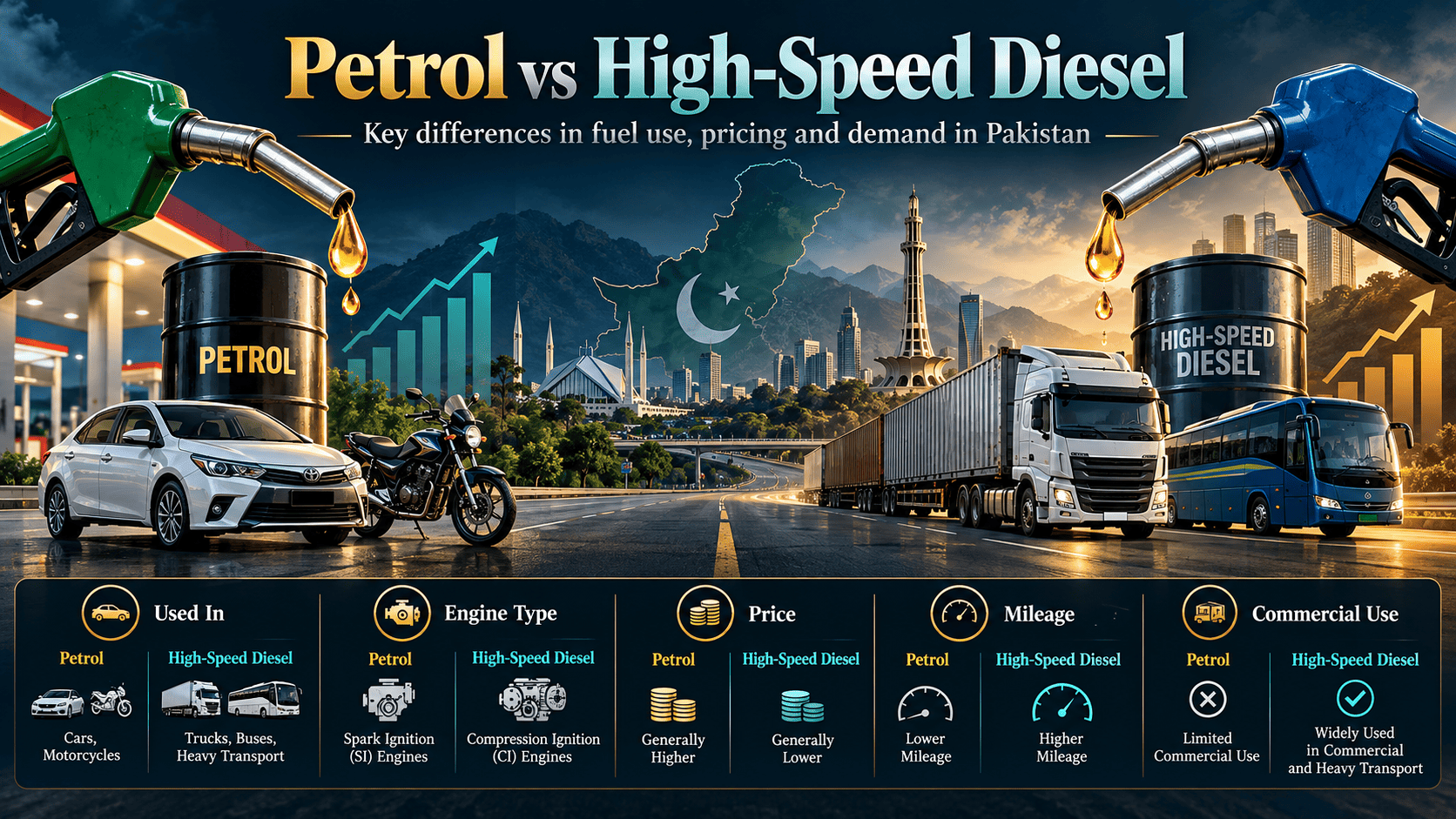
Petrol vs High-Speed Diesel
Petrol and High-Speed Diesel are two of the most important transportation fuels used in Pakistan.
At a petrol station, you will commonly see:
- Petrol
- High-Speed Diesel (HSD)
Although both are produced from petroleum and both are used to power vehicles and machinery, they are not the same fuel.
They are designed for different types of engines and have different characteristics, uses, fuel economy, combustion methods, and roles in Pakistan's economy.
In simple terms:
Petrol is mainly used in petrol-engine cars and motorcycles.
High-Speed Diesel is mainly used in diesel-engine cars, buses, trucks, agricultural machinery, generators, and heavy commercial vehicles.
Understanding the difference is useful not only for vehicle owners but also for anyone following fuel prices in Pakistan.
What Is Petrol?
Petrol is a refined petroleum product used mainly in spark-ignition engines.
In Pakistan's official petroleum terminology, petrol may also be referred to as:
Motor Spirit (MS)
or:
Motor Gasoline
Pakistan's petroleum-product regulations list Motor Spirit and High-Speed Diesel as separate petroleum products.
Petrol is commonly used in:
- Motorcycles
- Small cars
- Sedans
- SUVs with petrol engines
- Small commercial vehicles
- Some generators
- Other spark-ignition engines
For many private vehicle owners in Pakistan, petrol is the fuel they use every day.
What Is High-Speed Diesel?
High-Speed Diesel, commonly abbreviated as:
HSD
is a diesel fuel intended for diesel engines.
HSD is widely used in:
- Trucks
- Buses
- Diesel cars
- Agricultural tractors
- Construction machinery
- Commercial vehicles
- Heavy equipment
- Generators
- Transport fleets
Because diesel engines are commonly used in heavy transportation and commercial activity, HSD has an important role in Pakistan's logistics and broader economy.
The government has also emphasized continuity of HSD supplies during transport disruptions because of its importance to transportation and other essential activity.
Petrol vs High-Speed Diesel: Quick Comparison
| Feature | Petrol | High-Speed Diesel |
|---|---|---|
| Official/common name | Motor Spirit / Petrol | High-Speed Diesel / HSD |
| Engine type | Spark-ignition | Compression-ignition |
| Common use | Cars and motorcycles | Trucks, buses, tractors and diesel vehicles |
| Ignition | Spark plug | Compression |
| Fuel economy | Usually lower than comparable diesel | Often better in comparable applications |
| Low-speed torque | Generally lower | Generally higher |
| Heavy-duty use | Less common | Very common |
| Passenger vehicles | Very common | Also used in some vehicles |
| Agricultural use | Limited | Very important |
| Commercial transport | Used in some vehicles | Widely used |
| Petrol and diesel interchangeable? | No | No |
The exact performance difference depends on the vehicle, engine design, load, driving conditions, and fuel quality.
How Does a Petrol Engine Work?
A petrol engine generally uses a mixture of:
Air + Petrol
inside the engine.
The mixture is compressed and then ignited using a:
Spark Plug
The burning fuel creates pressure that pushes the engine's pistons and produces power.
A simplified process is:
Air + Petrol → Compression → Spark → Combustion → Power
This is why petrol engines are called:
Spark-Ignition Engines
How Does a Diesel Engine Work?
A diesel engine works differently.
Instead of using a spark plug to ignite the normal fuel-air mixture, the engine compresses air very strongly.
Compression increases the temperature of the air.
Diesel fuel is then injected into the hot compressed air and ignites.
A simplified process is:
Air → High Compression → Diesel Injection → Combustion → Power
This is known as:
Compression Ignition
This fundamental difference is one reason petrol and diesel cannot simply be substituted for each other.
Does a Diesel Engine Have Spark Plugs?
A conventional diesel engine does not rely on spark plugs for normal combustion.
It ignites fuel through the heat generated by high compression.
Some diesel engines have:
Glow Plugs
but glow plugs are different from petrol-engine spark plugs.
Glow plugs can assist with starting a diesel engine, particularly under certain temperature conditions, but they are not continuously producing the combustion spark used by a petrol engine.
Petrol and Diesel Are Not Interchangeable
This is extremely important.
You should not put petrol into a diesel-engine vehicle or diesel into a petrol-engine vehicle.
The engine and fuel systems are designed specifically for the correct fuel.
Using the wrong fuel can cause:
- Poor running
- Failure to start
- Fuel-system problems
- Engine problems
- Damage to pumps or injectors
- Expensive repairs
If the wrong fuel has been added, avoid starting the vehicle and seek professional assistance.
Why Is Diesel Used in Trucks?
Heavy commercial vehicles need large amounts of pulling power, especially at lower engine speeds.
Diesel engines are well suited to applications that require:
- High torque
- Heavy loads
- Long-distance travel
- Continuous operation
- Better fuel efficiency under load
That makes diesel engines especially common in:
- Cargo trucks
- Buses
- Tankers
- Heavy machinery
- Construction equipment
For a truck carrying many tonnes of cargo, these characteristics are particularly useful.
What Is Torque?
Torque is the rotational force produced by an engine.
An easy way to think about it is:
Horsepower helps describe how quickly work can be done, while torque describes turning force.
Heavy vehicles need strong torque because they must move significant weight.
Diesel engines often produce strong torque at relatively low engine speeds.
That is one reason diesel is popular for trucks, buses, tractors, and heavy machinery.
Why Are Motorcycles Usually Petrol-Powered?
Most motorcycles use petrol engines because petrol engines are well suited to:
- Smaller vehicles
- Lighter engine designs
- Higher engine speeds
- Smooth acceleration
- Lower vehicle weight
Motorcycles generally do not need the heavy-duty pulling characteristics of a large diesel engine.
This is why petrol is the dominant fuel for motorcycles in Pakistan.
Petrol vs Diesel for Cars
Passenger cars can use either petrol or diesel engines.
However, petrol vehicles are very common in Pakistan's private passenger-car market.
Petrol engines are often preferred for:
- City driving
- Short trips
- Quiet operation
- Smooth acceleration
- Lower initial vehicle cost in some cases
Diesel vehicles can make sense for:
- Long-distance driving
- High annual mileage
- Heavy loads
- Commercial use
The better choice depends on the specific vehicle and how it is used.
Which Gives Better Fuel Economy?
Diesel engines often provide better fuel economy than comparable petrol engines, particularly in vehicles designed for long-distance or heavy-duty use.
For example, imagine two similar vehicles.
A petrol version might travel:
12 km per litre
while a diesel version might travel:
16 km per litre
These figures are only illustrative.
Actual mileage depends on:
- Vehicle model
- Engine size
- Vehicle weight
- Driving style
- Traffic
- Air conditioning
- Road condition
- Tyre pressure
- Maintenance
- Passenger or cargo load
You should compare manufacturer specifications and real-world vehicle data instead of assuming every diesel vehicle will always give better mileage.
Why Can Diesel Engines Be More Fuel Efficient?
One reason is that diesel engines generally operate with higher compression ratios.
Their combustion characteristics can allow them to extract more useful energy from the fuel.
Diesel fuel also has different physical and energy characteristics from petrol.
As a result, diesel engines can be especially efficient under:
- Highway driving
- Heavy loads
- Long-distance operation
- Commercial use
However, modern petrol engines have also become significantly more efficient.
Which Fuel Is Better?
There is no single answer.
The correct fuel is first determined by the vehicle's engine.
A petrol vehicle requires petrol.
A diesel vehicle requires diesel.
If you are deciding between purchasing a petrol and diesel vehicle, several factors matter:
- Purchase price
- Fuel price
- Fuel economy
- Maintenance
- Driving distance
- Resale value
- Engine performance
- Vehicle availability
- Intended use
A person driving short distances in Karachi may have very different requirements from a transport company operating trucks between Karachi and Lahore.
Petrol vs HSD for Daily Driving
For a normal private car used mainly for:
- Office travel
- School runs
- Shopping
- Short city journeys
a petrol engine is often common and practical.
For vehicles travelling:
- Long distances
- With heavy cargo
- For commercial purposes
diesel can offer advantages.
However, fuel economy should be evaluated together with vehicle price and maintenance costs.
Petrol vs HSD for Commercial Transport
High-Speed Diesel has much greater importance in heavy commercial transportation.
It is commonly used in:
- Trucks
- Buses
- Intercity coaches
- Goods carriers
- Tankers
Therefore, changes in HSD prices can affect businesses beyond vehicle owners.
For example, if truck operating costs rise, the cost of moving goods from one city to another can also rise.
Businesses may eventually pass some of those transportation costs into product prices.
Why HSD Matters for Agriculture
High-Speed Diesel is also important in agriculture.
Diesel is commonly used in equipment such as:
- Tractors
- Harvesters
- Tube-well engines
- Agricultural machinery
- Transport vehicles
Therefore, HSD prices can influence the cost of farming.
For example, farmers may need diesel for:
Preparing land → Planting → Irrigation → Harvesting → Transportation
If diesel becomes more expensive, the cost of several stages of agricultural production may increase.
Why HSD Prices Can Affect Food Prices
Imagine that a farmer uses diesel for:
- Tractor operation
- Irrigation
- Harvesting
The crop is then transported using a diesel truck.
The wholesaler sends it to another city using another commercial vehicle.
Higher diesel costs can therefore appear at several stages of the supply chain.
This does not mean every HSD increase produces an identical increase in food prices.
But diesel is one of the important costs associated with agricultural production and transportation.
Why Petrol Prices Affect Consumers Directly
Petrol is particularly visible to ordinary consumers because of the large number of:
- Motorcycles
- Cars
- Ride-hailing vehicles
- Small commercial vehicles
that use it.
If a person uses:
40 litres of petrol per month
and petrol becomes:
Rs. 10 per litre more expensive
their monthly fuel expense increases by:
40 × 10 = Rs. 400
If someone uses:
100 litres
the difference becomes:
100 × 10 = Rs. 1,000
The impact depends on fuel consumption.
Petrol vs Diesel Price
Petrol and HSD do not necessarily have the same price.
Sometimes HSD can cost more than petrol.
At other times their difference may become smaller.
The two fuels have separate:
- International product prices
- Supply conditions
- Freight calculations
- Demand patterns
- Pricing components
- Government levy treatment
Therefore:
Petrol Price ≠ HSD Price
and the difference can change over time.
Why Petrol and HSD Prices Move Differently
People sometimes assume that if petrol falls by Rs. 5 per litre, diesel should also fall by Rs. 5.
That does not necessarily happen.
Petrol and diesel are separately traded petroleum products.
International markets can value them differently.
For example:
International petrol price may:
Fall
while international diesel price:
Rises
or falls by a smaller amount.
Pakistan's domestic prices can therefore move differently.
Crude Oil vs Petrol vs Diesel
Crude oil is the raw petroleum material.
Refineries process crude oil into products such as:
- Petrol
- Diesel
- Kerosene
- Jet fuel
- LPG-related products
- Other petroleum products
Therefore:
Crude Oil ≠ Petrol ≠ Diesel
They are connected, but they should not be treated as the same market price.
Why Diesel Can Become Expensive Even If Crude Oil Falls
Suppose crude oil prices fall.
At the same time, international demand for diesel becomes very strong.
International diesel prices may not fall by the same amount.
In addition:
- PKR may weaken
- Freight may change
- Levy may change
- Domestic supply conditions may change
As a result, HSD prices in Pakistan might not decline by the amount someone expects from looking only at crude-oil prices.
How USD to PKR Affects Both Petrol and Diesel
International petroleum products are generally priced in US dollars.
Pakistan sells them domestically in Pakistani rupees.
Therefore, USD to PKR affects both petrol and HSD.
Suppose international fuel costs:
$0.80 per litre
At:
USD/PKR = Rs. 280
PKR equivalent:
0.80 × 280 = Rs. 224
If the rupee weakens to:
USD/PKR = Rs. 290
then:
0.80 × 290 = Rs. 232
Difference:
Rs. 8 per litre
The international dollar price did not change.
Only the exchange rate changed.
Yet the Pakistani rupee cost increased.
How Petrol and HSD Prices Are Built
A simplified petroleum-price structure can include:
**International / Import-Based Fuel Cost
- Exchange Rate Effect
- Freight
- Oil Marketing Company Margin
- Dealer Margin
- Petroleum Levy
- Applicable Taxes and Charges**
The exact calculation and policy can change.
Pakistan's petroleum-pricing framework is also undergoing reform. In September 2026, the Petroleum Pricing Committee said it was continuing work on changes to the fuel-pricing framework, including diesel intervention rules for emergency price shocks and a possible June 2027 target for petrol deregulation.
OGRA currently publishes petroleum-price information including notified prices, IFEM data, detailed ex-depot calculations, and district/pump-wise prices.
What Is IFEM?
IFEM stands for:
Inland Freight Equalization Margin
It relates to transporting petroleum products across Pakistan and equalizing certain primary freight costs.
Petrol and High-Speed Diesel can have different IFEM amounts.
For example, an OGRA notification effective November 16, 2024 showed separate IFEM values of:
HSD: Rs. 1.60 per litre
and:
Motor Gasoline: Rs. 7.01 per litre
for that particular pricing period.
Those historical figures should not be treated as current rates, but they demonstrate that freight components for petrol and diesel do not necessarily have to be identical.
What Is Petroleum Levy?
Petroleum levy is a government fiscal charge applied to petroleum products.
The levy can form an important part of the final pump price.
Petrol and HSD may have different levy arrangements depending on current government policy.
Therefore, even if the underlying international prices move similarly, differences in levies and other price components can result in different final prices.
Petrol vs Diesel Demand in Pakistan
Petrol demand is strongly connected with:
- Motorcycles
- Passenger cars
- Small vehicles
- Personal transportation
HSD demand is closely associated with:
- Goods transportation
- Buses
- Agriculture
- Heavy machinery
- Commercial activity
This means the economic impact of each fuel is somewhat different.
Petrol affects household transportation costs very directly.
HSD can have a broader indirect impact through transportation, logistics, farming, and commercial activity.
Which Fuel Is More Important for Inflation?
Both can influence inflation, but through somewhat different channels.
Petrol
Petrol-price changes can affect:
- Household transport costs
- Motorcycle expenses
- Car expenses
- Ride-hailing fares
- Some delivery costs
HSD
HSD-price changes can affect:
- Truck transport
- Bus transport
- Agriculture
- Freight
- Construction
- Industrial activity
- Distribution of goods
Because diesel is widely used in commercial supply chains, changes in HSD can indirectly affect the prices of many goods.
However, inflation is influenced by many factors, so fuel prices should not be considered the only cause.
Petrol vs Diesel Engine Maintenance
Maintenance requirements can differ between petrol and diesel vehicles.
Petrol Engines
Typical maintenance can include:
- Engine oil
- Oil filters
- Air filters
- Spark plugs
- Fuel-system maintenance
- Cooling-system maintenance
Diesel Engines
Maintenance can include:
- Engine oil
- Oil filters
- Fuel filters
- Injectors
- Diesel fuel system
- Turbocharger, where equipped
- Emission-control systems on modern vehicles
Modern diesel fuel systems can be sophisticated and expensive to repair if they are damaged.
Therefore, fuel economy alone should not determine whether a diesel vehicle is cheaper to own.
Diesel Injectors and Fuel Quality
Modern diesel engines often use high-pressure fuel injection.
These systems require properly specified fuel and regular maintenance.
Contaminated or incorrect fuel can cause serious problems.
This is another reason to purchase fuel from reputable petrol stations.
Petrol Engine Advantages
Depending on the vehicle, petrol engines can offer benefits such as:
- Smooth operation
- Quieter engine sound
- Lighter engine design
- Good acceleration
- Simpler maintenance in some vehicles
- Suitability for short city trips
These are general characteristics rather than guarantees for every vehicle.
Diesel Engine Advantages
Diesel engines can offer:
- Strong low-speed torque
- Good fuel efficiency
- Suitability for heavy loads
- Long-distance efficiency
- Strong commercial applications
- Durability in some heavy-duty designs
Again, the actual experience depends heavily on the specific engine and vehicle.
Petrol Engine Disadvantages
Possible disadvantages compared with diesel in certain applications can include:
- Higher fuel consumption under heavy load
- Lower low-speed torque
- Less suitability for some heavy-duty uses
Modern engine technology can narrow these differences considerably.
Diesel Engine Disadvantages
Possible disadvantages can include:
- More engine noise in some vehicles
- Higher purchase cost in some models
- More expensive fuel-system repairs
- More complex emission equipment on modern engines
- Less suitability for repeated short journeys in some modern diesel vehicles
Vehicle design matters considerably.
Petrol vs Diesel for Long-Distance Driving
Imagine a vehicle travels:
3,000 km per month
Petrol vehicle mileage:
12 km/litre
Fuel required:
3,000 ÷ 12 = 250 litres
Diesel version mileage:
16 km/litre
Fuel required:
3,000 ÷ 16 = 187.5 litres
Difference:
62.5 litres
However, to determine which vehicle actually costs less, you would also need to consider:
- Petrol price
- Diesel price
- Vehicle purchase price
- Maintenance
- Insurance
- Resale value
Fuel efficiency alone does not provide the complete answer.
How to Calculate Monthly Petrol Cost
Formula:
Monthly Distance ÷ Mileage × Petrol Price
Suppose:
Monthly driving:
1,500 km
Mileage:
15 km/litre
Petrol consumption:
1,500 ÷ 15 = 100 litres
If petrol costs an example:
Rs. 300 per litre
monthly fuel cost:
100 × 300 = Rs. 30,000
How to Calculate Monthly Diesel Cost
Use the same formula:
Monthly Distance ÷ Diesel Mileage × HSD Price
Suppose:
Monthly distance:
1,500 km
Diesel mileage:
18 km/litre
Fuel consumption:
1,500 ÷ 18 ≈ 83.33 litres
If HSD costs an example:
Rs. 310 per litre
fuel expense:
83.33 × 310
≈ Rs. 25,833
In this simplified example, diesel costs less per month despite having a higher per-litre price because the vehicle uses fewer litres.
Actual vehicle performance can be very different.
Price Per Litre Is Not the Only Comparison
When comparing petrol and diesel, people sometimes look only at:
Which fuel costs less per litre?
A better comparison is:
Cost per kilometre
Formula:
Fuel Price ÷ Vehicle Mileage = Fuel Cost Per Kilometre
Petrol Example
Petrol:
Rs. 300/litre
Mileage:
15 km/litre
Cost per kilometre:
300 ÷ 15 = Rs. 20/km
Diesel Example
HSD:
Rs. 310/litre
Mileage:
18 km/litre
Cost:
310 ÷ 18 ≈ Rs. 17.22/km
Even though diesel costs more per litre in this example, the vehicle has a lower fuel cost per kilometre.
Again, these are illustrative numbers.
Which Is Better for Pakistan's Heavy Transport Sector?
For heavy transport, diesel remains especially important because of the characteristics of diesel engines.
Large trucks need:
- Strong torque
- Long-distance capability
- Fuel efficiency
- Heavy-load performance
That makes HSD particularly suitable for freight operations.
This is why uninterrupted HSD availability is an important part of Pakistan's fuel-supply planning. In September 2026, the Petroleum Division specifically directed advance arrangements for HSD transportation and stocks during possible logistical disruptions.
Environmental Difference Between Petrol and Diesel
Both petrol and diesel are fossil fuels and produce greenhouse-gas emissions when burned.
Their emission profiles differ.
Diesel engines can be fuel-efficient, but diesel exhaust can contain significant pollutants such as:
- Nitrogen oxides
- Particulate matter
Modern diesel engines may use emission-control technologies such as:
- Diesel particulate filters
- Catalytic systems
- Exhaust-gas recirculation
- Selective catalytic reduction
Petrol engines also emit pollutants and carbon dioxide.
Therefore, neither fuel should be considered pollution-free.
Petrol, Diesel and Electric Vehicles
Electric vehicles introduce another option.
Unlike petrol and diesel vehicles, an electric vehicle uses:
Electricity + Battery + Electric Motor
rather than an internal-combustion engine as its primary propulsion system.
The comparison then becomes broader:
Petrol vs Diesel vs Hybrid vs Electric
Each can have different:
- Purchase costs
- Running costs
- Maintenance requirements
- Charging or fueling requirements
- Driving range
- Resale considerations
What Happens If Petrol Is Put in a Diesel Car?
Petrol can reduce the lubrication provided by diesel fuel to parts of a diesel fuel system.
Modern diesel pumps and injectors can be particularly sensitive.
If petrol has mistakenly been added to a diesel vehicle:
Do not start the engine.
Seek professional assistance so the incorrect fuel can be removed appropriately.
Starting or driving the vehicle may circulate the wrong fuel and increase the risk of damage.
What Happens If Diesel Is Put in a Petrol Car?
Diesel does not behave correctly in an engine designed to burn petrol.
Possible symptoms can include:
- Engine failing to start
- Rough running
- Smoke
- Loss of power
- Stalling
Again, if you realize the wrong fuel has been added, avoid starting the engine and seek professional assistance.
How to Know Which Fuel Your Vehicle Uses
You can check:
- Fuel-filler cap
- Owner's manual
- Vehicle specification
- Dashboard label
- Manufacturer documentation
If you are uncertain, confirm before filling the vehicle.
Never choose fuel based simply on which one is cheaper.
Why Do Petrol Stations Sell Both?
Pakistan has a diverse vehicle fleet.
Different users need different fuels.
Petrol stations therefore serve customers ranging from:
Motorcycle riders
to:
Private car owners
to:
Commercial truck operators
to:
Agricultural users
Both Motor Spirit and High-Speed Diesel are formally recognized as separate petroleum products in Pakistan's regulatory framework.
How Are Petrol and HSD Prices Checked in Pakistan?
OGRA publishes petroleum-pricing information including:
- Notified petroleum prices
- IFEM notifications
- Ex-depot computations
- Price build-ups
- District/pump-wise prices
Its petroleum-price archive currently shows multiple price-effective dates during September 2026, reflecting the more frequent pricing environment that developed during the year.
Because petroleum pricing policies continue to evolve, consumers should always check the latest:
Price + Effective Date + Fuel Type + Location
rather than relying on an older quoted rate.
Common Petrol vs Diesel Misunderstandings
"Diesel Is Just a Cheaper Type of Petrol"
Incorrect.
Diesel and petrol are separate fuels with different combustion properties and engine requirements.
"Petrol Can Be Used in a Diesel Engine"
No.
Using the wrong fuel can damage the vehicle.
"Diesel Is Always Cheaper"
No.
The price relationship changes.
HSD may sometimes cost more per litre than petrol.
"Higher Diesel Price Means Diesel Vehicles Cost More to Run"
Not necessarily.
A diesel vehicle may consume fewer litres per kilometre.
The better measure is:
Fuel cost per kilometre
"Petrol Is Always Better for Cars"
Not necessarily.
The best engine type depends on the vehicle and its intended use.
"Diesel Is Only for Trucks"
No.
Diesel is also used in:
- Cars
- SUVs
- Generators
- Tractors
- Machinery
although it is especially important for heavy commercial transport.
"Petrol and Diesel Must Change by the Same Price"
No.
They have different international product markets and can have different domestic pricing components.
Frequently Asked Questions
What is petrol called officially in Pakistan?
Petrol is commonly referred to as:
Motor Spirit (MS)
or motor gasoline in petroleum terminology.
What does HSD stand for?
HSD stands for:
High-Speed Diesel
Are petrol and HSD the same?
No.
They are different petroleum products designed for different engine types.
Can petrol be used in a diesel vehicle?
No.
A diesel engine should use the fuel specified by its manufacturer.
Using petrol in a diesel vehicle can damage the fuel system or engine.
Can diesel be used in a petrol vehicle?
No.
Petrol engines are not designed to operate on High-Speed Diesel.
Which vehicles commonly use petrol?
Petrol is widely used in:
- Motorcycles
- Cars
- Small vehicles
- Some SUVs
Which vehicles commonly use HSD?
HSD is widely used in:
- Trucks
- Buses
- Tractors
- Commercial vehicles
- Diesel cars
- Heavy machinery
- Generators
Which gives better mileage?
Diesel engines often provide better fuel efficiency than comparable petrol engines, especially for longer-distance and heavy-duty applications.
Actual mileage depends on the vehicle.
Why do trucks use diesel?
Diesel engines provide strong low-speed torque and are well suited to heavy loads and long-distance commercial use.
Why do motorcycles use petrol?
Petrol engines are generally more suitable for the smaller, lighter, high-speed engines commonly used in motorcycles.
Is diesel always more expensive than petrol in Pakistan?
No.
Their price relationship can change according to international product prices, exchange rates, levies, freight and other pricing components.
Why do petrol and diesel prices change differently?
They are separate petroleum products and can have different:
- International prices
- Freight costs
- Demand conditions
- Levies
- Pricing components
Does USD to PKR affect both fuels?
Yes.
International petroleum products are priced largely in foreign currency, so changes in USD to PKR can affect their Pakistani rupee cost.
Which fuel affects transportation costs more?
Both matter, but HSD has particular importance for heavy transport, trucks, buses, agriculture, and logistics.
Does HSD affect food prices?
It can contribute indirectly because diesel is used in agriculture and transportation.
However, food prices depend on many other factors as well.
Which fuel is better for long-distance driving?
Diesel can be more fuel-efficient for some long-distance applications, but the correct comparison depends on vehicle price, maintenance, fuel cost, and actual mileage.
How should I compare petrol and diesel running costs?
Calculate:
Fuel Price ÷ Mileage = Fuel Cost Per Kilometre
This gives a more useful comparison than simply checking the price per litre.
Conclusion
Petrol and High-Speed Diesel are both important fuels in Pakistan, but they are designed for different purposes.
The simplest difference is:
Petrol → Primarily for spark-ignition engines
High-Speed Diesel → For compression-ignition diesel engines
Petrol is widely used in:
- Motorcycles
- Private cars
- Small vehicles
HSD is especially important for:
- Trucks
- Buses
- Tractors
- Agriculture
- Heavy machinery
- Commercial transport
- Generators
Diesel engines often provide strong torque and good fuel economy for heavy-duty and long-distance applications, while petrol engines are commonly used for lighter passenger vehicles and everyday city driving.
When comparing the cost of the two fuels, do not look only at the price per litre.
A better calculation is:
Fuel Cost Per Kilometre = Fuel Price ÷ Vehicle Mileage
You should also consider:
- Maintenance
- Vehicle purchase cost
- Annual driving distance
- Engine type
- Intended use
Finally, petrol and HSD prices do not necessarily move by the same amount. Their final prices can be affected by different international product prices, freight costs, petroleum levies, margins, USD to PKR movements, and government pricing policy.
Always use the fuel specified by your vehicle manufacturer.
Disclaimer: Petrol and High-Speed Diesel prices, petroleum levies, taxes, margins, freight charges, foreign exchange rates, and fuel-pricing policies can change frequently. Mileage, fuel economy, maintenance costs, and vehicle performance also vary by vehicle, engine, driving conditions, and usage. Calculations and figures used in this article are for educational purposes and examples only. Always check the latest applicable fuel price and your vehicle manufacturer's fuel requirements before refuelling or making a vehicle or financial decision.