
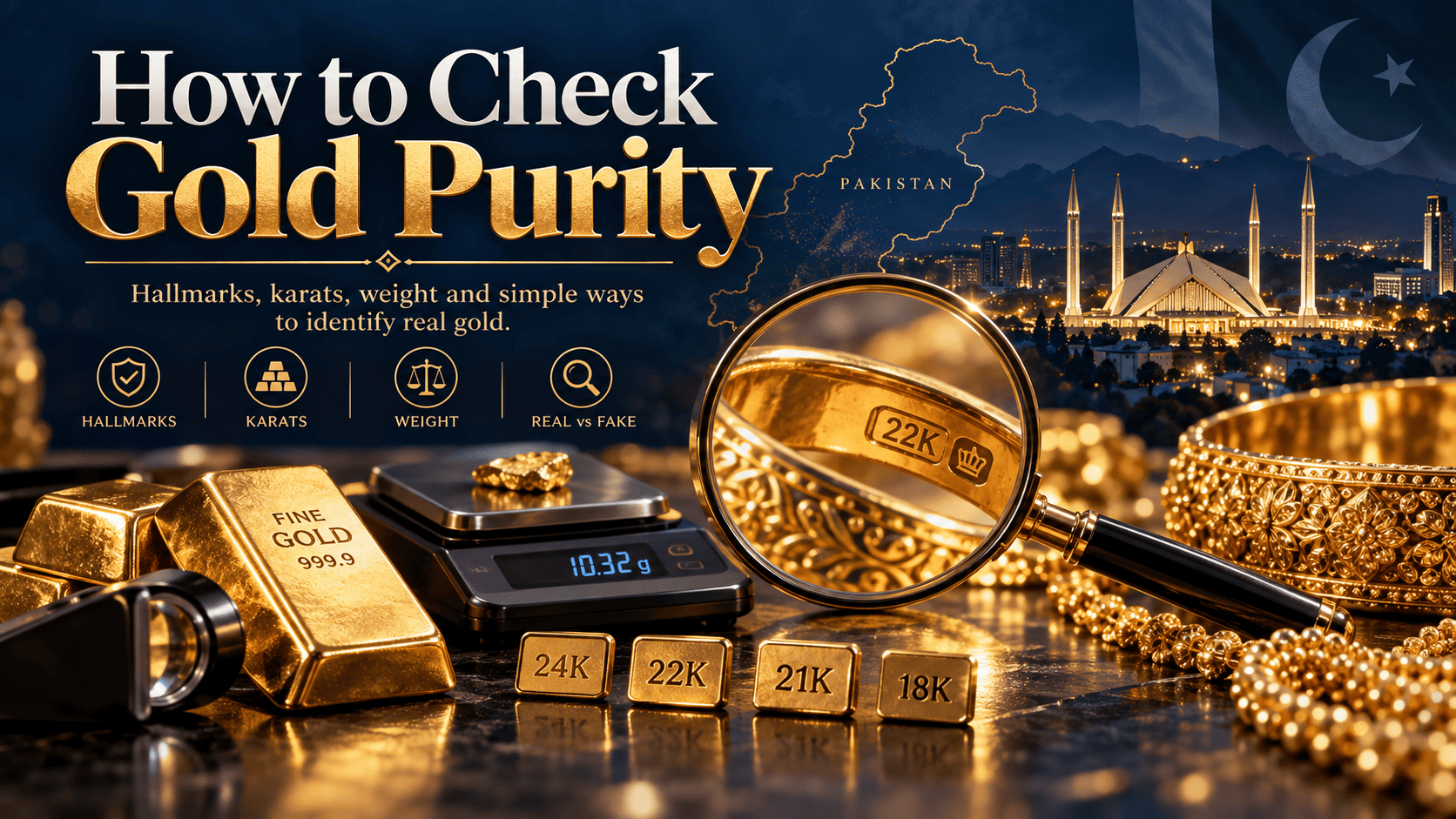
How to Check Gold Purity: 24K, 22K, 21K and 18K Explained
Gold jewellery can look beautiful and expensive, but appearance alone does not tell you how much pure gold it actually contains.
A yellow ring may be 22K, 18K, gold-plated, or something else entirely. Two pieces can even look almost identical while containing very different amounts of real gold.
That is why checking gold purity is important before buying expensive jewellery, selling old gold, or accepting gold as an investment.
For buyers in Pakistan, the most useful things to understand are:
- karat markings such as 24K and 22K;
- fineness numbers such as 999, 916 and 750;
- jewellery weight;
- seller documentation;
- professional purity-testing methods.
This guide explains the common ways to check gold purity, which methods are reliable, and which simple home tests should be treated only as rough indicators.
What Does Gold Purity Mean?
Gold purity tells you how much actual gold is present in an item compared with other metals.
Pure gold is very soft, so jewellery is often mixed with metals such as:
- silver;
- copper;
- zinc;
- palladium;
- other jewellery alloys.
These additional metals can improve:
- strength;
- durability;
- colour;
- suitability for detailed jewellery designs.
Gold purity is commonly expressed using either:
karats
or
fineness numbers.
What Does Karat Mean?
The karat system divides gold into 24 parts.
24K represents approximately pure gold.
22K means 22 out of 24 parts are gold.
18K means 18 out of 24 parts are gold.
The formula is:
Gold Purity % = Karat ÷ 24 × 100
For example:
22 ÷ 24 × 100 = 91.67%
Therefore, 22K gold contains approximately:
91.67% pure gold
with the remaining 8.33% consisting of other metals.
Gold Purity Chart
Here are some of the most common gold purities:
| Karat | Approximate Gold Purity | Common Fineness |
|---|---|---|
| 24K | 99.9%+ | 999 / 999.9 |
| 22K | 91.67% | 916 |
| 21K | 87.5% | 875 |
| 18K | 75% | 750 |
| 14K | 58.5% | 585 |
| 9K | 37.5% | 375 |
This table is useful when inspecting jewellery markings.
For example:
916 usually indicates approximately 22K gold.
750 indicates 18K gold.
What Does 999 Gold Mean?
A marking such as:
999
generally means the material contains approximately:
999 parts of gold out of 1,000
or:
99.9% gold
This corresponds closely to 24K gold.
You may also see:
999.9
on high-purity bullion products.
That represents approximately:
99.99% gold
What Does 916 Gold Mean?
916 gold means approximately 916 parts per 1,000 are gold.
That is:
91.6% gold
which closely corresponds to:
22K
because:
22 ÷ 24 = 91.67%
So:
916 ≈ 22K gold
What Does 875 Gold Mean?
875 means:
87.5% pure gold
which corresponds to:
21K gold
because:
21 ÷ 24 = 87.5%
Therefore:
875 = 21K
What Does 750 Gold Mean?
750 means:
75% pure gold
which corresponds to:
18K gold
because:
18 ÷ 24 = 75%
Therefore:
750 = 18K gold
First Check: Look for a Purity Mark
One of the easiest places to start is the jewellery itself.
Look carefully for small markings such as:
999
916
875
750
or:
24K
22K
21K
18K
These markings may appear:
- inside a ring;
- near a necklace clasp;
- on a bracelet;
- on the back of a pendant;
- near the locking mechanism of jewellery.
You may need good lighting or magnification because the mark can be very small.
Does a 916 Stamp Guarantee That Gold Is 22K?
No.
A stamp is useful information, but you should not rely on the number alone when significant money is involved.
A dishonest manufacturer could theoretically place a purity mark on an item that does not actually contain the stated amount of gold.
A marking should therefore be treated as:
one piece of evidence, not the complete test.
For an expensive purchase, combine the marking with:
- a reputable seller;
- proper invoice;
- stated weight;
- stated purity;
- professional testing where appropriate.
Hallmark vs Purity Stamp
People often use the terms hallmark and purity stamp interchangeably, but they are not necessarily the same thing.
A simple purity mark such as:
916
only states a claimed fineness.
A formal hallmarking or certification system can involve verification by an authorised or independent body.
The exact marks and regulatory requirements depend on the country and applicable standards.
For Pakistan, buyers should avoid assuming that every number stamped on jewellery automatically represents independent certification.
Instead, verify what the particular mark actually means and who issued it.
What Should You Check When Buying a Gold Bar?
Gold bars usually provide more identifying information than ordinary jewellery.
A Pakistan Standards and Quality Control Authority publication adopting ISO 24018 for gold bars specifies information such as the nature of the metal, mass, fineness and unique serial number as minimum markings for applicable gold bars. The standard also provides for a certificate of analysis containing key identifying information.
For a gold bar, useful information to check includes:
- manufacturer's or refiner's name;
- "Gold" or "Au";
- weight;
- fineness;
- serial number;
- accompanying certificate, where applicable.
For example:
Au 999.9 — 10 g
would indicate a 10-gram gold product claiming 999.9 fineness.
Check the Jewellery Invoice
When buying jewellery, do not focus only on the jewellery itself.
The invoice is extremely important.
A useful invoice should clearly identify important details such as:
- jewellery description;
- purity;
- gross weight;
- net gold weight where applicable;
- gold rate used;
- making charges;
- stones where applicable;
- other charges;
- seller details.
If you are buying a 22K necklace, the bill should not simply say:
Gold Necklace – Rs500,000
A more transparent bill explains what you actually purchased.
For example:
Purity: 22K / 916
Net Gold Weight: 12.40g
This information can also be useful if you later sell or exchange the jewellery.
Why Net Gold Weight Matters
Imagine a ring weighs:
10 grams
but contains:
2 grams of stones
The actual gold weight may be:
8 grams
The purity test tells you the percentage of gold in those 8 grams.
For example, if it is 22K:
8 × 22 ÷ 24
= approximately:
7.33 grams of pure gold equivalent
Therefore, checking purity without checking the net gold weight gives you only part of the picture.
When evaluating value, you need both:
weight + purity
Professional Gold Testing Methods
If you need greater confidence, gold can be tested professionally.
Common methods include:
- XRF testing
- acid testing
- electronic testing
- fire assay
Each method has advantages and limitations.
1. XRF Gold Testing
XRF stands for X-ray fluorescence.
It is one of the most useful modern methods for checking precious-metal composition.
The machine directs X-rays at the metal and analyses the characteristic response from the elements in the sample.
It can identify metals present and estimate their proportions.
The Sheffield Assay Office, for example, uses XRF technology to determine precious-metal content in articles submitted for hallmarking.
Advantages of XRF
XRF testing is generally:
- fast;
- highly informative;
- largely non-destructive;
- capable of identifying multiple metals.
For jewellery buyers and sellers, a professional XRF test can provide much more confidence than visual inspection alone.
Does XRF Damage Gold?
Normally, XRF is considered a non-destructive testing technique because it does not require cutting or significantly damaging the jewellery.
That makes it attractive for finished jewellery.
However, the interpretation of the reading still matters.
A professional operator should consider factors such as:
- plating;
- coatings;
- solder;
- surface composition;
- shape of the item.
For high-value transactions, experienced testing is preferable to simply trusting an inexpensive handheld reading without context.
Can Gold Plating Affect an XRF Result?
Potentially, yes.
XRF primarily analyses material within a limited depth from the surface.
If an item has a different surface layer from its interior, the reading requires careful interpretation.
For suspicious or very high-value material, additional testing or sampling may sometimes be needed.
This is one reason no single test should automatically be treated as infallible in every situation.
2. Acid Testing
The acid test is a traditional method used to estimate gold purity.
Typically, the jeweller creates a small sample or streak of material and applies specific testing acids.
Different purity levels react differently.
An experienced tester can use those reactions to estimate whether the gold matches a particular karat.
Advantages
Acid testing can be:
- relatively inexpensive;
- quick;
- widely available.
Disadvantages
It has limitations.
It can:
- mark or slightly damage a surface;
- depend on the tester's technique;
- be less informative than laboratory analysis;
- produce misleading results on plated items if performed poorly.
Therefore, you should not casually apply acids to valuable jewellery yourself.
3. Electronic Gold Testing
Electronic gold testers estimate purity using electrical characteristics.
They can be useful for quick jewellery checks.
Advantages may include:
- rapid testing;
- less damage than some traditional methods;
- simple operation.
However, accuracy depends on:
- the device;
- calibration;
- surface condition;
- testing technique;
- jewellery composition.
A professional instrument used by an experienced operator generally provides more confidence than a cheap consumer tester.
4. Fire Assay
Fire assay is one of the traditional reference methods for determining gold content.
It involves taking a sample and processing it under laboratory conditions to separate and measure precious-metal content.
The Sheffield Assay Office describes fire assay as a reference method used to verify gold-testing results, even though XRF is now routinely used for many jewellery tests.
Major advantage
It can provide highly accurate analysis.
Major disadvantage
It requires a physical sample.
That means it is generally considered destructive compared with XRF.
For ordinary jewellery purchases, fire assay is rarely the convenient first choice, but it can be important in professional refining and laboratory contexts.
Which Gold Test Is Better?
For many jewellery situations, a practical sequence is:
Visual marking → Invoice verification → Professional XRF test
If there is still a serious dispute involving a high-value quantity, more detailed laboratory testing may be appropriate.
There is no need to destroy a valuable jewellery item merely to perform a casual purity check when non-destructive methods may be available.
Can You Check Gold Purity at Home?
There are several popular home tests, but they should be treated carefully.
Home tests can sometimes indicate that something is suspicious.
They usually cannot prove precise karat purity with the same confidence as professional testing.
Let's examine the common methods.
Magnet Test
Pure gold is not strongly magnetic.
So people sometimes place a strong magnet near jewellery.
If the item is strongly attracted to the magnet, it may contain a significant amount of magnetic material.
However:
passing the magnet test does not prove that an item is gold.
Many non-gold metals are also non-magnetic.
Similarly, jewellery can contain small components such as clasps or springs made from other metals.
So:
Magnet test = rough screening only
not:
proof of gold purity
Water or Density Test
Gold has a high density.
This makes density testing potentially useful when checking a simple solid object such as a bar or coin.
The basic idea is:
Density = Mass ÷ Volume
Pure gold has a characteristic density, so a major difference may indicate another material.
However, this approach becomes much less reliable for jewellery because jewellery may contain:
- hollow spaces;
- stones;
- multiple metals;
- complex shapes.
Therefore, a home water test is not a reliable way to determine whether a complicated necklace is 22K or 21K.
Skin Colour Test
Some people believe real gold can be identified by whether it leaves a green or dark mark on the skin.
This is unreliable.
Skin reactions can be influenced by:
- sweat;
- cosmetics;
- alloy metals;
- chemicals;
- individual skin chemistry.
A skin mark does not provide a scientific measurement of gold purity.
Bite Test
You may have seen people biting gold in films or sporting events.
Do not use this as a purity test.
High-purity gold is relatively soft, but biting jewellery:
- does not measure purity accurately;
- can damage the item;
- can damage your teeth.
There are much better testing methods available.
Ceramic Scratch Test
Another internet method involves rubbing gold against an unglazed ceramic surface and inspecting the streak.
This is also not a reliable way to determine exact purity.
It can:
- scratch the jewellery;
- damage polished surfaces;
- produce ambiguous results.
A professional test is a much better choice for valuable items.
Colour Is Not a Reliable Gold Test
Gold colour can provide clues, but it cannot accurately determine purity.
For example:
22K jewellery can be a rich yellow.
18K can also appear yellow.
The final appearance depends partly on which alloying metals were used.
Gold can also be manufactured as:
- yellow gold;
- white gold;
- rose gold.
Therefore:
darker or brighter yellow does not automatically mean higher purity.
Never pay more simply because a piece "looks more golden."
Gold-Plated vs Solid Gold
A gold-plated item has only a thin layer of gold over another base metal.
For example, the outside may contain real gold while the majority of the object's weight is another metal.
This is very different from:
22K solid gold jewellery
where approximately 91.67% of the gold alloy itself is gold throughout.
This distinction is important when buying jewellery online or second-hand.
Gold-Plated Does Not Mean Fake Gold Coating
The plating itself can contain real gold.
The issue is that the entire item is not solid gold.
For resale purposes, a gold-plated item's gold content can be dramatically lower than an equivalent-weight solid gold item.
That is why total weight alone does not tell you value.
What Is Gold-Filled Jewellery?
Gold-filled products contain a layer of gold mechanically bonded to a base metal.
They generally contain more gold than very thin conventional plating, but they are still not the same thing as a solid 18K or 22K gold alloy.
If your purpose is investment or resale value, make sure you understand exactly what type of product you are purchasing.
How to Check 22K Gold
If you are checking an item sold as 22K:
Step 1
Look for:
22K
or:
916 / 917
Step 2
Check the invoice.
It should identify the purity clearly.
Step 3
Check net gold weight.
Especially important if stones are present.
Step 4
For a high-value purchase, consider professional purity verification such as XRF.
Remember:
A 916 marking by itself is not an independent laboratory test.
How to Check 18K Gold
For 18K jewellery, look for:
18K
or:
750
because:
18 ÷ 24 = 75%
A professional test should show a composition consistent with approximately 75% gold if the piece is genuinely 18K throughout.
How to Check a Gold Bar
A gold bar deserves careful inspection because it may represent a significant investment.
Check:
- manufacturer/refiner;
- exact weight;
- stated fineness;
- serial number;
- packaging;
- certificate where applicable;
- seller invoice;
- physical condition.
Pakistan's adoption/publication of ISO 24018 for gold bars includes requirements for markings such as the metal identification, weight, fineness and unique serial number, as well as certificate information.
If authenticity is uncertain, have the bar tested professionally rather than relying only on packaging.
Do Not Automatically Open Sealed Gold Bars
Some investment bars are sold in secure or certified packaging.
Opening or damaging packaging unnecessarily can complicate resale or verification depending on the product and dealer.
If you suspect a problem, ask a professional dealer or testing laboratory how the bar should be verified before breaking the packaging.
How to Check Gold When Buying From a Jeweller
A practical buying process looks like this:
Ask the purity
For example:
22K / 916
Check the weight
Ask for:
gross weight
and, where applicable:
net gold weight
Ask for the rate
Confirm which gold rate is being applied.
Ask for making charges
Make sure they are shown separately.
Check stones separately
If jewellery contains stones, ask for their:
- weight;
- price.
Request proper documentation
Keep the invoice.
Consider testing
For expensive jewellery, especially from an unfamiliar source, independent testing can provide additional confidence.
How to Check Gold Before Selling It
When selling old jewellery, do not immediately accept the first purity number someone tells you.
Ask:
What purity did the test show?
For example:
21.8K
or:
90.8%
Ask how the item was tested.
If the amount is significant and you disagree with the result, consider obtaining another independent test.
A small purity difference can have a meaningful impact on large quantities of gold.
Example: Why Purity Matters When Selling
Suppose you have:
100 grams of jewellery
If it is truly 22K:
Pure-gold equivalent:
100 × 22 ÷ 24
= approximately:
91.67 grams
If it were actually 18K:
100 × 18 ÷ 24
= 75 grams
Difference:
16.67 grams of pure-gold equivalent
That can represent a significant amount of money.
This is why purity verification matters.
How to Calculate the Value After Checking Purity
Once you know purity, use:
Gold Value = Weight × 24K Rate per Gram × Karat ÷ 24
Suppose:
Weight:
10 grams
Purity:
22K
24K rate:
Rs40,000 per gram
Calculation:
10 × 40,000 × 22 ÷ 24
= approximately:
Rs366,667
This gives the approximate underlying gold value.
Actual dealer buying or selling prices can differ because of spreads and other charges.
Can Different Parts of Jewellery Have Different Purity?
Potentially.
A jewellery piece may include:
- solder;
- clasps;
- springs;
- decorative components;
- stones;
- multiple alloys.
That can make complex pieces more difficult to evaluate than a simple solid gold bar.
Professional testing may therefore involve checking more than one location when necessary.
This is another reason a single surface reading should be interpreted carefully.
Should You Trust a Jewellery Shop's Gold Tester?
A professional tester can provide useful information.
But when the value is large, independent verification may provide more confidence.
This is especially useful when:
- buying second-hand gold;
- buying from an unfamiliar seller;
- selling inherited jewellery;
- testing unmarked gold;
- dealing with a purity dispute.
The objective is not to distrust every jeweller.
It is simply sensible to verify expensive assets when the result directly affects their value.
Gold Purity vs Gold Weight
Purity and weight are different things.
For example:
10 grams of 24K
and:
10 grams of 18K
have exactly the same total weight.
But they do not contain the same amount of gold.
10 grams of 24K contains roughly:
10 grams of gold
while 10 grams of 18K contains:
7.5 grams of pure-gold equivalent
The remaining approximately 2.5 grams consist of other metals.
So always check:
weight AND purity
rather than weight alone.
Gold Purity vs Jewellery Price
Higher-purity gold has more underlying gold value for the same weight.
But it does not automatically mean the final jewellery item will always cost more.
A designer 18K ring may be expensive because of:
- diamonds;
- craftsmanship;
- brand;
- design;
- making charges.
So:
Gold purity determines metal content.
It does not by itself determine the entire retail price.
Common Mistakes When Checking Gold Purity
Mistake 1: Trusting Colour
Yellow colour does not prove purity.
Mistake 2: Trusting Only the Stamp
A 916 stamp should be supported by seller credibility and verification when appropriate.
Mistake 3: Using Only a Magnet
A magnet can identify some suspicious materials but cannot confirm gold purity.
Mistake 4: Ignoring Stones
Gross jewellery weight may include materials that are not gold.
Mistake 5: Buying Without an Invoice
Without documentation, later disputes about weight and purity become more difficult.
Mistake 6: Damaging Jewellery With Home Tests
Acids, scratching and other DIY methods can damage valuable jewellery.
Professional non-destructive testing is often the better approach.
Gold Purity Checklist
Before buying a significant gold item, check:
Purity: 24K, 22K, 21K or 18K
Fineness: 999, 916, 875 or 750
Weight: confirm on a proper scale
Net gold weight: especially with stones
Invoice: check purity and weight are written clearly
Making charges: understand separately
Seller: use an established and traceable business
Testing: consider professional verification for high-value or uncertain purchases
This simple checklist can prevent many misunderstandings.
Frequently Asked Questions
How can I tell if gold is real?
Start by checking purity markings and documentation.
For meaningful financial verification, a professional test such as XRF is much more useful than relying only on colour, magnets or other home tests.
What does 916 mean on gold?
916 means approximately:
91.6% gold
which corresponds closely to:
22K
What does 750 mean?
750 means:
75% gold
which corresponds to:
18K
Is 875 gold 21K?
Yes.
21 ÷ 24 equals:
87.5%
so 875 fineness corresponds to 21K.
Is 999 gold 24K?
999 fineness represents approximately 99.9% gold and is generally associated with 24K gold.
Is a hallmark enough to prove gold purity?
A genuine hallmark or trusted certification can provide valuable evidence, but a simple purity number stamped on jewellery should not automatically be assumed to be independent certification.
For expensive transactions, verify the mark and use professional testing if needed.
Can a magnet test identify fake gold?
It can sometimes identify suspicious magnetic material.
However, many non-gold metals are also non-magnetic.
Therefore, passing a magnet test does not prove that an item is gold.
What is the best non-destructive gold test?
Professional XRF testing is widely used because it can provide detailed elemental information without requiring the type of sample removal associated with traditional fire assay. The Sheffield Assay Office uses XRF routinely for precious-metal testing.
What is the most accurate laboratory method?
Fire assay remains an important reference method for gold analysis in professional assay work, although it requires physical sampling and is therefore more invasive.
Final Thoughts
Checking gold purity should involve more than looking at the colour of a jewellery item.
Start by understanding the common purity numbers:
999 ≈ 24K
916 ≈ 22K
875 = 21K
750 = 18K
Then check:
purity marking + weight + invoice + seller credibility
For expensive or uncertain gold, professional testing provides much stronger evidence than home methods.
XRF testing is particularly useful because it can analyse precious-metal composition without significantly damaging the jewellery, while laboratory methods such as fire assay remain important where highly rigorous verification is required.
Most importantly, remember that a stamp such as 916 tells you what purity is being claimed. It should not be your only reason for trusting an expensive purchase.
When buying gold in Pakistan, knowing the item's actual purity, net gold weight and price breakdown will give you a much clearer idea of what you are paying for and what the gold may be worth when you eventually sell it.
Disclaimer: This article is for general educational purposes. Testing methods have limitations, and jewellery construction can affect test results. For valuable purchases, sales or purity disputes, consider professional testing by a qualified jeweller, assay service or laboratory.