
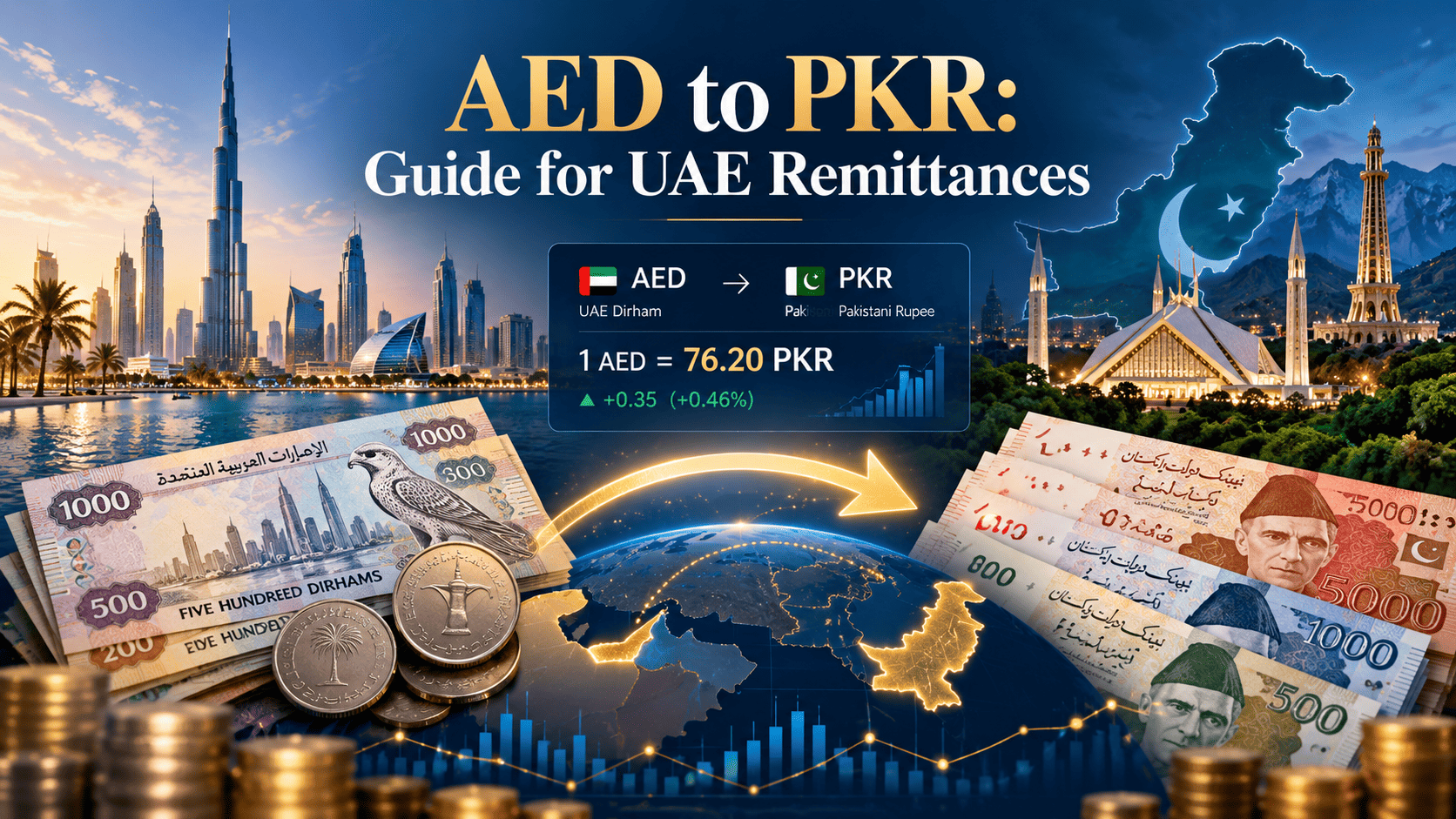
AED to PKR: Guide for UAE Remittances
The UAE Dirham to Pakistani Rupee (AED to PKR) exchange rate is especially important for Pakistan because a large number of Pakistanis live and work in the United Arab Emirates and regularly send money home.
Whether someone is working in Dubai, Abu Dhabi, Sharjah, Ajman, or another part of the UAE, converting UAE dirhams into Pakistani rupees is usually part of the remittance process.
For example, if the exchange rate is:
1 AED = Rs. 76
then:
AED 1,000 × Rs. 76 = Rs. 76,000
So AED 1,000 would be worth approximately Rs. 76,000 at that example exchange rate.
However, the actual amount received by a family in Pakistan may be different because the final conversion can depend on:
- The remittance provider
- The exchange rate offered
- Transfer fees
- Bank charges
- Payment method
- Receiving method
- Time of conversion
This guide explains how AED to PKR conversion works, how UAE remittances reach Pakistan, what affects the exchange rate, and what you should check before sending money.
What Does AED to PKR Mean?
AED is the international currency code for the:
United Arab Emirates Dirham
PKR is the international currency code for the:
Pakistani Rupee
Therefore:
AED/PKR
shows how many Pakistani rupees one UAE dirham is worth.
For example:
AED/PKR = 76
means:
1 AED = Rs. 76
Using that example:
10 AED = Rs. 760
100 AED = Rs. 7,600
1,000 AED = Rs. 76,000
5,000 AED = Rs. 380,000
The actual rate can change, so these figures should only be treated as examples.
How to Convert AED to PKR
The basic formula is:
AED Amount × AED to PKR Rate = PKR Amount
Suppose you want to convert:
AED 2,000
and the exchange rate is:
Rs. 76 per AED
Calculation:
2,000 × 76 = 152,000
Therefore:
AED 2,000 = approximately Rs. 152,000
at that example exchange rate.
AED to PKR Conversion Examples
Using an example exchange rate of:
1 AED = Rs. 76
| AED Amount | Approximate PKR |
|---|---|
| AED 1 | Rs. 76 |
| AED 10 | Rs. 760 |
| AED 50 | Rs. 3,800 |
| AED 100 | Rs. 7,600 |
| AED 500 | Rs. 38,000 |
| AED 1,000 | Rs. 76,000 |
| AED 2,000 | Rs. 152,000 |
| AED 3,000 | Rs. 228,000 |
| AED 5,000 | Rs. 380,000 |
| AED 10,000 | Rs. 760,000 |
These figures are examples only and will change when the AED to PKR rate changes.
How to Convert PKR to AED
You can also calculate how many UAE dirhams you can purchase with Pakistani rupees.
Use:
PKR Amount ÷ AED to PKR Rate = AED Amount
For example:
Rs. 152,000 ÷ 76 = AED 2,000
Therefore:
Rs. 152,000 = approximately AED 2,000
at the example rate.
Why AED to PKR Is Important for UAE Remittances
Many Pakistani workers living in the UAE send part of their earnings to their families in Pakistan.
The AED to PKR exchange rate directly affects the number of rupees the recipient may receive.
For example, suppose someone sends:
AED 5,000
At:
1 AED = Rs. 75
the basic conversion is:
5,000 × 75 = Rs. 375,000
If the rate increases to:
1 AED = Rs. 77
the conversion becomes:
5,000 × 77 = Rs. 385,000
Difference:
Rs. 10,000
The sender transferred exactly the same AED 5,000, but the PKR value increased because the exchange rate changed.
How UAE Remittances Reach Pakistan
Money sent from the UAE can reach Pakistan through different authorized channels.
These can include:
- Banks
- Exchange houses
- International money transfer operators
- Remittance companies
- Digital remittance services
- Other authorized financial channels
Pakistan's formal remittance framework includes banks, authorized dealers, exchange companies, and international remittance arrangements. SBP has continued updating its rules for inward home remittances and regulated remittance channels.
The exact service available depends on the sender's provider and the receiving institution in Pakistan.
Bank Account Transfer
One common option is sending money directly to the recipient's Pakistani bank account.
The sender provides details such as:
- Recipient name
- Bank name
- Account number or IBAN
- Other information required by the transfer provider
The remittance service then sends the funds through its banking or payment network.
The recipient receives Pakistani rupees according to the exchange rate applied to the transaction.
Cash Pickup
Some remittance services allow beneficiaries in Pakistan to collect money from an authorized payment location.
Instead of receiving funds directly into a bank account, the recipient may collect the payment after completing the required identity verification.
The exact availability, documents, and payment method depend on the remittance provider and applicable regulations.
Digital Remittances
Digital platforms have made UAE-to-Pakistan remittances easier.
A sender may be able to:
- Open a remittance application or website.
- Select Pakistan as the destination.
- Enter the amount in AED.
- Review the offered AED to PKR exchange rate.
- Enter the recipient's details.
- Pay for the transfer.
- Confirm the transaction.
The recipient may then receive the money in a bank account or through another supported payout method.
How the AED to PKR Remittance Rate Is Calculated
Suppose you send:
AED 3,000
and your remittance provider offers:
1 AED = Rs. 76.20
The basic calculation is:
3,000 × 76.20
= Rs. 228,600
Therefore, the recipient could receive approximately:
Rs. 228,600
before considering any fees, deductions, or provider-specific terms.
Exchange Rate vs Transfer Fee
When comparing remittance services, do not look only at the transfer fee.
The exchange rate can make an equally important difference.
Consider two example providers.
Provider A
Exchange rate:
1 AED = Rs. 76.00
Transfer fee:
AED 0
Sending:
AED 5,000
Recipient receives approximately:
5,000 × 76 = Rs. 380,000
Provider B
Exchange rate:
1 AED = Rs. 76.50
Transfer fee:
AED 20
After the AED 20 fee, suppose AED 4,980 is effectively converted:
4,980 × 76.50
= approximately Rs. 380,970
Although Provider B charges a fee in this simplified example, its better exchange rate could result in a higher PKR amount.
The exact fee structure varies between providers, so the most useful number to compare is often:
How many PKR will the recipient actually receive?
What Is the Remittance Exchange Rate?
The remittance exchange rate is the rate a money-transfer provider applies when converting your UAE dirhams into Pakistani rupees.
It may not be exactly the same as:
- An online reference rate
- Google's displayed rate
- Pakistan's open-market cash rate
- A bank's interbank reference
- A currency exchange shop's cash rate
The remittance provider may quote its own customer rate.
For this reason, always check the final PKR amount shown before confirming the transfer.
Why Does a Remittance Provider Show a Different AED Rate?
There can be several reasons.
Exchange Rate Margin
A provider may build part of its revenue into the exchange rate.
For example, suppose a market reference is:
1 AED = Rs. 76.40
but the remittance provider offers:
1 AED = Rs. 76.00
The difference may form part of the provider's pricing.
Transfer Fee
Some services charge a separate fee.
For example:
AED 10
or:
AED 20
per transfer.
Promotional Rate
A provider may temporarily offer a better exchange rate to:
- New customers
- Users of its mobile application
- Customers sending above a certain amount
- Customers using a particular payment method
These promotional rates may only apply under specific conditions.
Why Is the UAE Dirham Closely Linked to the US Dollar?
An important feature of the UAE dirham is that it is maintained at a fixed exchange-rate relationship with the US dollar.
The Central Bank of the UAE maintains the dirham's peg to the US dollar and currently uses intervention rates around AED 3.672–3.673 per US dollar, while its official exchange-rate data commonly uses USD/AED 3.6725.
In simple terms:
USD 1 ≈ AED 3.6725
This relationship helps explain why AED to PKR often moves closely with USD to PKR.
How USD to PKR Can Affect AED to PKR
Because AED is closely linked to USD, changes in USD/PKR can influence the theoretical value of AED/PKR.
A simplified formula is:
AED to PKR ≈ USD to PKR ÷ 3.6725
Suppose:
USD/PKR = Rs. 280
Then:
280 ÷ 3.6725 ≈ Rs. 76.24
So the approximate theoretical AED to PKR value would be around:
Rs. 76.24 per AED
However, the actual rate available from a bank, exchange company, or remittance provider may differ because of:
- Buying and selling spreads
- Fees
- Customer pricing
- Provider margins
- Cash handling
- Market conditions
Example: If USD to PKR Changes
Suppose:
USD/PKR = 280
Approximate AED value:
280 ÷ 3.6725 ≈ Rs. 76.24
Now suppose USD/PKR moves to:
Rs. 290
Approximate AED value:
290 ÷ 3.6725 ≈ Rs. 78.96
This shows why AED to PKR can rise when USD becomes more expensive against the Pakistani rupee.
Does AED Move Independently Against PKR?
Because the UAE maintains the dirham's fixed relationship with the US dollar, much of AED/PKR movement comes from changes in the Pakistani rupee's value against USD rather than large fluctuations in AED against USD.
The Central Bank of the UAE describes maintaining this fixed exchange-rate relationship as a central objective of its monetary framework.
Therefore, if USD/PKR rises significantly, AED/PKR will generally also move upward, all else being equal.
Why Does AED to PKR Change?
Several factors can affect AED to PKR indirectly through changes in PKR against USD.
These include:
- Pakistan's import demand
- Export earnings
- Overseas remittances
- Foreign investment
- External debt payments
- Foreign exchange reserves
- International oil prices
- Inflation
- Interest rates
- External financing
- Market expectations
Since AED is closely linked to USD, many of the same factors affecting USD/PKR also influence AED/PKR.
Remittances Can Support Pakistan's Foreign Exchange Supply
When overseas Pakistanis send money through formal channels, foreign currency enters Pakistan's financial system.
Remittances are therefore an important source of foreign-exchange inflows.
SBP has maintained programs and regulatory measures intended to encourage and facilitate home remittances through regulated channels.
Higher formal remittance inflows can improve foreign-currency availability in Pakistan.
AED Buying Rate vs Selling Rate
Just like USD, UAE dirham quotations may include:
AED Buying Rate
and:
AED Selling Rate
Suppose an exchange company displays:
AED Buying = Rs. 76.00
AED Selling = Rs. 76.80
If You Have AED and Want PKR
The dealer is buying AED from you.
Use:
Buying Rate = Rs. 76.00
If You Have PKR and Want AED
The dealer is selling AED to you.
Use:
Selling Rate = Rs. 76.80
This distinction is particularly important when dealing with physical currency.
Example: Selling AED in Pakistan
Suppose you return from Dubai with:
AED 2,000
An exchange company offers:
AED Buying = Rs. 76
Calculation:
2,000 × 76
= Rs. 152,000
You would receive approximately:
Rs. 152,000
before any applicable charges.
Example: Buying AED for a UAE Trip
Suppose you need:
AED 3,000
and the exchange company's selling rate is:
Rs. 77
Calculation:
3,000 × 77
= Rs. 231,000
You would need approximately:
Rs. 231,000
before any additional charges.
Open-Market AED Rate vs Remittance Rate
These are not necessarily the same.
An open-market AED rate may relate to physical currency notes bought and sold by an exchange company.
A remittance rate relates to an electronic money transfer.
For example:
Open Market AED Buying = Rs. 76.00
while a remittance provider might offer:
AED to PKR = Rs. 76.30
Another provider could offer:
Rs. 76.15
These differences can occur because each transaction has a different pricing structure.
Why Google's AED to PKR Rate May Be Different
If you search:
1 AED to PKR
online, you may see a reference market rate.
Your remittance provider may show another figure.
For example:
Online reference: Rs. 76.30
Provider rate:
Rs. 76.00
Exchange-company buying rate:
Rs. 75.90
Exchange-company selling rate:
Rs. 76.80
These numbers serve different purposes.
Therefore, the rate displayed by an online converter should not automatically be treated as the amount available for a real transaction.
How to Compare UAE Remittance Providers
Before sending money, compare the complete transaction rather than focusing on one advertised number.
Important things to check include:
Exchange Rate
How many Pakistani rupees does the provider give for each AED?
Transfer Fee
Does the provider charge:
- No fee
- Fixed fee
- Percentage-based fee
Final PKR Amount
This is one of the most important figures.
Ask:
How many rupees will my recipient actually receive?
Transfer Speed
Some transfers may arrive quickly, while others may take longer depending on the payment method and provider.
Receiving Method
Check whether the recipient can receive funds through:
- Bank account
- Cash pickup
- Another supported payout option
Limits
Providers may have minimum and maximum transaction limits.
Identification Requirements
The provider may require identity verification and other information depending on the transaction and applicable regulations.
A Better Way to Compare Remittance Offers
Suppose you want to send:
AED 5,000
Provider A shows:
Rate = Rs. 76.00
Fee = AED 0
PKR amount:
Rs. 380,000
Provider B shows:
Rate = Rs. 76.40
but charges:
AED 25
Instead of simply choosing the higher exchange rate, check the final PKR amount after all applicable fees.
This gives you a more realistic comparison.
How Exchange Rate Differences Affect Large Remittances
Small exchange-rate differences can become significant when sending larger amounts.
Suppose two providers offer:
Provider A = Rs. 76.00
Provider B = Rs. 76.50
Difference:
Rs. 0.50 per AED
For:
AED 1,000
difference:
1,000 × 0.50 = Rs. 500
For:
AED 5,000
difference:
5,000 × 0.50 = Rs. 2,500
For:
AED 10,000
difference:
10,000 × 0.50 = Rs. 5,000
Therefore, even a small difference in AED to PKR rates can matter.
Example: Monthly UAE Remittance
Suppose a Pakistani worker in Dubai sends:
AED 2,500
every month.
Provider rate:
1 AED = Rs. 76
Monthly conversion:
2,500 × 76
= Rs. 190,000
Over 12 months:
Rs. 190,000 × 12
= Rs. 2,280,000
Now suppose the average rate were instead:
Rs. 77
Monthly amount:
2,500 × 77
= Rs. 192,500
Annual amount:
Rs. 2,310,000
Difference:
Rs. 30,000
This shows why the exchange rate can make a noticeable difference over repeated transfers.
Should You Wait for a Better AED to PKR Rate?
Exchange rates can move up or down, and future movements cannot be known with certainty.
Waiting for a slightly better exchange rate also involves the risk that the rate could move in the opposite direction.
For regular family expenses, many people focus more on:
- Required payment date
- Transfer reliability
- Total fees
- Final recipient amount
rather than attempting to predict short-term currency movements.
Sending Money for Family Expenses
UAE remittances are commonly used for expenses such as:
- Household costs
- Education
- Rent
- Utility bills
- Healthcare
- Family support
- Savings
If the recipient needs a specific PKR amount, it can be useful to calculate backwards.
Suppose the family needs:
Rs. 200,000
and the remittance rate is:
Rs. 76 per AED
Required AED:
200,000 ÷ 76
= approximately:
AED 2,631.58
Additional funds may be needed if the provider charges a fee.
How to Calculate the AED Needed for a Specific PKR Amount
Formula:
PKR Required ÷ AED/PKR Rate = AED Required
Suppose:
PKR Required = Rs. 500,000
Exchange rate:
1 AED = Rs. 76
Calculation:
500,000 ÷ 76
= approximately:
AED 6,578.95
Therefore, approximately AED 6,579 would be required before considering fees or rate changes.
Should You Use the Buying or Selling Rate for a Remittance?
For a normal electronic remittance, you should generally use the specific conversion rate quoted by the remittance provider.
Do not automatically use the open-market AED buying or selling rate.
Open-market buying and selling rates are more directly relevant to physical currency exchange.
For electronic remittances, the provider's quoted conversion rate and final recipient amount are more useful.
Cash Exchange vs Remittance
Consider two different situations.
Situation 1: Physical AED Notes
You return from Dubai with:
AED 1,000 cash
and sell them to an exchange company in Pakistan.
The exchange company's:
AED buying rate
generally applies.
Situation 2: Electronic Remittance
You are in Dubai and transfer:
AED 1,000
to a Pakistani bank account.
The:
remittance provider's conversion rate
applies.
These two rates do not have to be identical.
Can the Recipient Receive Exactly the Amount Shown?
Often the provider displays the amount expected to be delivered to the recipient before you confirm the transfer.
However, the final amount can depend on:
- Provider terms
- Exchange-rate locking
- Fees
- Receiving method
- Intermediary arrangements
- Timing
Check the transaction summary carefully before confirming the remittance.
What Does "Rate Locked" Mean?
Some remittance services lock the exchange rate when you confirm the transaction.
For example:
Locked Rate: 1 AED = Rs. 76.30
If the market moves shortly afterward, the transfer may still use the locked rate, subject to the provider's terms.
Other services may determine the conversion rate at another stage of the transaction.
Always check when the exchange rate becomes final.
Does Transfer Speed Affect the Exchange Rate?
Potentially.
A provider may offer different options such as:
- Standard transfer
- Instant transfer
- Bank-funded transfer
- Card-funded transfer
Different options may have different:
- Fees
- Exchange rates
- Processing times
The fastest transfer is therefore not necessarily the least expensive.
Are Zero-Fee Remittances Really Free?
A provider may advertise:
Zero Transfer Fee
but that does not necessarily mean the provider earns nothing from the transaction.
Part of its revenue may come from the exchange-rate margin.
For example:
Market reference:
Rs. 76.40
Provider rate:
Rs. 76.00
Difference:
Rs. 0.40 per AED
For AED 5,000:
5,000 × 0.40
= Rs. 2,000
Therefore, compare the final recipient amount rather than looking only at an advertised zero fee.
Why Authorized Remittance Channels Matter
Using regulated remittance channels helps ensure that money moves through documented financial systems.
Formal channels can provide:
- Transaction records
- Payment receipts
- Tracking information
- Regulatory oversight
- Recipient verification
- Customer support
Pakistan has specifically developed payment infrastructure and regulatory arrangements intended to facilitate secure home-remittance delivery through formal channels.
Common AED to PKR Remittance Mistakes
Looking Only at the Transfer Fee
A zero-fee transfer may still have a less favorable exchange rate.
Using the Open-Market Rate for a Bank Remittance
The actual remittance rate may be different.
Assuming Google's Rate Is Guaranteed
An online rate is usually a reference rather than a guaranteed customer rate.
Ignoring the Final PKR Amount
The most useful comparison is often the amount the beneficiary actually receives.
Sending to Incorrect Account Details
Always carefully verify the recipient's:
- Name
- Account number
- IBAN
- Bank information
before confirming a transfer.
Not Checking the Provider
Use reputable and appropriately authorized or regulated financial channels.
Focusing Only on Speed
An instant transfer may cost more than a standard transfer.
Compare speed, rate, fees, and reliability together.
Frequently Asked Questions
How do I convert AED to PKR?
Multiply the AED amount by the applicable AED to PKR exchange rate.
AED × Exchange Rate = PKR
For example:
AED 1,000 × Rs. 76 = Rs. 76,000
How do I convert PKR to AED?
Divide the PKR amount by the applicable AED to PKR exchange rate.
PKR ÷ AED Rate = AED
For example:
Rs. 76,000 ÷ 76 = AED 1,000
Why does AED to PKR change?
AED is closely linked to the US dollar, so AED/PKR is strongly influenced by movements in USD/PKR.
Changes in Pakistan's foreign-currency demand and supply can therefore affect AED/PKR.
Is AED fixed to USD?
The UAE maintains a fixed exchange-rate relationship between the dirham and US dollar. The Central Bank of the UAE currently maintains intervention rates around AED 3.672–3.673 per USD.
How can I estimate AED to PKR from USD to PKR?
A simplified calculation is:
USD/PKR ÷ 3.6725 ≈ AED/PKR
This gives an approximate theoretical rate before customer spreads, fees, and other charges.
Is the open-market AED rate the same as the remittance rate?
Not necessarily.
The open-market rate generally relates to physical currency exchange, while an electronic remittance provider can offer a different conversion rate.
Which rate should I use when sending money from UAE to Pakistan?
Use the actual AED to PKR rate quoted by your remittance provider and check the final PKR amount shown before confirming the transfer.
Does the recipient pay a fee?
This depends on the provider and receiving method.
Always check the transaction terms before sending money.
Why does one remittance company offer a better rate?
Different providers may use different exchange-rate margins, fees, promotions, operating models, and pricing strategies.
Should I choose the provider with the highest AED rate?
Not automatically.
Check:
Exchange rate + fees + final PKR amount + transfer speed + reliability
together.
Why does Google show a different AED rate?
Google or another financial platform may show a market/reference rate.
Your remittance provider may include a spread or use a different customer conversion rate.
Can AED to PKR change during the day?
Yes.
Although AED remains closely linked to USD, PKR can move against USD, which can cause AED/PKR quotations to change.
How much will AED 1,000 give me in Pakistan?
It depends on the current rate.
If the example rate were:
Rs. 76 per AED
then:
AED 1,000 = Rs. 76,000
Always use the latest rate offered by your provider for an actual transfer.
How much will AED 5,000 give me in Pakistan?
At an example rate of:
Rs. 76 per AED
calculation:
5,000 × 76
= Rs. 380,000
The actual amount may differ depending on the provider's rate and fees.
Conclusion
AED to PKR conversion is especially important for Pakistani families receiving remittances from the United Arab Emirates.
The basic calculation is simple:
AED Amount × AED to PKR Rate = Pakistani Rupees
For example:
AED 1,000 × Rs. 76
= Rs. 76,000
However, an actual UAE remittance involves more than just multiplying two numbers.
You should also consider:
- Provider exchange rate
- Transfer fee
- Exchange-rate margin
- Transfer speed
- Receiving method
- Final PKR amount
Because the UAE dirham is closely linked to the US dollar, changes in USD to PKR generally have a major influence on AED to PKR.
When comparing remittance services, focus on the most practical question:
How many Pakistani rupees will the recipient actually receive after the complete transaction?
A service advertising a zero fee does not automatically provide the best overall value, and the provider with the highest advertised exchange rate may have other charges.
Always review the complete transaction details before sending money.
Disclaimer: Foreign exchange and remittance rates can change frequently and may vary between banks, exchange companies, money-transfer operators, digital remittance providers, and other financial institutions. Calculations, exchange rates, fees, and figures used in this article are for educational purposes and examples only. Actual exchange rates, transfer fees, processing times, taxes, deductions, and recipient amounts may differ depending on market conditions and the service provider. Always check the latest applicable AED to PKR rate, fees, and transaction terms before sending, receiving, buying, selling, or making a financial decision.