
Why Does USD to PKR Change?
The USD to PKR exchange rate is one of the most closely followed financial indicators in Pakistan. People check it when sending or receiving remittances, importing goods, travelling abroad, purchasing international services, investing, or simply trying to understand changes in the economy.
You may see the US dollar trading at one rate today and a different rate tomorrow. Sometimes the movement is small, while at other times the exchange rate can change noticeably within a relatively short period.
So why does USD to PKR keep changing?
The simple answer is:
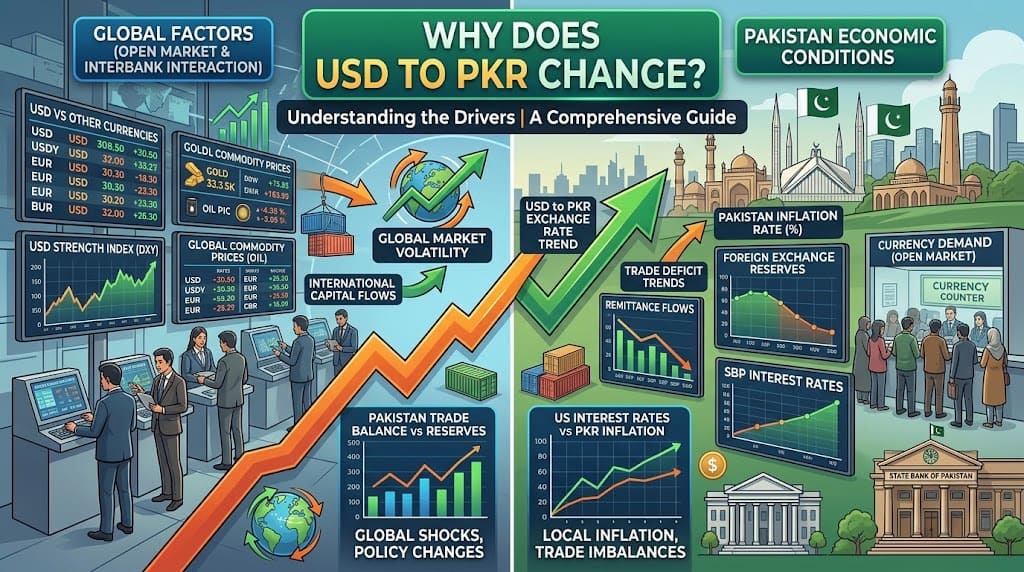
The value of the Pakistani rupee against the US dollar changes mainly because the demand and supply of foreign currency change.
Pakistan operates a market-based flexible exchange-rate system. According to the State Bank of Pakistan (SBP), the exchange rate is determined by market demand and supply conditions and generally reflects the country's external balance-of-payments position and other macroeconomic indicators.
However, many different factors influence that demand and supply.
These include:
- Imports
- Exports
- Overseas remittances
- Foreign investment
- External debt payments
- Foreign exchange reserves
- Inflation
- International oil prices
- Global US dollar movements
- Market expectations
- Official foreign inflows
Understanding these factors makes USD to PKR movements much easier to understand.
What Does USD to PKR Mean?
USD stands for:
United States Dollar
PKR stands for:
Pakistani Rupee
If the exchange rate is:
1 USD = Rs. 280
it means one US dollar is worth approximately 280 Pakistani rupees at that quoted rate.
If the rate later becomes:
1 USD = Rs. 285
more Pakistani rupees are now required to purchase one US dollar.
In this situation:
The Pakistani rupee has weakened or depreciated against the US dollar.
If the rate falls from:
Rs. 285 to Rs. 280
fewer rupees are required to purchase one dollar.
In this situation:
The Pakistani rupee has strengthened or appreciated against the US dollar.
What Does Rupee Depreciation Mean?
Rupee depreciation means the PKR loses value against another currency.
For example:
Before: 1 USD = Rs. 280
After: 1 USD = Rs. 290
Previously, Rs. 280 could purchase one dollar.
Now you need Rs. 290.
Therefore, the rupee has depreciated against the US dollar.
What Does Rupee Appreciation Mean?
Rupee appreciation is the opposite.
For example:
Before: 1 USD = Rs. 290
After: 1 USD = Rs. 280
You now need fewer Pakistani rupees to purchase the same US dollar.
Therefore, the PKR has appreciated against the USD.
The Main Reason: Demand and Supply
The easiest way to understand exchange rates is through demand and supply.
Think of the US dollar as something that businesses, banks, travellers, importers, and other participants need to purchase.
If many people and businesses need dollars while the supply of dollars is limited, the price of dollars in rupees can increase.
In simple terms:
Higher USD Demand + Limited USD Supply → Pressure for USD/PKR to Rise
On the other hand:
Higher USD Supply + Lower USD Demand → Pressure for USD/PKR to Fall
The real foreign exchange market is more complex, but this basic idea explains a large part of exchange-rate movement.
1. Imports Increase Demand for US Dollars
Imports are one of the most important sources of foreign-currency demand.
Pakistan imports many products and commodities, including items such as:
- Petroleum products
- Machinery
- Chemicals
- Electronic equipment
- Industrial raw materials
- Food products
- Vehicles and parts
- Medical equipment
International suppliers often require payment in US dollars or other foreign currencies.
Suppose a Pakistani company imports machinery worth:
USD 1 million
The importer generally needs access to foreign currency to pay the overseas supplier.
If many companies require dollars for imports at the same time, demand for USD can increase.
All else being equal, stronger dollar demand can put upward pressure on USD/PKR.
2. A Higher Import Bill Can Put Pressure on PKR
It is not only the quantity of imported goods that matters.
The international price of those goods also matters.
For example, imagine Pakistan imports the same quantity of oil, but international oil prices increase significantly.
Pakistan would then need more foreign currency to pay for the same amount of oil.
Example:
Oil import cost before:
USD 2 billion
Oil import cost after higher prices:
USD 3 billion
That creates an additional:
USD 1 billion
of foreign-currency requirement.
If additional dollar supply does not arrive at the same time, pressure on the exchange rate may increase.
3. Oil Prices Can Affect USD to PKR
Pakistan imports a substantial portion of its energy requirements.
Oil and other energy imports therefore matter for foreign-exchange demand.
If international energy prices increase, Pakistan may need more dollars to pay its import bill.
That can increase demand for foreign currency.
However, oil prices are only one factor.
USD/PKR does not automatically move by a fixed amount whenever international oil prices change because many other foreign-exchange inflows and outflows are happening simultaneously.
4. Exports Bring Foreign Currency Into Pakistan
Exports generally work in the opposite direction to imports.
Pakistani businesses sell goods and services internationally and receive foreign currency.
Major export categories can include:
- Textiles
- Garments
- Rice
- Leather products
- Surgical instruments
- Sports goods
- IT and technology services
- Other manufactured and agricultural products
When exporters receive dollars and those foreign-currency receipts enter Pakistan's financial system, they contribute to foreign-exchange supply.
Higher export earnings can therefore support the availability of foreign currency.
In simplified terms:
More exports → More foreign currency inflows → Greater USD supply
This can reduce pressure on the rupee, assuming other factors remain unchanged.
5. Imports vs Exports Matter Together
Looking only at imports or only at exports does not provide the full picture.
Suppose Pakistan earns:
USD 30 billion from exports
but spends:
USD 50 billion on imports
The difference is:
USD 20 billion
That gap needs to be financed through other foreign-currency inflows, such as:
- Remittances
- Foreign investment
- Loans
- Official financing
- Other financial inflows
If foreign-currency outflows consistently exceed inflows, pressure can build on the country's external position and potentially its currency.
6. Overseas Remittances Can Support the Rupee
Millions of Pakistanis living abroad send money to their families in Pakistan.
These transfers are known as workers' remittances.
For example, someone working in the UAE may send:
AED 5,000
to their family in Pakistan.
Someone working in Saudi Arabia may send:
SAR 3,000
A Pakistani working in the United States may send dollars.
These funds enter Pakistan through banks, exchange companies, and remittance channels and contribute to foreign-currency inflows.
Higher remittance inflows can therefore increase the supply of foreign currency.
SBP's FY2025 annual reporting, for example, noted that improvement in Pakistan's external account during that period was supported significantly by workers' remittances and official inflows.
7. Foreign Exchange Reserves Matter
Foreign exchange reserves are foreign-currency assets held by a country's central bank.
In Pakistan, the State Bank of Pakistan manages the country's foreign exchange reserves.
Reserves are important because Pakistan needs foreign currency for external obligations such as:
- Debt repayments
- Imports
- International payments
- Other external obligations
Market participants closely follow reserve levels because they provide information about the country's ability to meet foreign-currency requirements.
A stronger reserve position can improve confidence in the availability of foreign currency.
A very low reserve position can create concerns about the ability to meet external payments and may contribute to pressure in the foreign-exchange market.
However, reserves are only one part of the exchange-rate picture.
8. External Debt Payments Can Increase Dollar Demand
Pakistan has external debt obligations that need to be repaid in foreign currencies.
Suppose the government or another Pakistani borrower has a:
USD 1 billion
external payment due.
The payment requires foreign currency.
Large repayments can therefore create foreign-currency outflows.
The important factor is not simply whether debt exists, but whether foreign-currency inflows and reserves are sufficient to comfortably meet upcoming obligations.
9. Foreign Loans and Official Inflows Can Increase Dollar Supply
Foreign currency can also enter Pakistan through:
- Multilateral financing
- Bilateral financing
- Development institutions
- Foreign loans
- International bond proceeds
- Other official inflows
For example, if Pakistan receives a foreign-currency financing inflow, the country's available foreign-exchange resources may increase.
The impact on USD/PKR depends on the amount, timing, market expectations, and the wider economic situation.
10. IMF Programs Can Affect Market Expectations and Foreign-Currency Availability
International Monetary Fund programs can affect Pakistan's external financing environment.
An IMF disbursement itself provides foreign currency, but an IMF-supported program can also influence expectations regarding:
- External financing
- Economic policies
- Foreign-exchange availability
- Other international financing
Other lenders and institutions may also make financing decisions based partly on broader economic conditions and program progress.
However, USD/PKR does not move only because of an IMF announcement.
The market considers many factors at the same time.
11. Foreign Investment Can Affect USD Supply
Foreign investment can bring additional foreign currency into Pakistan.
Examples include:
Foreign Direct Investment
A foreign company may invest money to:
- Build a factory
- Purchase a business
- Expand an existing operation
- Develop infrastructure
Portfolio Investment
Foreign investors may purchase:
- Government securities
- Shares
- Other financial assets
When foreign capital enters Pakistan, it can increase foreign-currency supply.
When capital leaves, it can create additional foreign-currency demand.
12. Inflation Can Affect the Rupee Over Time
Inflation refers to a general increase in prices.
If Pakistan experiences higher inflation than major trading partners over a sustained period, Pakistani goods may become relatively more expensive.
Over longer periods, differences in inflation can influence:
- Import demand
- Export competitiveness
- Interest rates
- Purchasing power
- Expectations about the currency
Therefore, inflation can contribute to exchange-rate pressure.
However, inflation does not determine USD/PKR by itself.
The relationship is affected by many other economic factors.
13. Interest Rates Can Affect Currency Markets
Interest rates can influence:
- Saving
- Borrowing
- Investment
- Inflation
- Foreign capital flows
- Economic activity
Higher interest rates may sometimes support a currency by making local financial assets more attractive or by reducing domestic demand.
Lower interest rates may have the opposite effect under some conditions.
However, the relationship is not automatic.
For example, a country can have high interest rates while still experiencing currency depreciation if inflation, external financing needs, or other pressures are large.
Therefore:
Higher interest rates do not automatically mean a stronger PKR.
14. The US Dollar Itself Can Become Stronger Globally
USD/PKR does not depend only on Pakistan.
The US dollar also changes in value internationally.
The dollar may strengthen or weaken against currencies such as:
- Euro
- British pound
- Japanese yen
- Australian dollar
- Other emerging-market currencies
Global movements in the dollar can be influenced by:
- US interest rates
- Federal Reserve policy
- US inflation
- Global financial conditions
- Investor demand for dollar assets
If the US dollar strengthens globally, currencies in many countries can face pressure against it, including the Pakistani rupee.
15. US Federal Reserve Decisions Can Matter
The US Federal Reserve sets monetary policy in the United States.
Changes in US interest rates can influence global capital flows.
For example, higher US interest rates may make US dollar assets more attractive to global investors.
That can increase demand for dollars internationally.
This does not mean every Federal Reserve rate increase will automatically cause USD/PKR to rise, but US monetary policy is one of the international factors that can influence the exchange rate.
16. Market Expectations Can Move the Exchange Rate
Currency markets do not respond only to what is happening today.
Participants also think about what might happen in the future.
For example, businesses may consider:
- Future import requirements
- Expected export receipts
- External debt repayments
- Inflation expectations
- Future foreign financing
- International commodity prices
If businesses expect the dollar to become more expensive, some may try to meet their foreign-currency requirements earlier.
That itself can increase short-term demand.
Similarly, if exporters expect the rupee to strengthen, their behaviour regarding conversion of foreign-currency earnings may change.
Expectations can therefore influence current market activity.
17. Supply and Demand Can Change During the Day
USD/PKR does not have to remain at one rate throughout the entire day.
Banks and authorized dealers continuously process foreign-exchange transactions.
At different times, there may be:
- More import demand
- More export proceeds
- Corporate payments
- Remittance inflows
- Large currency transactions
- Other market flows
As these transactions occur, buying and selling quotations can move.
This is why the rate you see in the morning may differ from the rate available later.
18. The State Bank of Pakistan's Role
Pakistan currently operates a market-based flexible exchange-rate regime.
According to SBP, exchange rates are determined by demand and supply conditions. SBP states that its foreign-exchange market interventions are intended to address disorderly market conditions and build foreign-exchange buffers rather than suppress an underlying exchange-rate trend.
This is important because people sometimes assume SBP simply chooses one USD/PKR number every morning.
That is not how Pakistan's current exchange-rate framework is described by the central bank.
Market conditions play the central role.
19. Open Market and Interbank Rates Can Be Different
When people say:
"The dollar is Rs. X today"
it is important to ask:
Which dollar rate?
There can be:
- Interbank buying rate
- Interbank selling rate
- Open-market buying rate
- Open-market selling rate
- Bank customer rate
- Remittance conversion rate
- Card conversion rate
These rates can differ.
Therefore, two websites showing slightly different USD/PKR values are not necessarily incorrect.
They may simply be showing different types of exchange rates.
20. Why Can Open Market USD/PKR Move?
The open market is influenced by demand and supply for foreign currency through exchange companies.
Demand can come from people who need foreign currency for purposes such as:
- Travel
- Education
- Medical expenses
- Personal requirements
- Business travel
Supply can come from people selling foreign currency and other permitted sources available to exchange companies.
Therefore, open-market conditions can sometimes be different from interbank-market conditions.
21. Why Can Interbank USD/PKR Move?
The interbank market involves banks and authorized dealers.
Foreign-currency demand and supply can arise from:
- Imports
- Exports
- Corporate payments
- Remittances
- Investment flows
- External financing
- Debt payments
- Other banking transactions
SBP states that authorized dealers in the interbank market are free to quote their own buying and selling rates.
22. Current Account Balance and USD/PKR
Another important concept is the current account.
Very simply, the current account captures major external flows including:
- Trade in goods
- Trade in services
- Income
- Transfers such as remittances
A large current-account deficit means more foreign currency is generally leaving through these transactions than entering.
That gap needs financing.
A smaller deficit—or a surplus—reduces that particular external financing requirement.
For example, SBP reported a current-account surplus of about USD 2.1 billion in FY2025, compared with a deficit of a similar size in FY2024.
The exchange rate still depends on the full balance of payments and market expectations, so the current account should not be considered in isolation.
23. Balance of Payments and the Exchange Rate
The balance of payments records a country's economic transactions with the rest of the world.
It includes money entering and leaving through areas such as:
- Trade
- Services
- Remittances
- Investments
- Loans
- Debt payments
- Official financing
SBP specifically notes that exchange-rate trends generally reflect the country's external balance-of-payments position along with other macroeconomic indicators.
This is why economists often look beyond just imports and exports when trying to understand currency movements.
24. Simple Example: Why USD/PKR Might Rise
Imagine the following situation:
Pakistan's importers suddenly need more dollars.
At the same time:
- Export receipts are weak
- Remittance inflows are lower
- Large external debt payments are due
Demand for dollars increases while dollar supply is relatively limited.
The market may move from:
1 USD = Rs. 280
to:
1 USD = Rs. 285
In this simplified example, the dollar has become more expensive and the rupee has depreciated.
25. Simple Example: Why USD/PKR Might Fall
Now imagine another situation.
Pakistan receives:
- Strong export proceeds
- Higher remittances
- Foreign investment
- Official financing
while import-related dollar demand remains moderate.
The supply of foreign currency improves relative to demand.
The rate might move from:
1 USD = Rs. 285
to:
1 USD = Rs. 280
In this simplified example, the rupee has appreciated against the US dollar.
26. How to Calculate Percentage Change in USD/PKR
Suppose USD/PKR moves from:
Rs. 280 to Rs. 285
Difference:
285 - 280 = Rs. 5
Percentage increase:
5 ÷ 280 × 100
= approximately:
1.79%
Therefore, USD/PKR increased by approximately 1.79%.
From the PKR perspective, this means the rupee weakened against the dollar.
27. How USD/PKR Affects Imported Products
When the dollar becomes more expensive, imported products can become more costly in Pakistani rupees.
Suppose an imported item costs:
USD 1,000
At:
1 USD = Rs. 280
the basic currency value is:
1,000 × 280 = Rs. 280,000
If USD/PKR rises to:
Rs. 290
the same USD 1,000 becomes:
1,000 × 290 = Rs. 290,000
That is an increase of:
Rs. 10,000
before considering duties, taxes, shipping, margins, and other costs.
28. How USD/PKR Can Affect Fuel Prices
Pakistan imports petroleum and energy products.
If international oil prices remain unchanged but the rupee weakens against the dollar, the same dollar-denominated energy import can cost more in PKR.
Fuel prices are affected by several components, so the exchange rate alone does not determine the final retail price.
However, USD/PKR is an important factor in the rupee cost of imported energy.
29. How USD/PKR Can Affect Gold Prices in Pakistan
International gold is commonly priced in US dollars.
Therefore, Pakistan's gold price can be influenced by both:
- International gold prices
- USD to PKR exchange rate
For example, even if the international gold price remains unchanged, a weaker Pakistani rupee can increase the theoretical PKR value of gold.
This is why local gold rates can change even when international gold prices are relatively stable.
30. How USD/PKR Can Affect Silver Prices
The same principle applies to silver.
International silver is typically quoted in dollars per troy ounce.
To estimate its Pakistani rupee value, the USD price needs to be converted using the applicable USD/PKR rate.
Therefore, changes in USD/PKR can influence the calculated local value of silver.
31. How USD/PKR Affects Overseas Education
Students studying abroad often need foreign currency for:
- Tuition
- Accommodation
- Living expenses
- Travel
- Other costs
Suppose annual tuition is:
USD 20,000
At Rs. 280:
20,000 × 280 = Rs. 5,600,000
At Rs. 290:
20,000 × 290 = Rs. 5,800,000
The difference is:
Rs. 200,000
even though the dollar tuition fee itself has not changed.
32. How USD/PKR Affects Freelancers
The effect can be different for people earning in dollars.
Suppose a freelancer earns:
USD 1,000
At:
Rs. 280 per USD
the approximate PKR equivalent is:
Rs. 280,000
At:
Rs. 290 per USD
the approximate value becomes:
Rs. 290,000
A weaker rupee therefore increases the PKR equivalent of the same dollar income.
However, freelancers may also face higher costs for imported equipment, software, subscriptions, and other dollar-linked expenses.
33. Does a Higher USD/PKR Always Mean the Economy Is Getting Worse?
Not necessarily.
Exchange-rate movement is an important economic indicator, but it should not be interpreted in isolation.
A currency can move because of:
- Global dollar strength
- Commodity-price shocks
- Import demand
- Capital flows
- Monetary policy
- External financing
- Temporary market conditions
Economic performance should be evaluated using a wider range of indicators rather than one exchange rate alone.
34. Can USD/PKR Stay Completely Fixed?
A government could theoretically operate a fixed or tightly managed exchange-rate system, but maintaining a fixed exchange rate requires policies and sufficient foreign-currency resources to support that level.
Pakistan currently describes its regime as a market-based flexible exchange-rate system, meaning the rate can adjust according to changing foreign-exchange demand and supply conditions.
Therefore, some movement in USD/PKR is a normal feature of the current framework.
35. Why Does Google Show a Different USD/PKR Rate?
Google or other financial data providers may show a market or reference rate.
Your bank or exchange company may instead offer:
- A buying rate
- A selling rate
- A cash rate
- A transfer rate
For example:
Online reference:
USD/PKR = Rs. 280
Exchange-company buying:
Rs. 279
Exchange-company selling:
Rs. 282
All three values can be different because they represent different types of quotations.
36. Why Does USD/PKR Sometimes Move Suddenly?
Large or sudden moves can occur when there is an unexpected change in:
- Foreign-currency demand
- Foreign-currency supply
- International commodity prices
- External financing expectations
- Global financial conditions
- Market expectations
Currency markets can react quickly because participants constantly reassess future conditions.
Factors That Can Put Upward Pressure on USD/PKR
USD/PKR may face upward pressure when circumstances include:
- Higher import demand
- Higher international oil prices
- Large external debt repayments
- Lower export receipts
- Lower remittance inflows
- Foreign capital outflows
- Reduced foreign-currency availability
- Higher demand for physical dollars
- Global strengthening of the US dollar
No single factor guarantees that the exchange rate will rise because multiple factors operate simultaneously.
Factors That Can Put Downward Pressure on USD/PKR
USD/PKR may face downward pressure when circumstances include:
- Strong export earnings
- Higher remittances
- Foreign direct investment
- Official foreign-currency inflows
- Lower import demand
- Improved foreign-exchange availability
- Stronger external balances
- Reduced demand for dollars
Again, the final movement depends on the overall balance of demand and supply.
Frequently Asked Questions
Why does the dollar rate change every day in Pakistan?
USD/PKR changes because the demand and supply of US dollars in Pakistan's foreign-exchange market change continuously.
Imports, exports, remittances, foreign investment, debt payments, reserves, and international market conditions can all affect demand and supply.
Why does USD rise against PKR?
USD/PKR can rise when demand for dollars becomes stronger relative to available dollar supply.
Why does PKR strengthen?
PKR can strengthen when foreign-currency supply improves relative to demand.
This could occur alongside stronger inflows, lower dollar demand, or other favourable external-market conditions.
Do imports weaken PKR?
Imports create demand for foreign currency because overseas suppliers need to be paid.
Higher imports can therefore increase dollar demand, but the final exchange-rate effect depends on exports, remittances, investment, financing, and other foreign-currency flows.
Do exports strengthen PKR?
Export earnings bring foreign currency into Pakistan and increase foreign-currency supply.
Higher exports can therefore support the rupee, although other external flows also matter.
Do remittances affect USD to PKR?
Yes.
Remittances bring foreign currency into Pakistan and are an important source of foreign-exchange inflows.
Do foreign reserves affect USD to PKR?
Reserve levels can influence market confidence and the country's ability to meet external foreign-currency obligations.
However, reserves are only one of several factors affecting the exchange rate.
Does inflation affect USD to PKR?
Inflation can affect exchange rates over time by influencing purchasing power, competitiveness, interest rates, and market expectations.
Does the US Federal Reserve affect USD to PKR?
It can.
US interest rates and monetary policy influence the global value and demand for the US dollar, which can indirectly affect USD/PKR.
Can USD/PKR change during the same day?
Yes.
Foreign-exchange supply and demand can change throughout the trading day, causing buying and selling rates to move.
Is the open-market USD rate the same as the interbank rate?
No.
Open-market and interbank rates come from different parts of the foreign-exchange market and can differ.
Does SBP decide the USD rate every day?
Pakistan currently operates a market-based flexible exchange-rate system. According to SBP, market demand and supply determine the exchange rate, while central-bank interventions are intended mainly to address disorderly market conditions and build reserve buffers rather than maintain a fixed exchange-rate path.
Conclusion
USD to PKR changes because the supply of and demand for foreign currency are constantly changing.
The basic idea is simple:
More demand for USD relative to supply can put upward pressure on USD/PKR.
More USD supply relative to demand can put downward pressure on USD/PKR.
But behind that simple relationship are many important factors, including:
- Imports
- Exports
- Remittances
- Foreign investment
- Foreign exchange reserves
- External debt payments
- International oil prices
- Inflation
- Interest rates
- Official foreign inflows
- Global US dollar movements
- Market expectations
This is why there is rarely one single explanation for a change in USD/PKR.
A more accurate way to understand the exchange rate is to look at Pakistan's overall foreign-currency inflows and outflows together rather than focusing on only one factor.
Disclaimer: Foreign exchange rates can change frequently and may vary between banks, exchange companies, remittance providers, and other financial institutions. Calculations, exchange rates, and figures used in this article are for educational purposes and examples only. They should not be considered predictions of future currency movements or financial advice. Always check the latest applicable market rate before buying, selling, transferring, investing, or making a financial decision.