
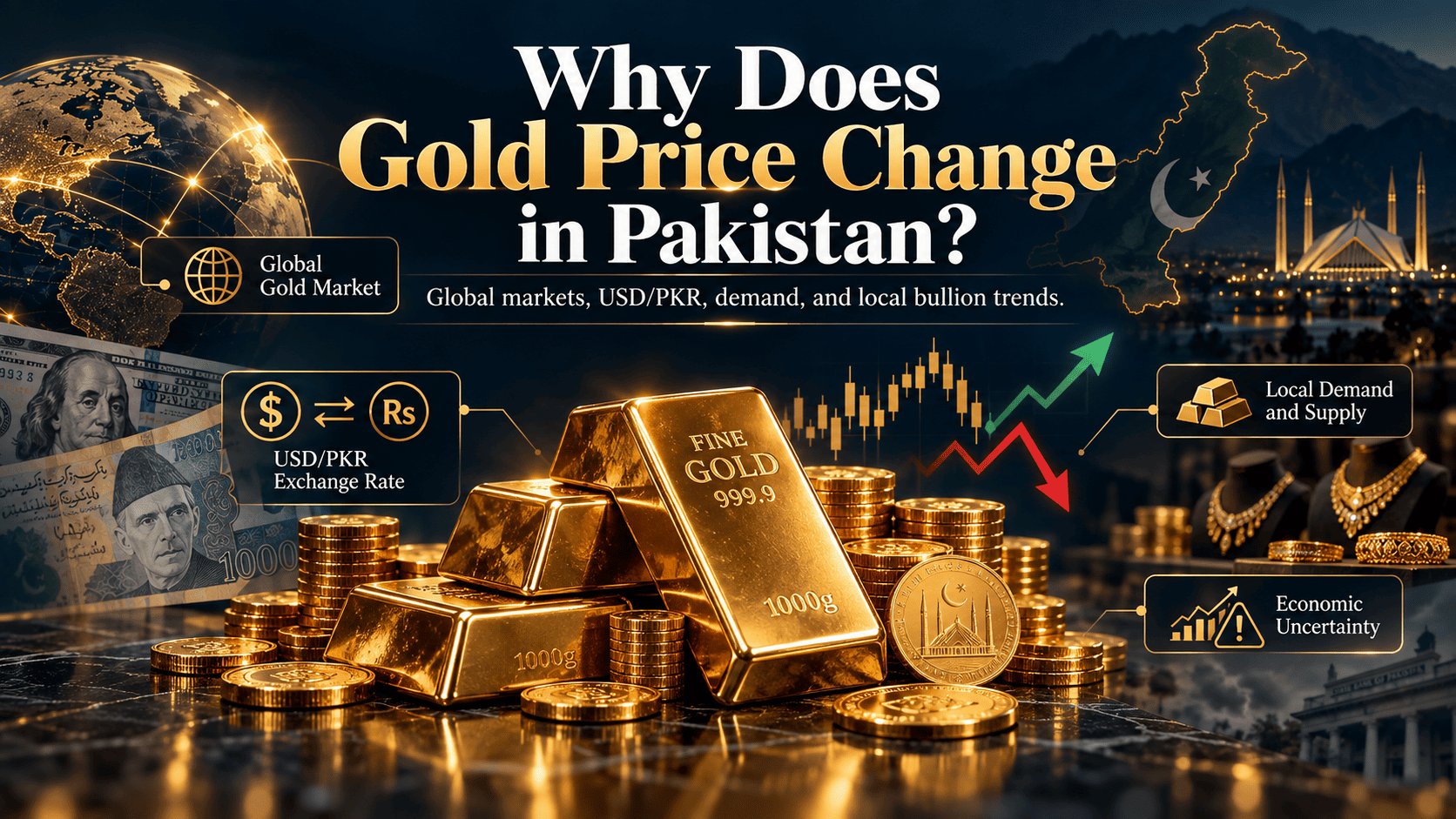
Why Does the Gold Price Change in Pakistan?
If you check the gold rate in Pakistan in the morning and check again a few hours later, you may see a different price.
Sometimes the change is small. On a volatile day, the price can move by several thousand rupees per tola.
This naturally raises a question:
Why does the gold price change so frequently in Pakistan?
The short answer is that Pakistan's gold market is connected to the international gold market, while gold is internationally priced in US dollars. Therefore, the Pakistani gold rate is mainly affected by two moving numbers:
International Gold Price + USD/PKR Exchange Rate
Local bullion-market conditions can then create an additional premium or discount.
That means Pakistan's gold price can change even when there is no change in the physical gold itself.
Let's understand each factor in simple terms.
The Two Biggest Factors Behind Gold Prices in Pakistan
For most consumers, the easiest way to understand Pakistan's gold rate is to watch:
- International gold price
- US dollar to Pakistani rupee exchange rate
International precious-metal markets typically quote gold in US dollars per troy ounce. The London Bullion Market Association's gold benchmark is also quoted in US dollars per troy ounce.
Pakistan, however, sells gold in Pakistani rupees and commonly quotes it per:
- tola;
- 10 grams;
- gram.
Therefore, the international dollar price must first be converted into rupees.
This creates an important relationship:
Pakistan Gold Rate ≈ International Gold Price × USD/PKR × Weight Conversion ± Local Market Adjustment
Understanding this formula explains most of the daily movements you see in Pakistan.
1. International Gold Prices Change
The first major reason is simple:
Gold itself is constantly being traded internationally.
Gold prices can rise or fall because investors around the world continuously buy and sell it.
The global price responds to economic and financial developments such as:
- inflation expectations;
- interest-rate expectations;
- movements in the US dollar;
- geopolitical uncertainty;
- investor demand;
- central-bank activity;
- financial-market uncertainty;
- changes in supply and demand.
Because Pakistan's market uses international gold as an important reference, a large international move can quickly affect local prices.
Recent Pakistani market reporting provides a clear example of this relationship. Business Recorder has repeatedly reported changes in Pakistan's per-tola gold price alongside corresponding movements in international gold, based on rates supplied by the All-Pakistan Gems and Jewellers Sarafa Association.
A Simple Example
Suppose international gold is:
$4,000 per troy ounce
and the USD/PKR rate is:
Rs280
One troy ounce equals approximately:
31.1035 grams
while one tola equals approximately:
11.6638 grams
One tola is therefore approximately:
0.375 troy ounce
The theoretical calculation becomes:
$4,000 × Rs280 × 0.375
= approximately:
Rs420,000 per tola
Now imagine international gold increases from:
$4,000 to $4,050
while the exchange rate remains unchanged.
The new theoretical value becomes:
$4,050 × 280 × 0.375
= approximately:
Rs425,250
That is an increase of about:
Rs5,250 per tola
without any change in the dollar rate.
This is why even relatively small movements in international gold can create noticeable changes in Pakistan's per-tola price.
These numbers are illustrative examples, not current market rates.
2. The USD to PKR Exchange Rate Changes
The second major factor is the value of the Pakistani rupee.
International gold is primarily quoted in US dollars, but Pakistani consumers buy gold using rupees.
Therefore:
a weaker rupee usually increases the rupee value of gold, all else being equal.
According to the State Bank of Pakistan, Pakistan operates a market-based flexible exchange-rate system in which the exchange rate is determined by market demand and supply conditions.
This means the USD/PKR rate itself can change.
And whenever it changes, the converted value of gold changes too.
Example: Gold Stays the Same, Dollar Goes Up
Suppose:
International gold:
$4,000 per ounce
USD/PKR:
Rs280
Estimated per-tola value:
4,000 × 280 × 0.375
= Rs420,000
Now assume international gold stays exactly at $4,000, but USD/PKR rises to:
Rs285
New calculation:
4,000 × 285 × 0.375
= Rs427,500
Gold has not become more expensive internationally.
Yet Pakistan's theoretical price has increased by:
Rs7,500 per tola
because the rupee weakened.
This is one of the most important concepts for anyone following gold prices in Pakistan.
Can Gold Rise in Pakistan While International Gold Falls?
Yes.
This is completely possible.
Imagine international gold falls by 1%, but during the same period the Pakistani rupee weakens significantly against the dollar.
The currency movement can offset the international decline.
For example:
Before
Gold:
$4,000
USD/PKR:
Rs280
Calculation:
4,000 × 280 × 0.375 = Rs420,000
After
Gold falls to:
$3,950
but USD/PKR rises to:
Rs290
Calculation:
3,950 × 290 × 0.375
= approximately:
Rs429,563
International gold fell.
Yet the theoretical Pakistan rate increased.
Why?
Because the rupee weakened enough to more than compensate for the international decline.
Can Gold Fall in Pakistan While International Gold Rises?
The opposite can also happen.
If international gold increases slightly while the rupee strengthens considerably, the local rupee value can stay stable or even decline.
That is why looking only at international gold is not enough.
For Pakistan, you should watch both:
Gold/USD
and
USD/PKR
3. Local Bullion Market Adjustments
International gold and USD/PKR can give you a strong theoretical estimate.
But the actual market rate in Pakistan does not always match that calculation exactly.
The local bullion market may trade at a:
premium
or
discount
relative to the theoretical international-equivalent value.
A useful way of representing this is:
Local Gold Rate = Calculated Gold Rate + Local Adjustment
Suppose:
Calculated international-equivalent rate:
Rs420,000
Published local rate:
Rs423,000
Difference:
+Rs3,000
The market is effectively trading Rs3,000 above the simple theoretical calculation.
If instead the local rate is:
Rs417,500
the difference would be:
-Rs2,500
This is why a gold-rate website should ideally distinguish between a mathematically calculated gold rate and an observed local market rate.
Why Does a Local Premium or Discount Exist?
A local adjustment can reflect several market conditions.
These may include:
- physical gold availability;
- buying and selling demand;
- dealer inventories;
- import-related costs;
- trading conditions;
- liquidity;
- bullion supply;
- local market sentiment;
- dealer spreads.
For example, if physical gold demand suddenly becomes very strong while supply is limited, buyers may be willing to pay more than the basic international-equivalent value.
The opposite may happen when demand is weak.
Pakistani gold-market reports sometimes explicitly quote an international gold figure including a stated premium, showing that the market reference is not always simply the raw international spot number.
4. The Pakistani Rupee's Strength Matters
Because Pakistan imports many goods and conducts international trade in foreign currencies, changes in the rupee affect many domestic prices.
Gold is particularly sensitive because the international benchmark is dollar-based.
Consider two situations.
Rupee Weakens
USD/PKR:
280 → 290
This generally puts upward pressure on Pakistan's gold price.
Rupee Strengthens
USD/PKR:
290 → 280
This generally puts downward pressure on the converted gold price.
However, international gold can be moving at the same time.
That is why there is no rule saying:
“Dollar down means gold must go down today.”
Both variables need to be considered together.
5. Global Economic Uncertainty Can Affect Gold
Gold is often treated by investors as an asset that can serve as a store of value during periods of uncertainty.
When global financial markets become uncertain, investor demand for gold may increase.
Events that can influence global demand include:
- economic recessions;
- banking concerns;
- geopolitical conflicts;
- uncertainty about inflation;
- major economic policy changes;
- financial-market volatility.
Higher global demand can push international gold prices upward.
When that happens, Pakistan can also experience higher local gold prices.
6. Interest Rates Can Affect International Gold
Interest-rate expectations can also influence gold.
Gold itself does not pay interest.
Assets such as:
- government bonds;
- bank deposits;
- other interest-bearing investments
can generate income.
When interest rates are high, some investors may prefer interest-bearing assets.
When markets expect interest rates to decline, gold can become relatively more attractive to some investors.
However, gold does not respond mechanically to interest rates alone.
Markets also consider:
- inflation;
- currency movements;
- economic growth;
- geopolitical risks;
- investor expectations.
So interest rates should be understood as one influence among several, rather than a guaranteed predictor of gold prices.
7. The US Dollar Can Affect Global Gold
Gold and the US dollar often interact because international gold is quoted in dollars.
When the dollar becomes stronger against major currencies, gold can become more expensive for buyers using other currencies.
When the dollar weakens, gold becomes relatively cheaper for some international buyers.
This can influence global demand.
For Pakistani buyers there are therefore potentially two currency effects:
Global effect
The US dollar's strength against international currencies can influence global gold markets.
Pakistan effect
USD/PKR directly affects how many Pakistani rupees are needed to purchase dollar-priced gold.
These should not be confused.
8. Central-Bank Gold Buying Can Influence Global Demand
Central banks around the world hold gold as part of their reserves.
When central banks increase gold purchases, they add another source of demand to the global gold market.
Large changes in institutional demand can influence international prices over time.
For a Pakistani buyer, the effect is indirect:
Central-bank demand → International gold movement → Pakistan gold rate
This is another example of how events occurring far outside Pakistan can eventually affect the price shown in a local jewellery market.
9. Geopolitical Events Can Move Gold Quickly
Wars, international tensions and political uncertainty can sometimes cause investors to move money toward assets perceived as stores of value.
Gold is one asset that may receive increased demand during such periods.
As a result, major international developments can sometimes cause the global gold market to move quickly.
When this happens during active market hours, Pakistani gold rates may also change rapidly.
This is one reason the price you checked earlier in the day may no longer be valid later.
10. Local Gold Demand Can Change
Pakistan also has its own domestic demand patterns.
Gold jewellery is commonly purchased for occasions such as:
- weddings;
- engagements;
- Eid;
- family celebrations;
- gifts;
- savings.
Periods of stronger jewellery buying can increase local physical-market demand.
However, local demand alone does not determine Pakistan's gold rate.
It operates alongside:
international gold + exchange rate + local bullion conditions
That distinction is important.
A busy wedding season does not automatically mean the international gold price will increase, but it can affect local physical-market conditions.
11. Physical Gold Supply Can Affect the Local Market
Gold is a physical commodity.
The availability of bullion within the domestic market can therefore matter.
If traders face limited availability while demand remains strong, local premiums may increase.
If the market has abundant supply and weak demand, premiums can narrow or prices can trade closer to theoretical international values.
This explains why converting international gold using USD/PKR does not always reproduce the exact local quote.
12. Why Can Gold Change Several Times in One Day?
International markets do not wait for Pakistan's jewellery shops to close.
Gold trades across major financial centres in different time zones.
During Pakistan's daytime, prices can respond to developments in:
- Asian markets;
- European markets;
- London;
- US markets.
The LBMA Gold Price itself is set twice daily in London, at 10:30 a.m. and 3:00 p.m. London time, while broader gold trading takes place beyond those benchmark auctions.
Therefore, the international market can continue moving while Pakistan's local market is active.
Add USD/PKR movements and local adjustments, and the Pakistani rate can change multiple times.
Why Is Today's Gold Rate Different From Yesterday's?
Suppose yesterday:
International gold:
$4,000
USD/PKR:
Rs280
Today:
International gold:
$4,050
USD/PKR:
Rs282
Yesterday's approximate value:
4,000 × 280 × 0.375
= Rs420,000
Today's approximate value:
4,050 × 282 × 0.375
= approximately:
Rs428,288
Difference:
Approximately:
Rs8,288 per tola
Both international gold and USD/PKR moved upward.
Their effects combined to push the theoretical local price higher.
This is why gold can sometimes move significantly from one day to another.
What Happens When Both Gold and the Dollar Rise?
This situation can create particularly strong upward pressure.
If:
International Gold ↑
and:
USD/PKR ↑
Pakistan's gold price receives upward pressure from both sides.
For example:
International gold rises 2%.
At the same time, the rupee weakens 1%.
The resulting PKR gold price can increase by roughly the combined effect, before considering local-market adjustments.
What Happens When Both Fall?
If:
International Gold ↓
and:
USD/PKR ↓
then both movements generally put downward pressure on Pakistan's gold price.
This can produce a larger decline than either factor would create individually.
What If One Goes Up and the Other Goes Down?
This is where gold pricing becomes less obvious.
Consider:
International Gold ↑
USD/PKR ↓
One factor pushes Pakistan's gold rate upward.
The other pushes it downward.
The final direction depends on which movement is stronger.
The same is true when:
International Gold ↓
USD/PKR ↑
This is why simply saying:
“The dollar went up, so gold must go up”
is an oversimplification.
Both variables should be measured.
Simple Gold Price Direction Table
| International Gold | USD/PKR | Typical Pressure on Pakistan Gold |
|---|---|---|
| ↑ Rising | ↑ Rising | Strong upward pressure |
| ↓ Falling | ↓ Falling | Strong downward pressure |
| ↑ Rising | ↓ Falling | Mixed |
| ↓ Falling | ↑ Rising | Mixed |
This table describes the general relationship.
Local bullion-market conditions can still affect the final quoted rate.
How Is Pakistan's Gold Rate Calculated?
A simplified calculation for 24K gold per tola is:
International Gold Price × USD/PKR × 11.6638 ÷ 31.1035
Because:
11.6638 ÷ 31.1035 ≈ 0.375
you can simplify it to:
Gold Price per Tola ≈ International Gold Price × USD/PKR × 0.375
For example:
International gold:
$4,200 per ounce
USD/PKR:
Rs280
Calculation:
4,200 × 280 × 0.375
= approximately:
Rs441,000 per tola
The actual Pakistani market quote may differ because of local adjustments.
Why Does My Calculation Not Match the Sarafa Rate Exactly?
This is a common question.
Suppose your calculation gives:
Rs441,000
but the published market rate is:
Rs444,000
It does not automatically mean either rate is incorrect.
Your calculation may represent a theoretical international-equivalent price.
The quoted local rate can incorporate:
- market premiums;
- physical supply;
- local demand;
- timing differences;
- different USD/PKR reference rates;
- dealer spreads;
- local bullion adjustments.
Even a small difference in the international price or USD/PKR input can change the final number.
Why Do Different Websites Show Different Gold Rates?
You may sometimes check two Pakistani websites and find different rates.
Possible reasons include:
Different update times
One website may have updated five minutes ago while another may still be displaying an earlier quote.
Different international feeds
Gold prices change continuously, so two market-data providers can show slightly different snapshots.
Different USD/PKR rates
One provider may use an interbank rate while another uses a different FX reference.
Different local-market sources
Some websites publish calculated rates while others publish reported Sarafa-market rates.
Caching
A website may cache rates for several minutes or longer rather than updating on every page request.
For users, the most useful gold websites clearly state:
when the rate was updated and what type of rate is being displayed.
Calculated Gold Rate vs Market Gold Rate
A gold-rate website can provide better transparency by displaying both.
Calculated Rate
Derived mathematically from:
International gold × USD/PKR × weight conversion
Market Rate
The actual observed or reported domestic bullion-market price.
Adjustment
The difference between them.
For example:
Calculated rate:
Rs441,000
Local market rate:
Rs443,500
Adjustment:
+Rs2,500
Showing these separately helps users understand why local rates sometimes differ from a simple international conversion.
Gold Rate vs Jewellery Price
Another important distinction is that the gold rate you see online is not necessarily what you will pay for finished jewellery.
The final jewellery price can include:
Gold Value + Making Charges + Other Applicable Costs
Jewellery price may depend on:
- gold purity;
- gold weight;
- design;
- craftsmanship;
- making charges;
- gemstones;
- jeweller margin.
Therefore:
gold rate changing and jewellery retail price changing are related but not identical concepts.
Does 22K Gold Change When 24K Gold Changes?
Yes.
22K, 21K and 18K gold values are usually derived from the underlying 24K gold value according to purity.
For example:
22K
24K Rate × 22 ÷ 24
21K
24K Rate × 21 ÷ 24
18K
24K Rate × 18 ÷ 24
So when the underlying 24K rate moves, lower-karat gold values usually move in the same direction.
Can Gold Prices Be Predicted?
Nobody can know future gold prices with certainty.
Gold is influenced by multiple variables that can change unexpectedly.
These include:
- global economic news;
- currency movements;
- interest-rate expectations;
- investor behaviour;
- geopolitical events;
- local market conditions.
Instead of treating one indicator as a guaranteed prediction, it is better to understand the factors affecting the current price.
For Pakistani consumers, two of the most useful numbers to monitor remain:
international gold price and USD/PKR.
Frequently Asked Questions
Why does gold go up in Pakistan?
Gold can increase because international gold prices rise, the Pakistani rupee weakens against the US dollar, local market premiums increase, or several of these factors happen together.
Why does gold price fall in Pakistan?
The rate can decline if international gold falls, the rupee strengthens, local bullion-market conditions weaken, or a combination of these occurs.
Does USD/PKR affect gold price?
Yes.
Because international gold is typically quoted in US dollars, the USD/PKR conversion directly affects its value in Pakistani rupees. Pakistan's exchange rate operates under a market-based flexible system according to the State Bank of Pakistan.
Why does Pakistan follow international gold prices?
Gold is a globally traded commodity. Major international benchmarks, including the LBMA Gold Price, are quoted in US dollars per troy ounce. Pakistani traders therefore use international prices as an important reference when determining local gold values.
Who publishes gold rates in Pakistan?
Pakistani financial media commonly report rates supplied by the All-Pakistan Gems and Jewellers Sarafa Association (APGJSA) for per-tola and 10-gram gold prices.
Individual jewellery-shop buying and selling prices can still differ.
Why does the gold rate change during the day?
International gold markets and foreign-exchange markets continue moving throughout the day.
When either the international gold price, USD/PKR or local market adjustment changes, Pakistan's rate can change as well.
Why is the jeweller's price different from the online gold rate?
An online gold rate normally represents the underlying metal value or bullion-market quote.
A jewellery shop may additionally include:
- making charges;
- design charges;
- dealer margin;
- stones or other materials.
The jeweller may also have separate buying and selling rates.
Final Thoughts
Gold prices in Pakistan do not change randomly.
Most movements can be understood by looking at three major components:
1. International gold price
2. USD/PKR exchange rate
3. Local bullion-market adjustment
International gold determines the global starting point.
USD/PKR determines how much that dollar-priced gold is worth in Pakistani rupees.
Finally, domestic supply, demand and trading conditions can create a local premium or discount.
The simplest formula to remember is:
International Gold × USD/PKR × 0.375 ≈ Estimated 24K Gold Rate per Tola
But this gives a theoretical rate, not necessarily the exact rate being quoted in Pakistan's bullion market.
That distinction explains why gold can rise even when the international price falls, why different websites can occasionally show different figures, and why Pakistan's gold rate can change several times in a single day.
For anyone buying, selling or simply tracking gold, watching both international gold and USD/PKR together provides a much clearer picture than following either one alone.
Disclaimer: This article is for general educational and informational purposes only. Gold and foreign-exchange prices can change frequently, and local buying or selling rates may differ between markets and jewellers. Examples used above are illustrative and do not represent current gold prices or financial advice.