
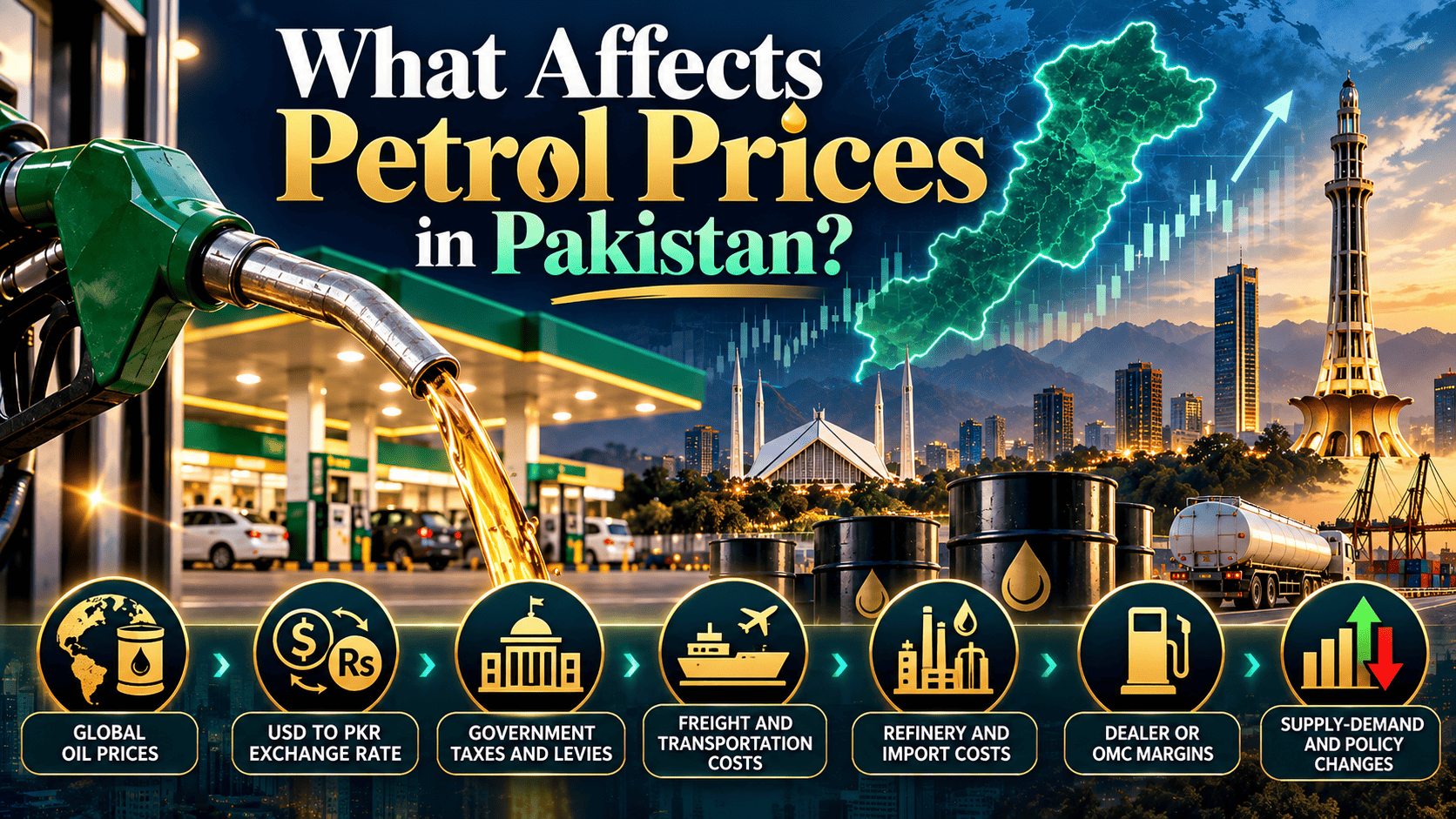
What Affects Petrol Prices in Pakistan?
Petrol prices are closely followed in Pakistan because even a small change in the price per litre can affect household budgets, transportation expenses, delivery costs, business operations, and the broader economy.
When petrol becomes more expensive, many people immediately look at international crude oil prices and ask:
“Oil prices have fallen, so why is petrol still expensive in Pakistan?”
The reason is that the price of petrol in Pakistan does not depend on international crude oil prices alone.
Several factors work together, including international petrol prices, the USD to PKR exchange rate, freight costs, the petroleum levy, oil marketing company margins, dealer margins, taxes and government policy.
Pakistan's pricing framework has also been changing. As of September 2026, the government has described the current mechanism as using a seven-day rolling-average pricing system, while work continues toward a more deregulated petrol market, with June 2027 discussed as a likely target for further petrol deregulation.
Understanding these components makes it much easier to understand why petrol prices rise or fall.
The Main Factors That Affect Petrol Prices
A simplified way to think about Pakistan's petrol price is:
International Petrol Cost + Exchange Rate Effect + Freight + Margins + Petroleum Levy + Applicable Taxes and Charges = Final Petrol Price
Every part of this calculation can change independently.
For example, international petrol prices could fall while the Pakistani rupee weakens against the US dollar.
In that situation, one factor is pushing petrol prices downward while another is pushing them upward.
The final petrol price depends on the combined effect.
1. International Petrol Prices
International petroleum-product prices are one of the biggest factors affecting petrol prices in Pakistan.
Pakistan obtains petroleum products through both local refineries and imports. Because petroleum is part of a global commodity market, international prices strongly influence the underlying cost of petrol.
Suppose the international petrol price increases from:
$80 per barrel
to:
$90 per barrel
The increase is:
$10 per barrel
Percentage increase:
$10 ÷ $80 × 100 = 12.5%
If everything else remained unchanged, this increase would put upward pressure on petrol prices in Pakistan.
However, the final pump price would not necessarily increase by exactly 12.5% because the international product cost is only one component of the final price.
Crude Oil Price and Petrol Price Are Not the Same
People commonly check international crude oil prices when trying to predict petrol prices.
Crude oil is important, but crude oil and petrol are not the same product.
Crude oil is the raw material extracted from the ground.
A refinery processes crude oil into products such as petrol, diesel, kerosene and jet fuel.
Therefore:
Crude Oil Price ≠ Petrol Price
Petrol itself is traded internationally as a refined petroleum product.
International petrol prices can sometimes increase even when crude oil prices remain relatively stable.
Similarly, crude oil may fall while petrol falls by a smaller amount.
Refining Margins Can Affect Petrol Prices
The difference between the price of crude oil and the value of refined petroleum products is influenced partly by refinery economics.
For example, if global refinery capacity becomes tight while demand for petrol remains high, international petrol prices may increase relative to crude oil.
This is why checking only Brent crude or another crude benchmark does not always provide the full picture.
When analysing petrol prices, the price of the refined petrol product is also important.
2. USD to PKR Exchange Rate
The exchange rate is one of the most important factors affecting petrol prices in Pakistan.
International petroleum products are generally priced in US dollars.
Pakistan sells petrol to consumers in Pakistani rupees.
Therefore, the international dollar price must effectively be converted into PKR.
Suppose the international petrol cost is:
$0.75 per litre
If:
1 USD = Rs. 280
then:
0.75 × 280 = Rs. 210
Now suppose the international petrol price remains exactly the same, but USD/PKR increases to:
Rs. 295
Calculation:
0.75 × 295 = Rs. 221.25
Difference:
Rs. 11.25 per litre
Nothing changed in the international dollar price.
But because the Pakistani rupee weakened, the PKR equivalent became more expensive.
Why a Weak Rupee Can Make Petrol More Expensive
Suppose:
1 USD = Rs. 280
and later:
1 USD = Rs. 300
Pakistan now needs more Pakistani rupees to purchase the same amount of dollar-priced petroleum.
Therefore:
Weaker PKR → Higher PKR Import Cost
This can put upward pressure on petrol prices.
Can a Stronger Rupee Reduce Petrol Prices?
Potentially, yes.
Suppose USD/PKR falls from:
Rs. 300
to:
Rs. 280
The same dollar-denominated petrol becomes cheaper when converted into Pakistani rupees.
That creates downward pressure on the domestic cost.
However, the final retail price may still remain unchanged or fall by less if other components increase at the same time.
3. International Oil and Exchange Rates Work Together
International petroleum prices and USD/PKR should usually be analysed together.
Consider this example.
First Period
International petrol:
$0.75 per litre
USD/PKR:
Rs. 280
PKR equivalent:
0.75 × 280 = Rs. 210
Second Period
International petrol falls to:
$0.70 per litre
but USD/PKR rises to:
Rs. 300
Calculation:
0.70 × 300 = Rs. 210
The international petrol price fell by about 6.7%.
But the basic PKR value remained exactly the same because the rupee weakened.
This explains why Pakistan may not always receive the full benefit of lower international oil prices.
4. Import Costs
Pakistan imports petroleum products and also imports crude oil that is processed by domestic refineries.
Importing petroleum involves more than simply paying the international product price.
Depending on the pricing framework and product, costs can involve international freight, insurance, port handling and other import-related expenses.
If shipping costs rise significantly, the landed cost of petrol can increase even if the underlying petroleum price remains unchanged.
Example of Higher Shipping Cost
Suppose the basic international petrol cost is equivalent to:
Rs. 200 per litre
Freight and related costs initially add:
Rs. 4 per litre
Basic landed amount:
Rs. 204
Now imagine freight rises to:
Rs. 8
The amount becomes:
Rs. 208
That represents a Rs. 4 increase even though the petrol commodity price itself did not change.
5. Global Shipping and Supply Routes
Pakistan depends on international shipping routes for a significant portion of its energy imports.
Disruptions affecting major shipping routes can influence:
Freight costs, insurance costs, delivery times and petroleum availability.
For example, geopolitical tensions affecting the Middle East or major shipping routes can increase uncertainty in international energy markets.
In July 2026, Pakistan's Petroleum Division specifically referred to global energy-market uncertainty linked with developments around the Strait of Hormuz while reviewing petroleum pricing.
Even when actual supply continues normally, increased market risk can affect international petroleum prices and transportation costs.
6. Supply and Demand for Petrol
Like other commodities, petroleum prices are affected by demand and supply.
If global demand for petrol increases faster than available supply, prices can rise.
Higher demand may occur during periods of increased:
Travel, economic activity, transportation and seasonal fuel consumption.
Supply disruptions can also increase prices.
For example, refinery shutdowns, production problems, geopolitical conflicts or transportation disruptions can reduce petroleum availability.
7. OPEC+ and Global Oil Production
Major oil-producing countries influence global crude-oil supply.
Production decisions by OPEC and other major producers can affect international oil markets.
If global oil production is reduced while demand remains strong, crude prices may rise.
If production increases or global demand weakens, prices may fall.
These international movements can eventually affect refined petroleum-product costs in Pakistan.
However, there is no fixed formula saying that a 5% move in crude oil will produce exactly a 5% move in Pakistan's petrol price.
8. Pakistan's Petroleum Levy
Another major factor affecting the petrol price is the:
Petroleum Levy
Petroleum levy is a government fiscal charge applied to petroleum products.
It is separate from the international cost of petrol.
Suppose the underlying price before the petroleum levy is:
Rs. 220 per litre
and an illustrative petroleum levy is:
Rs. 60
Then:
220 + 60 = Rs. 280
before any remaining applicable components.
The actual petroleum levy can change according to government policy.
Pakistan's Petroleum Division has continued issuing separate petroleum levy and petroleum-price notifications during 2026, showing that levy decisions remain an important part of the price structure.
Why Does the Government Charge Petroleum Levy?
Petroleum levy is an important source of government revenue.
Its level may be influenced by fiscal and budgetary requirements.
This means international petrol prices can fall while the government changes another component of the domestic price structure.
As a result, consumers may not always receive the entire international price reduction at the petrol pump.
Example
Suppose the international-price effect reduces petrol cost by:
Rs. 8 per litre
but the petroleum levy increases by:
Rs. 5
Net change:
-Rs. 8 + Rs. 5 = -Rs. 3
Instead of petrol falling by Rs. 8, the final reduction might be closer to Rs. 3, assuming all other components remain unchanged.
This is only an example, but it shows why the final petrol-price change can differ from the international movement.
9. Taxes and Government Charges
Government taxes and statutory charges can also influence fuel pricing.
The exact tax structure can change through fiscal policy.
For this reason, it is better to check the current official petroleum price build-up rather than assuming a particular tax percentage applies permanently.
Petroleum pricing is closely linked with government revenue policy because fuel consumption represents a large taxable economic activity.
10. Inland Freight Equalization Margin
Another important component is the:
Inland Freight Equalization Margin (IFEM)
Petroleum products need to be moved from ports, refineries and storage depots to different parts of Pakistan.
Transportation costs naturally differ depending on location.
For example, transporting fuel near Karachi's petroleum infrastructure may have different costs from moving it much farther inland.
The IFEM mechanism is used within Pakistan's petroleum distribution structure to account for certain transportation costs.
OGRA publishes separate IFEM notifications, and its current archive shows repeated IFEM updates throughout September 2026.
Why Can IFEM Change?
IFEM can change because transportation patterns and costs can change.
Factors can include:
Fuel movement, depot locations, transport distances, supply patterns and freight expenses.
The government has also been reviewing how IFEM should operate as the petroleum market moves toward greater deregulation. In September 2026, the Petroleum Pricing Committee agreed on a revised IFEM methodology and said OGRA's FY2026 IFEM audit was expected to be completed by the end of 2026.
11. Oil Marketing Company Margins
Oil Marketing Companies, or OMCs, play an important role between refineries/importers and petrol stations.
They handle activities such as storage, transportation, supply management, distribution and marketing.
Their business costs have to be covered.
Therefore, an OMC margin can form part of the final petroleum-price structure.
Changes to allowable margins or future deregulated pricing arrangements can therefore influence the amount consumers ultimately pay.
12. Petrol Pump Dealer Margin
Petrol stations also need revenue to operate.
A petrol pump has expenses such as:
Employee salaries, electricity, maintenance, safety equipment, property costs, financing and general operating expenses.
The dealer margin helps cover these expenses and provides a business return to the petrol-station operator.
Therefore:
Petrol Station Margin ≠ International Petrol Cost
It is another domestic component of the final price.
13. Local Transportation Costs
Petroleum needs to reach individual petrol stations.
Depending on the location, secondary transportation costs may vary.
A petrol station in a remote location can face different transportation economics from a station located close to a major depot.
As Pakistan moves toward more market-based petroleum pricing, location and company-specific differences may become increasingly relevant.
OGRA's current petroleum-price section includes district/pump-wise pricing alongside notified petroleum prices and detailed price computations.
14. Pakistan's Petrol Pricing System Is Changing
It is important not to describe Pakistan's petrol pricing system using an outdated rule such as:
“Petrol prices always change every 15 days.”
For many years, Pakistan commonly used a fortnightly petroleum-price review.
However, the system has changed significantly during 2026.
In July 2026, the Petroleum Division announced work on a transition from weekly pricing toward a more frequent, market-driven pricing system.
By September 15, 2026, the government described the operative petroleum-pricing mechanism as using a seven-day rolling average.
At the same time, the Petroleum Pricing Committee said on September 3, 2026 that June 2027 was a likely target for further petrol deregulation.
Therefore, Pakistan's petrol-pricing structure should currently be understood as being in a period of transition.
15. Government Petroleum Policy
Petrol prices are not determined only by market movements.
Government policy affects several important components.
Policy decisions can influence:
Petroleum levy, taxes, margins, regulation, deregulation, freight methodology and pricing frequency.
Therefore, a change in government petroleum policy can affect fuel prices even when international markets remain relatively stable.
16. Deregulation
Deregulation means allowing market competition to play a greater role in determining prices rather than having one centrally controlled pricing structure.
Pakistan has been working toward greater petroleum-market deregulation.
The Petroleum Division has said the objective is to improve competition, transparency and market efficiency while protecting consumers from excessive price volatility.
If deregulation progresses, petrol prices could increasingly differ by:
Oil marketing company, location and petrol station.
This is one reason company- and pump-level pricing information is becoming more relevant.
17. Global Political Events
Petroleum is highly sensitive to geopolitical events.
Events involving major oil-producing regions can influence prices very quickly.
Examples can include:
Wars, sanctions, shipping disruptions, instability in oil-producing countries and restrictions on major transportation routes.
These events may affect either actual petroleum supplies or expectations about future supplies.
Markets often respond before a physical shortage actually occurs.
18. The Strait of Hormuz
The Strait of Hormuz is particularly important to global energy markets because large quantities of petroleum move through the region.
Concerns about disruption can affect:
Oil prices, shipping insurance, freight costs and market expectations.
Pakistan's Petroleum Division referred specifically to uncertainty surrounding the Strait of Hormuz during its July 2026 petroleum-pricing discussions.
19. Pakistan's Foreign Exchange Reserves
Foreign-exchange availability can also matter indirectly.
Pakistan needs foreign currencies, particularly US dollars, to pay for petroleum imports.
If foreign-currency availability becomes tight, importing petroleum can become more challenging.
Foreign-exchange reserves therefore matter to the country's overall ability to finance imports.
However, reserve levels do not directly translate into a fixed amount per litre.
Their impact works through broader exchange-rate, financing and import conditions.
20. Inflation
Inflation can also influence various domestic components of petrol distribution.
If operating costs rise, businesses throughout the petroleum supply chain can face higher costs for:
Wages, transportation, electricity, equipment and services.
These changes may eventually affect margins or transportation costs.
Inflation can also influence the PKR exchange rate over longer periods, providing another connection between domestic inflation and imported petroleum costs.
21. Interest Rates and Economic Conditions
Interest rates do not directly determine petrol prices, but they can influence:
The exchange rate, economic activity, financing costs and fuel demand.
For example, slower economic activity may reduce transportation and industrial fuel consumption.
Lower demand can sometimes reduce pressure on petroleum markets.
Conversely, strong economic growth can increase transportation and fuel consumption.
22. Seasonal Demand
Petroleum demand can vary during the year.
Travel patterns, agricultural activity and economic cycles can affect demand for different fuels.
Global petrol demand may also increase during major travel seasons.
Higher international demand can influence refined petroleum-product prices.
Pakistan's domestic demand patterns can affect supply-chain management and petroleum availability as well.
23. Local Refinery Production
Pakistan has domestic refineries.
Higher domestic production can reduce reliance on imported finished petroleum products.
However, this does not mean locally refined petrol is completely disconnected from international prices.
Refineries may use imported crude oil, and petroleum-product pricing has historically remained closely connected with international and import-parity economics.
Therefore:
Locally Refined Petrol ≠ Petrol Completely Independent of Global Prices
24. Refinery Shutdowns and Maintenance
Refineries periodically require maintenance.
If a major refinery reduces production temporarily, Pakistan may need to obtain more fuel from other sources or increase imports.
This can change supply patterns and potentially influence:
Import requirements, freight costs and domestic product availability.
Similarly, stronger domestic refinery output can reduce pressure on imported finished-product requirements.
25. Fuel Inventories
Oil marketing companies maintain petroleum inventories.
Adequate stocks can help the market continue operating during temporary supply disruptions.
Low inventories can make the market more sensitive to disruptions.
The Petroleum Pricing Committee has also emphasized the importance of maintaining adequate fuel reserves as Pakistan considers a more deregulated market.
Why Petrol Prices Can Rise Even When Crude Oil Falls
Consider this simplified example.
International petroleum price effect:
-Rs. 10 per litre
PKR depreciation effect:
+Rs. 6
Higher freight:
+Rs. 1
Higher levy:
+Rs. 4
Total:
-10 + 6 + 1 + 4 = +Rs. 1
Despite international prices falling, the final price in this example actually increases by Rs. 1.
This is why looking only at a crude-oil chart can give an incomplete picture.
Why Petrol Prices Can Fall Even When Crude Oil Is Stable
Now consider another example.
International price effect:
Rs. 0
PKR appreciation:
-Rs. 5
Lower freight:
-Rs. 1
Lower levy:
-Rs. 4
Total:
-Rs. 10
Petrol could fall by approximately Rs. 10 even though international crude oil prices remained unchanged.
Again, the example is simplified, but it demonstrates how the different components interact.
How Much Does a Petrol Price Change Affect a Driver?
Suppose your car consumes:
100 litres per month
and petrol rises by:
Rs. 5 per litre
Additional monthly cost:
100 × 5 = Rs. 500
If petrol rises by:
Rs. 20 per litre
Additional cost:
100 × 20 = Rs. 2,000 per month
For someone using:
200 litres
a Rs. 20 increase means:
200 × 20 = Rs. 4,000
additional monthly fuel expenditure.
How Petrol Prices Affect Transportation
Higher petrol prices can increase the operating costs of:
Cars, motorcycles, taxis, ride-hailing vehicles, delivery riders and small commercial vehicles.
Businesses that rely heavily on transportation may need to absorb these additional costs or pass some of them to customers.
The effect depends on the type of business and how much fuel it uses.
Petrol Prices and Delivery Costs
Imagine a delivery business uses:
1,000 litres of petrol per month
If petrol rises by:
Rs. 10 per litre
additional monthly cost:
1,000 × 10 = Rs. 10,000
If several operating costs increase simultaneously, the business may eventually adjust delivery charges.
Petrol Prices and Inflation
Higher petrol prices can contribute to inflation through transportation and distribution costs.
However, petrol is only one part of inflation.
Prices can also be affected by:
Food supply, electricity, gas, wages, exchange rates, taxes, imports and monetary conditions.
It would therefore be inaccurate to attribute all inflation to petrol prices alone.
Petrol vs High-Speed Diesel
Petrol and High-Speed Diesel are separate petroleum products.
Petrol is commonly used in:
Motorcycles and passenger cars
while HSD is especially important for:
Trucks, buses, agriculture, heavy vehicles and commercial transportation.
Their international prices can move differently.
Their freight and policy components may also differ.
Therefore, petrol and HSD do not necessarily rise or fall by the same amount.
Why a Rs. 10 Fall in Oil Does Not Mean Rs. 10 Cheaper Petrol
Suppose someone reads that the international oil price has fallen by an amount equivalent to Rs. 10 per litre.
It may be tempting to expect:
Petrol Price - Rs. 10
But the retail price includes several components.
If the international component represents only part of the final price and other costs change, the final reduction could be smaller.
Therefore:
International Change ≠ Automatic Identical Pump-Price Change
What Should You Check When Petrol Prices Change?
To understand a petrol-price movement properly, compare several factors rather than only one.
A useful analysis would examine:
| Factor | Effect to Watch |
|---|---|
| International petrol price | Higher price can increase domestic cost |
| International crude oil | Influences petroleum-product costs |
| USD/PKR | Weaker PKR can increase import cost |
| Petroleum levy | Higher levy can increase final price |
| Taxes | Changes can affect retail price |
| Freight/IFEM | Transportation costs affect price |
| OMC margin | Part of distribution cost |
| Dealer margin | Part of retail cost |
| Refinery/import supply | Can affect underlying cost |
| Government policy | Can change pricing structure |
Looking at these factors together gives a much more accurate explanation.
Where Can You Check Official Petrol Prices?
Pakistan's Oil and Gas Regulatory Authority publishes petroleum-pricing information including:
Notified petroleum prices, IFEM notifications, detailed ex-depot computations and district/pump-wise prices.
Its current petroleum-price archive contains multiple effective-date notifications during September 2026, reflecting the country's more frequent pricing framework.
When checking a petrol price, always pay attention to:
Fuel type, effective date, oil marketing company and location where relevant.
Why the Effective Date Matters
Petrol-price information can become outdated quickly.
For example, OGRA's current archive lists notified petroleum-price changes effective on:
September 5, September 12 and September 19, 2026, among other recent dates.
Therefore, simply searching for “petrol price Pakistan” without checking when the number became effective can lead to outdated information.
Common Misunderstandings About Petrol Prices
Petrol Depends Only on Crude Oil
Not correct.
Crude oil is an important factor, but international petrol prices, USD/PKR, freight, levies, margins and policy also matter.
If International Oil Falls, Petrol Must Fall Immediately
Not necessarily.
Other price components may move in the opposite direction.
The Government Can Set Any Price Without Considering Markets
Pakistan's pricing framework uses market-related petroleum costs and a formula-based mechanism, while government decisions affect fiscal and regulatory components. The framework itself is currently undergoing reform.
Petrol Prices Still Change Only Every 15 Days
That description is outdated for the current 2026 framework. The government has moved to a seven-day rolling-average system while continuing work toward greater deregulation.
Every Petrol Pump Will Always Have Exactly the Same Price
This may become increasingly less accurate as Pakistan transitions toward more competitive and deregulated pricing, with OGRA already publishing district/pump-wise information.
Frequently Asked Questions
What is the biggest factor affecting petrol prices in Pakistan?
International petroleum-product prices and USD to PKR are two of the largest underlying factors.
However, petroleum levy, freight, margins, taxes and government policy also affect the final price.
Why does USD to PKR affect petrol prices?
Petroleum products are generally priced internationally in US dollars.
When PKR weakens, more rupees are required to purchase the same amount of dollar-priced fuel.
Why does petrol sometimes become expensive when crude oil falls?
Because crude oil is only one factor.
The rupee may weaken, freight may rise, international petrol prices may behave differently from crude oil, or domestic levies and other components may increase.
Can a stronger Pakistani rupee reduce petrol prices?
A stronger rupee reduces the PKR equivalent of dollar-denominated petroleum and can therefore create downward pressure on petrol prices.
The final price still depends on all other components.
What is petroleum levy?
Petroleum levy is a government fiscal charge applied to petroleum products.
It forms part of the domestic price structure and can change according to government policy.
What is IFEM?
IFEM stands for:
Inland Freight Equalization Margin
It relates to certain transportation costs involved in moving petroleum products within Pakistan.
What is an OMC?
OMC stands for:
Oil Marketing Company
These companies distribute petroleum products and supply petrol stations.
Does international crude oil directly determine Pakistan's petrol rate?
No.
Crude oil influences petroleum markets, but petrol is itself a refined product with its own international price.
The final Pakistani price also includes domestic components.
Does Pakistan import petrol?
Pakistan uses a combination of imported petroleum products and products produced by domestic refineries.
Domestic refineries can also use imported crude oil.
Can geopolitics increase petrol prices?
Yes.
Conflict or disruption involving major oil-producing regions or shipping routes can influence global oil prices, freight costs, insurance costs and supply expectations.
Does the government still revise petrol every 15 days?
Pakistan's pricing system changed during 2026. As of September 2026, the government has described the current pricing mechanism as based on a seven-day rolling average, while broader deregulation reforms continue.
Is petrol going to become fully deregulated?
The government's Petroleum Pricing Committee said in September 2026 that June 2027 was a likely target for petrol deregulation, but this remains part of an ongoing reform process and can change before implementation.
Where can I check official petrol prices?
OGRA publishes notified petroleum prices, IFEM information, detailed price calculations and district/pump-wise petroleum-price data.
Conclusion
Petrol prices in Pakistan are affected by several factors working together.
The most important are:
International petroleum prices
USD to PKR exchange rate
Petroleum levy
Freight and IFEM
Oil marketing company margin
Dealer margin
Applicable taxes and government charges
Government petroleum policy
The international oil market provides an important starting point, but it does not determine the final pump price by itself.
For example:
International oil may fall while PKR weakens
or:
International oil may rise while PKR strengthens
In both situations, the final effect depends on which factor is stronger and what happens to domestic levies, freight and margins.
This is why the best way to understand a petrol-price change is not simply to ask:
“Did crude oil rise or fall?”
Instead, check:
International petrol prices + USD/PKR + petroleum levy + freight + margins + current pricing policy
together.
Pakistan's petroleum-pricing system is also currently changing. As of September 2026, the government is using a seven-day rolling-average mechanism while continuing work toward greater market-based pricing and potential petrol deregulation around June 2027.
Understanding these different factors provides a much clearer picture of why petrol prices change in Pakistan.
Disclaimer: Petrol prices, international petroleum prices, crude-oil prices, foreign exchange rates, petroleum levies, taxes, margins, freight charges and government pricing policies can change frequently. Calculations and figures used in this article are for educational purposes and examples only and should not be treated as current official petrol prices unless specifically stated. Always check the latest applicable petrol price, effective date and official notifications from OGRA or the Government of Pakistan before making a financial or business decision.