
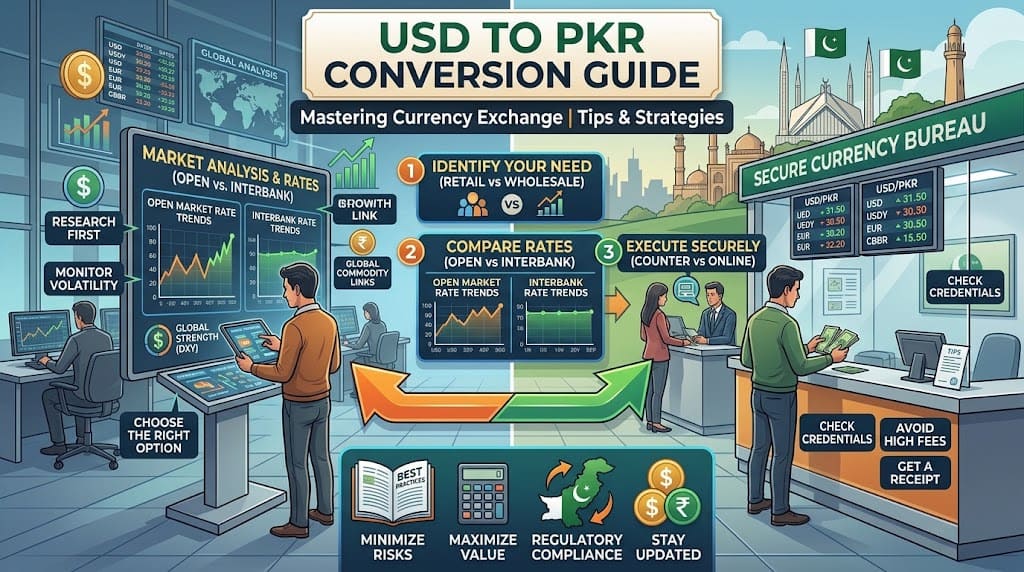
USD to PKR Conversion Guide
The US Dollar to Pakistani Rupee (USD to PKR) exchange rate is one of the most closely followed currency rates in Pakistan.
People use USD to PKR conversion for many different purposes, including:
- Receiving overseas remittances
- Freelance income
- International business payments
- Imports and exports
- Foreign travel
- Overseas education
- Online subscriptions
- International shopping
- Credit and debit card transactions
- Comparing international prices
At first, converting US dollars into Pakistani rupees appears simple.
If:
1 USD = Rs. 280
then:
USD 100 × Rs. 280 = Rs. 28,000
However, actual currency conversion can be more complicated because there is not always one single USD to PKR rate.
You may see different rates for:
- Interbank market
- Open market
- Bank customers
- Physical currency
- Telegraphic transfers
- Remittances
- Credit or debit cards
You may also see separate:
Buying Rate
and:
Selling Rate
Understanding these differences can help you calculate USD to PKR more accurately and understand why the amount you receive from a bank or exchange company may differ from the result shown by an online currency converter.
What Does USD to PKR Mean?
USD stands for:
United States Dollar
PKR stands for:
Pakistani Rupee
USD/PKR tells you how many Pakistani rupees are required for one US dollar.
For example:
USD/PKR = 280
means:
1 US Dollar = 280 Pakistani Rupees
Therefore:
USD 10 = Rs. 2,800
USD 100 = Rs. 28,000
USD 1,000 = Rs. 280,000
The exact value depends on the exchange rate being used.
How to Convert USD to PKR
The basic formula is:
USD Amount × USD to PKR Exchange Rate = PKR Amount
For example, suppose:
USD Amount = $500
and:
Exchange Rate = Rs. 280 per USD
Calculation:
500 × 280 = 140,000
Therefore:
USD 500 = approximately Rs. 140,000
at that example exchange rate.
USD to PKR Conversion Examples
Suppose the exchange rate is:
1 USD = Rs. 280
The following examples show how conversion works:
| USD Amount | PKR Value |
|---|---|
| $1 | Rs. 280 |
| $5 | Rs. 1,400 |
| $10 | Rs. 2,800 |
| $20 | Rs. 5,600 |
| $50 | Rs. 14,000 |
| $100 | Rs. 28,000 |
| $500 | Rs. 140,000 |
| $1,000 | Rs. 280,000 |
| $5,000 | Rs. 1,400,000 |
| $10,000 | Rs. 2,800,000 |
These are example calculations only. The actual USD to PKR exchange rate can change.
How to Convert PKR to USD
You can also convert Pakistani rupees back into US dollars.
Use:
PKR Amount ÷ USD/PKR Rate = USD Amount
For example:
PKR Amount = Rs. 280,000
Exchange rate:
Rs. 280 per USD
Calculation:
280,000 ÷ 280 = 1,000
Therefore:
Rs. 280,000 = approximately USD 1,000
at that example rate.
PKR to USD Conversion Examples
Using:
1 USD = Rs. 280
| PKR Amount | Approximate USD |
|---|---|
| Rs. 1,000 | $3.57 |
| Rs. 5,000 | $17.86 |
| Rs. 10,000 | $35.71 |
| Rs. 25,000 | $89.29 |
| Rs. 50,000 | $178.57 |
| Rs. 100,000 | $357.14 |
| Rs. 280,000 | $1,000 |
| Rs. 500,000 | $1,785.71 |
| Rs. 1,000,000 | $3,571.43 |
Again, these figures are examples based on the assumed rate of Rs. 280 per US dollar.
Why Is There More Than One USD to PKR Rate?
This is one of the most important things to understand about currency conversion.
You might see:
Interbank Rate: Rs. 280
Open Market Buying Rate: Rs. 281
Open Market Selling Rate: Rs. 283
A bank may display another customer rate.
An online financial website may display a different reference rate.
These numbers can all be different because they relate to different types of transactions.
Pakistan operates a market-based flexible exchange-rate system, under which exchange rates are primarily determined by demand and supply conditions in the foreign-exchange market. Authorized dealers in the interbank market can quote their own buying and selling rates.
What Is the USD to PKR Interbank Rate?
The interbank rate refers to foreign-exchange pricing in the banking market.
It is particularly relevant for transactions involving banks and authorized foreign-exchange dealers.
Interbank foreign-exchange activity may be connected with:
- Imports
- Exports
- Corporate payments
- International settlements
- Foreign investment
- Commercial transactions
- Other banking-related foreign-currency transactions
According to the State Bank of Pakistan, authorized dealers participating in the interbank market are free to quote their own buying and selling exchange rates.
The interbank USD to PKR rate is therefore an important market reference.
However, this does not necessarily mean an individual customer will receive exactly the headline interbank rate from a bank.
What Is the USD to PKR Open Market Rate?
The open-market rate generally refers to USD buying and selling rates available through authorized currency exchange companies.
This is particularly relevant for people exchanging physical currency.
For example, if you have US dollar notes and want Pakistani rupees, you may visit an exchange company.
Similarly, if you are travelling abroad and want to purchase physical dollars, the exchange company's selling rate may apply.
The State Bank of Pakistan publishes open-market closing exchange-rate information as part of its foreign-exchange market data.
Buying Rate vs Selling Rate
When looking at USD to PKR rates, you will usually see two prices:
Buying Rate
and:
Selling Rate
Understanding which one applies to you is essential.
USD Buying Rate
The buying rate is the rate at which a bank or exchange company buys US dollars from you.
If you have dollars and want Pakistani rupees:
Use the USD buying rate.
USD Selling Rate
The selling rate is the rate at which a bank or exchange company sells US dollars to you.
If you have Pakistani rupees and want to purchase dollars:
Use the USD selling rate.
Simple Buying and Selling Example
Suppose an exchange company shows:
USD Buying: Rs. 280
USD Selling: Rs. 282
If You Sell USD 1,000
The company buys your dollars at:
Rs. 280
Calculation:
1,000 × 280 = Rs. 280,000
You would receive approximately:
Rs. 280,000
If You Buy USD 1,000
The company sells you the dollars at:
Rs. 282
Calculation:
1,000 × 282 = Rs. 282,000
You would need approximately:
Rs. 282,000
before considering any other applicable charges.
Why Are Buying and Selling Rates Different?
The difference between buying and selling rates is called the:
Spread
Formula:
Spread = Selling Rate - Buying Rate
Using the previous example:
Rs. 282 - Rs. 280 = Rs. 2
Therefore:
Spread = Rs. 2 per USD
This spread helps financial institutions and currency dealers cover costs and manage risks associated with currency trading.
How Much Difference Can the Spread Make?
The effect becomes more noticeable when exchanging larger amounts.
Suppose:
Buying Rate = Rs. 280
Selling Rate = Rs. 282
Difference:
Rs. 2 per dollar
For:
USD 100
Difference:
100 × 2 = Rs. 200
For:
USD 1,000
Difference:
1,000 × 2 = Rs. 2,000
For:
USD 10,000
Difference:
10,000 × 2 = Rs. 20,000
This is why even a relatively small rate difference can matter when converting a large amount.
How to Calculate USD to PKR Using the Buying Rate
Suppose you have:
USD 2,000
and want to sell it.
The buying rate is:
Rs. 280
Use:
USD Amount × Buying Rate
Calculation:
2,000 × 280 = Rs. 560,000
Therefore, you would receive approximately:
Rs. 560,000
before any applicable charges.
How to Calculate USD to PKR Using the Selling Rate
Suppose you want to purchase:
USD 2,000
Selling rate:
Rs. 282
Calculation:
2,000 × 282 = Rs. 564,000
Therefore, you would need approximately:
Rs. 564,000
before other applicable charges.
Which USD Rate Should You Use?
The correct rate depends on what you are doing.
| Transaction | Rate to Check |
|---|---|
| Selling physical USD | Buying Rate |
| Buying physical USD | Selling Rate |
| Receiving bank remittance | Bank/remittance conversion rate |
| Sending money abroad | Provider's selling/conversion rate |
| Import payment | Bank's applicable FX rate |
| International card purchase | Bank/card provider conversion rate |
| Comparing market movement | Interbank/reference rate |
| Exchanging cash | Open-market rate |
Using the wrong rate can produce an inaccurate estimate.
Example: Selling Dollars After Travelling
Suppose you return to Pakistan with:
USD 750
An exchange company offers:
USD Buying Rate = Rs. 280
Calculation:
750 × 280
= Rs. 210,000
Therefore, your USD 750 would be worth approximately:
Rs. 210,000
at that example buying rate.
Example: Buying Dollars for Travel
Suppose you are travelling abroad and want:
USD 2,500
Exchange-company selling rate:
Rs. 282
Calculation:
2,500 × 282
= Rs. 705,000
You would therefore need approximately:
Rs. 705,000
before any applicable charges.
USD to PKR for Overseas Remittances
Remittances are another common reason people convert USD into PKR.
Suppose a family member sends:
USD 1,000
from the United States.
If the remittance provider uses:
Rs. 280 per USD
the basic conversion would be:
1,000 × 280
= Rs. 280,000
However, the amount actually received may depend on:
- Remittance provider
- Sending bank
- Receiving bank
- Conversion rate
- Transfer method
- Fees and charges
- Timing of conversion
For this reason, the open-market USD rate should not automatically be used to estimate a bank remittance.
USD to PKR for Freelancers
Many Pakistani freelancers and remote workers earn income in US dollars.
Suppose you earn:
USD 1,500
If the applicable conversion rate is:
Rs. 280
then:
1,500 × 280
= Rs. 420,000
If the applicable conversion rate later becomes:
Rs. 285
then:
1,500 × 285
= Rs. 427,500
Difference:
Rs. 7,500
The amount ultimately credited to your account can depend on the payment service, bank conversion rate, charges, and withdrawal method.
USD to PKR for International Online Purchases
Suppose an international website charges:
USD 100
and the USD/PKR reference rate is:
Rs. 280
The basic converted amount would be:
100 × 280 = Rs. 28,000
However, Rs. 28,000 may not be the final amount deducted from your card.
Your bank or card provider may apply:
- Its own exchange rate
- Foreign transaction charges
- Card network conversion
- Applicable taxes
- Other fees
Therefore, the final amount may be higher than the simple USD × PKR calculation.
USD to PKR for Software Subscriptions
The same issue applies to subscriptions such as:
- Web hosting
- Cloud services
- Development tools
- Design software
- SaaS applications
- Streaming platforms
- International digital services
Suppose your subscription is:
USD 50 per month
At:
Rs. 280 per USD
the basic conversion is:
50 × 280 = Rs. 14,000
But the actual card charge may differ because of banking charges and the exchange rate applied at settlement.
USD to PKR for Importers
Businesses importing goods into Pakistan commonly need foreign currency to pay overseas suppliers.
Suppose an importer needs to pay:
USD 25,000
The bank quotes:
Rs. 281 per USD
Calculation:
25,000 × 281
= Rs. 7,025,000
Therefore, the foreign-currency value is approximately:
Rs. 7.025 million
Additional banking and transaction charges may apply.
Importers should therefore use the actual quotation provided by their bank rather than simply using an online open-market rate.
USD to PKR for Exporters
Suppose a Pakistani exporter receives:
USD 50,000
and the applicable customer conversion rate is:
Rs. 280
Calculation:
50,000 × 280
= Rs. 14,000,000
The approximate PKR equivalent would be:
Rs. 14 million
before considering applicable banking arrangements and charges.
What Is the Bank Customer Exchange Rate?
A bank may apply a specific rate when buying or selling foreign currency for a customer.
For example:
Market reference: Rs. 280
Bank customer buying rate:
Rs. 279.50
Bank customer selling rate:
Rs. 281.00
The State Bank of Pakistan publishes Weighted Average Customer Exchange Rates, providing market information based on customer transactions.
Your individual bank's rate can still differ from the published weighted average.
What Is a TT Rate?
TT generally stands for:
Telegraphic Transfer
Today, the term is commonly used for electronic foreign-currency transfer rates offered by banks.
You may see:
TT Buying Rate
and:
TT Selling Rate
A TT buying rate may be relevant when foreign currency is being converted into Pakistani rupees.
A TT selling rate may be relevant when a customer needs foreign currency for an outgoing international payment.
The exact rate and application depend on the bank and transaction.
TT Rate vs Cash Rate
A USD cash rate does not necessarily equal a USD TT rate.
For example:
USD Cash Buying = Rs. 279
USD TT Buying = Rs. 280
Why can they differ?
Physical cash involves:
- Currency note handling
- Transportation
- Security
- Currency inventory
- Other operational costs
Electronic transfers have different settlement and operational arrangements.
Therefore, always use the rate that matches the type of transaction.
Why Is Google's USD to PKR Rate Different?
Many people search:
1 USD to PKR
on Google and then compare the result with their bank or an exchange company.
The numbers may be different.
This does not necessarily mean one of them is incorrect.
An online financial platform may show a:
- Reference rate
- Market-derived rate
- Mid-market rate
while an exchange company shows:
- Cash buying rate
- Cash selling rate
and a bank may show:
- TT buying rate
- TT selling rate
- Customer rate
For example:
Online Reference: Rs. 280
Exchange Buying: Rs. 279
Exchange Selling: Rs. 282
These rates serve different purposes.
What Is the Mid-Market USD to PKR Rate?
A mid-market rate is approximately the midpoint between a buying and selling quotation.
Suppose:
Buying = Rs. 279
Selling = Rs. 281
Midpoint:
(279 + 281) ÷ 2
= Rs. 280
The mid-market rate can be useful as a reference.
However, customers generally cannot expect to buy and sell physical dollars at exactly the midpoint.
Why Does USD to PKR Change?
USD to PKR changes mainly because foreign-currency demand and supply change.
Some of the important factors include:
- Imports
- Exports
- Remittances
- Foreign investment
- External debt payments
- Foreign-exchange reserves
- International oil prices
- Inflation
- Interest rates
- Global US dollar movements
- Market expectations
- Official foreign-currency inflows
Pakistan's exchange-rate framework is market-based and flexible, meaning foreign-exchange demand and supply play the central role in determining the exchange rate.
Imports and USD Demand
Pakistan imports many goods that have to be paid for in foreign currency.
Examples include:
- Petroleum products
- Machinery
- Electronics
- Chemicals
- Raw materials
- Medical equipment
If importers require more US dollars, foreign-currency demand can increase.
Higher dollar demand, if not matched by additional supply, can put upward pressure on USD/PKR.
Exports and USD Supply
Exports bring foreign currency into Pakistan.
Pakistani exporters receive foreign currency for products and services such as:
- Textiles
- Rice
- Sports goods
- Surgical instruments
- IT services
- Leather products
Stronger export receipts can contribute to foreign-currency supply.
Remittances and USD Supply
Money sent home by overseas Pakistanis is an important source of foreign exchange.
When foreign currency enters Pakistan through formal remittance channels, it contributes to foreign-currency availability.
Higher remittance flows can therefore help support the country's external foreign-exchange position.
Foreign Exchange Reserves
Foreign exchange reserves are also closely watched.
The State Bank of Pakistan is responsible for managing the country's foreign-exchange reserves.
Reserve levels matter because foreign currency is needed for:
- External debt payments
- International obligations
- Other foreign-currency requirements
However, reserves are only one factor affecting USD/PKR.
Does a Higher USD/PKR Mean the Rupee Is Weaker?
Yes, when comparing the same currency pair.
For example:
Before:
1 USD = Rs. 280
Later:
1 USD = Rs. 290
You now need more PKR to purchase the same one US dollar.
Therefore:
PKR has depreciated against USD.
What Does Rupee Appreciation Mean?
Suppose USD/PKR changes from:
Rs. 290
to:
Rs. 280
You now need fewer rupees to buy one US dollar.
Therefore:
PKR has appreciated against USD.
How to Calculate a Change in USD to PKR
Suppose the rate changes from:
Rs. 280
to:
Rs. 285
Difference:
285 - 280 = Rs. 5
The dollar has become Rs. 5 more expensive in this example.
To calculate the percentage change:
(New Rate - Old Rate) ÷ Old Rate × 100
So:
(285 - 280) ÷ 280 × 100
= approximately:
1.79%
USD/PKR has therefore increased by approximately 1.79%.
How a USD Rate Change Affects Your Conversion
Suppose you have:
USD 10,000
At:
Rs. 280
your conversion is:
10,000 × 280 = Rs. 2,800,000
At:
Rs. 285
your conversion becomes:
10,000 × 285 = Rs. 2,850,000
Difference:
Rs. 50,000
A movement of only Rs. 5 per dollar creates a Rs. 50,000 difference when converting USD 10,000.
How USD to PKR Affects Imported Goods
Suppose a product imported into Pakistan costs:
USD 5,000
At:
Rs. 280/USD
basic PKR cost:
5,000 × 280 = Rs. 1,400,000
If USD/PKR increases to:
Rs. 290
the same product becomes:
5,000 × 290 = Rs. 1,450,000
Difference:
Rs. 50,000
This is before considering:
- Shipping
- Customs duties
- Taxes
- Dealer margin
- Transportation
- Other expenses
How USD to PKR Can Affect Gold Prices
International gold prices are generally quoted in US dollars.
Therefore, calculating an international gold price in Pakistani rupees requires converting the dollar value into PKR.
If international gold remains at the same USD price but USD/PKR rises, the theoretical PKR value of gold can also increase.
This is one reason Pakistan gold prices can move even when the international gold price itself changes only slightly.
How USD to PKR Can Affect Silver Prices
International silver is also commonly quoted in US dollars.
Therefore, local silver calculations can be influenced by:
- International silver price
- USD to PKR rate
- Local market conditions
- Dealer premium
A change in USD/PKR can affect the calculated Pakistani rupee value of silver.
USD to PKR for Overseas Education
Suppose annual university tuition costs:
USD 20,000
At:
Rs. 280
the PKR equivalent is:
20,000 × 280 = Rs. 5,600,000
If USD/PKR rises to:
Rs. 290
the same tuition becomes:
20,000 × 290 = Rs. 5,800,000
Difference:
Rs. 200,000
The university has not changed its USD fee, but the PKR cost has increased because the exchange rate changed.
USD to PKR for Foreign Travel
Suppose your travel budget is:
USD 3,000
At Rs. 280:
3,000 × 280 = Rs. 840,000
At Rs. 290:
3,000 × 290 = Rs. 870,000
Difference:
Rs. 30,000
Therefore, exchange-rate changes can significantly affect international travel budgets.
Why Does the USD Rate Change During the Day?
Currency markets continuously process transactions.
During the day:
- Importers may purchase dollars
- Exporters may sell foreign-currency proceeds
- Banks may process commercial payments
- Remittances may enter the banking system
- Investors may move funds
- Large corporate transactions may occur
As market demand and supply change, exchange quotations can also move.
SBP's data calendar indicates that several foreign-exchange datasets, including weighted-average exchange rates and open-market closing rates, are published on a daily basis.
Why Do Different Websites Show Different USD Rates?
Different websites may use different sources.
One may show:
Interbank rate
another:
Open-market rate
another:
Mid-market reference
and another:
Previous closing rate
Differences can also result from update timing.
For example, one website may update every few minutes while another may still show an earlier rate.
Therefore, whenever comparing USD/PKR values, check:
- Source
- Rate type
- Update time
- Buying or selling
- Interbank or open market
How to Read a USD to PKR Rate Page
A useful USD to PKR rate page should clearly show:
USD Buying Rate
USD Selling Rate
It may also show:
- Current rate
- Previous rate
- Daily change
- Percentage change
- Last updated time
- Open-market rate
- Interbank rate
- Conversion calculator
This allows users to understand exactly what they are looking at rather than seeing only one unexplained number.
Simple USD to PKR Calculator Formula
If you are building or using a USD to PKR converter, the core formula is:
PKR = USD × Exchange Rate
For example:
USD = 250
Exchange Rate = 280
Calculation:
250 × 280
= Rs. 70,000
For the reverse conversion:
USD = PKR ÷ Exchange Rate
For:
PKR = 70,000
and:
Rate = 280
Calculation:
70,000 ÷ 280
= USD 250
Should a USD to PKR Calculator Use Buying or Selling Rate?
Ideally, the calculator should allow the user to choose.
For example:
I am selling USD
→ Use buying rate
I am buying USD
→ Use selling rate
A general reference converter may use a market or midpoint rate, but it should clearly label the rate being used.
This helps prevent users from assuming the result is a guaranteed transaction price.
Example of a Better Currency Converter
Suppose a user enters:
USD 1,000
Your converter could display:
Using Buying Rate
Rs. 280 × $1,000
= Rs. 280,000
Using Selling Rate
Rs. 282 × $1,000
= Rs. 282,000
Difference
= Rs. 2,000
This is more informative than showing only one conversion figure.
Common USD to PKR Conversion Mistakes
Using the Wrong Buying or Selling Rate
If you are selling dollars, use the buying rate.
If you are buying dollars, use the selling rate.
Assuming Online Rates Are Guaranteed
The final rate offered by a bank or exchange company may differ.
Ignoring Fees
International transfers, cards, and remittance services may charge additional fees.
Mixing Interbank and Open-Market Rates
These rates represent different parts of the foreign-exchange market.
Using an Old Exchange Rate
USD/PKR can change during the day.
Check when the rate was last updated.
Comparing Different Rate Sources Without Checking Their Type
One source may show a mid-market rate while another shows an open-market selling rate.
They should not be compared as if they are identical.
Frequently Asked Questions
How do I convert USD to PKR?
Multiply your US dollar amount by the applicable USD to PKR exchange rate.
USD × Exchange Rate = PKR
For example:
$100 × Rs. 280 = Rs. 28,000
How do I convert PKR to USD?
Divide your Pakistani rupee amount by the USD to PKR rate.
PKR ÷ Exchange Rate = USD
For example:
Rs. 28,000 ÷ 280 = USD 100
Which rate should I use when selling US dollars?
If you are selling physical USD to an exchange company, check its USD buying rate.
Which rate should I use when buying US dollars?
If you are purchasing USD from an exchange company, check its USD selling rate.
Why is USD buying lower than USD selling?
The difference is known as the spread.
The spread helps the bank or exchange company cover operating costs, market risks, and business margins.
Is the interbank rate the same as the open-market rate?
No.
The interbank rate relates to the banking foreign-exchange market, while the open-market rate generally refers to currency exchange through exchange companies.
Is Google's USD to PKR rate the rate I will get?
Not necessarily.
Google or another financial website may display a reference or market-derived rate. Banks and exchange companies may quote separate buying and selling rates.
Why does USD to PKR change?
The exchange rate changes as demand and supply for foreign currency change.
Factors can include imports, exports, remittances, foreign investment, debt repayments, reserves, global dollar movements, and market expectations.
Can USD to PKR change during the same day?
Yes.
Foreign-exchange quotations can move during the day as market demand and supply change.
Why does my bank give a different USD rate?
Banks can apply their own customer buying and selling rates, spreads, and transaction charges.
Why is my credit card conversion different from the online USD rate?
Card transactions may involve a card-network conversion rate, bank rate, foreign transaction charges, taxes, and other applicable fees.
Which rate applies to remittances?
The relevant rate is generally the conversion rate offered by the remittance provider or receiving bank.
Where can official foreign-exchange market data be checked?
The State Bank of Pakistan publishes multiple foreign-exchange datasets, including weighted-average customer exchange rates, mark-to-market rates, conversion rates, and open-market closing rates.
Conclusion
Converting USD to PKR is mathematically simple:
USD Amount × USD/PKR Rate = Pakistani Rupees
For example:
USD 1,000 × Rs. 280 = Rs. 280,000
But choosing the correct exchange rate is just as important as the calculation itself.
You may encounter:
- Interbank rates
- Open-market rates
- Buying rates
- Selling rates
- Bank customer rates
- TT rates
- Remittance rates
- Card conversion rates
The easiest rule to remember for physical currency is:
Selling USD → Check the buying rate
Buying USD → Check the selling rate
For bank transfers, remittances, international card purchases, imports, exports, and other transactions, use the actual exchange rate and charges provided by the financial institution handling your transaction.
Also remember that USD to PKR can change throughout the day. Always check the latest applicable rate and make sure you know whether the number you are using represents a buying rate, selling rate, interbank rate, open-market rate, or another reference rate.
Disclaimer: Foreign exchange rates can change frequently and may vary between banks, exchange companies, remittance providers, card issuers, and other financial institutions. Calculations, exchange rates, and figures used in this article are for educational purposes and examples only. Actual buying and selling rates, spreads, fees, taxes, and other charges may differ depending on market conditions and the service provider. Always check the latest applicable exchange rate before buying, selling, transferring, converting currency, or making a financial decision.