
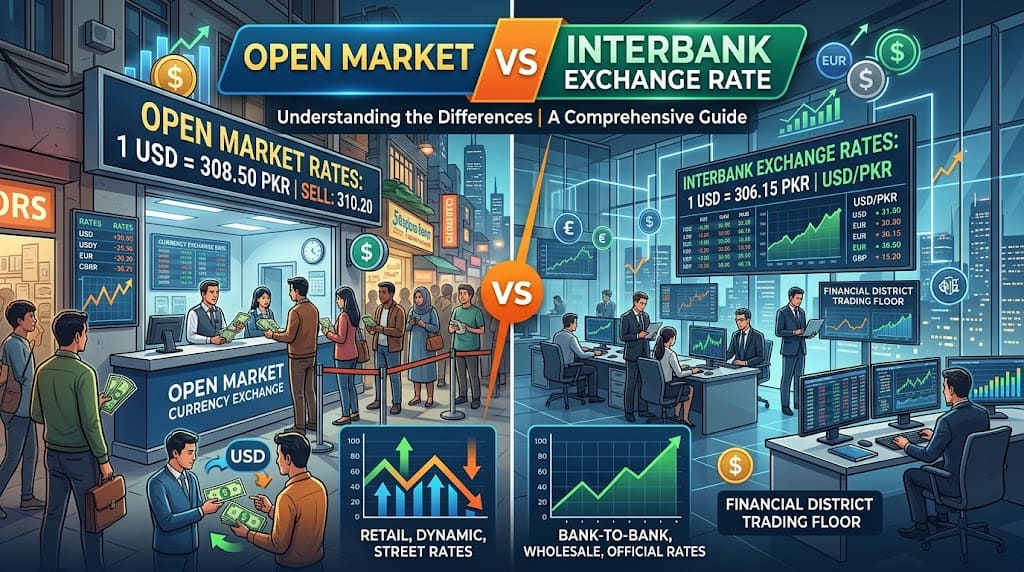
Open Market vs Interbank Exchange Rate
If you regularly check currency rates in Pakistan, you may notice that the US Dollar to Pakistani Rupee (USD/PKR) rate is not always the same everywhere.
A bank may show one rate, a currency exchange company may display another, and financial websites may publish something called the interbank rate.
This often creates a simple question:
Why are there different exchange rates for the same currency?
The main reason is that Pakistan's foreign exchange market operates through different channels. Two of the most commonly discussed rates are:
- Interbank exchange rate
- Open market exchange rate
The interbank market mainly involves banks and authorized dealers dealing in foreign currency, while the open market is more relevant when individuals buy or sell physical foreign currency through exchange companies.
Pakistan currently operates a market-based flexible exchange-rate system, where exchange rates are influenced by demand and supply conditions. The State Bank of Pakistan (SBP) also publishes various foreign-exchange market datasets, including weighted-average customer rates and open-market closing rates.
Understanding the difference between these rates is important when exchanging cash, receiving remittances, making international payments, importing goods, or simply following the value of the Pakistani rupee.
What Is an Exchange Rate?
An exchange rate tells you how much one currency is worth in terms of another currency.
For example, suppose:
1 USD = Rs. 280
This means one US dollar is worth approximately Rs. 280 at that particular quoted rate.
Exchange rates exist for many currency pairs, including:
- USD to PKR
- GBP to PKR
- EUR to PKR
- AED to PKR
- SAR to PKR
- CAD to PKR
- AUD to PKR
However, the actual amount you receive or pay can depend on where and how you exchange the currency.
That is where the difference between interbank and open-market rates becomes important.
What Is the Interbank Exchange Rate?
The interbank exchange rate is associated with foreign-exchange transactions between banks and other authorized dealers in the formal banking market.
In Pakistan, authorized dealers participate in the interbank foreign-exchange market and can quote their own buying and selling rates. SBP describes Pakistan's exchange-rate system as market-based and flexible, with exchange rates generally determined by market demand and supply.
For USD/PKR interbank trading, SBP also operates a centralized electronic foreign-exchange trading framework for authorized dealers.
The interbank market is especially important for larger foreign-exchange transactions related to activities such as:
- Imports
- Exports
- Corporate payments
- Commercial transactions
- Banking transactions
- Foreign investment
- International settlements
The interbank rate is therefore often viewed as an important benchmark for the value of the Pakistani rupee against foreign currencies.
Does an Individual Customer Get the Exact Interbank Rate?
Not necessarily.
This is an important distinction.
The rate you see reported as an interbank rate does not automatically mean that a bank will give an individual customer exactly the same rate.
Banks can have their own:
- Buying rates
- Selling rates
- Customer exchange rates
- Transaction charges
- Service fees
SBP publishes Weighted Average Customer Exchange Rates, which are separate market data from its other foreign-exchange rates.
Therefore, if the interbank USD/PKR rate is around a certain level, your bank's actual rate for a transaction may be slightly different.
What Is the Open Market Exchange Rate?
The open market exchange rate generally refers to rates available through licensed currency exchange companies for buying and selling foreign currencies.
This market is particularly relevant for people who want to exchange physical currencies such as:
- US Dollars
- UAE Dirhams
- Saudi Riyals
- British Pounds
- Euros
- Canadian Dollars
For example, someone travelling abroad may visit an exchange company and purchase foreign currency.
Similarly, someone returning from another country may sell foreign currency and receive Pakistani rupees.
SBP publishes open-market closing exchange-rate information, including rates supplied through the Exchange Companies Association of Pakistan.
Simple Example of Open Market vs Interbank Rate
Suppose, purely as an example, the rates are:
Interbank USD/PKR: Rs. 280
Open Market USD Buying: Rs. 281
Open Market USD Selling: Rs. 283
If you have dollars and sell them to an exchange company, it may buy those dollars from you at approximately:
Rs. 281 per USD
If you want to purchase dollars, the exchange company may sell them to you at:
Rs. 283 per USD
These figures are only examples. Actual rates can change during the trading day.
Open Market vs Interbank Exchange Rate: Main Differences
| Feature | Interbank Rate | Open Market Rate |
|---|---|---|
| Main participants | Banks and authorized dealers | Exchange companies and retail customers |
| Typical transactions | Banking, trade and larger FX transactions | Physical currency buying and selling |
| Common users | Banks, companies, importers and exporters | Travellers and individuals exchanging cash |
| Buying/Selling spread | Exists | Exists |
| Rate movement | Based on interbank market conditions | Influenced by retail currency demand and supply |
| Physical currency | Not primarily a retail cash-market rate | Commonly used for physical notes |
| Published data | Available from SBP | Open-market closing data is also published by SBP |
The exact rate available to a customer can still vary by bank, exchange company, transaction size, currency, and market conditions.
Why Is the Open Market Rate Different From the Interbank Rate?
Although both markets deal with foreign currency, their demand and supply conditions are not identical.
Several factors can create a difference between the two rates.
1. Demand for Physical Foreign Currency
Open-market rates can be affected by how many people want to purchase physical foreign currency.
Demand may increase because of:
- International travel
- Education expenses
- Medical travel
- Business travel
- Personal foreign-currency requirements
When demand for physical dollars or another foreign currency increases, exchange-company selling rates may also move.
2. Supply of Foreign Currency
Exchange companies need foreign currency available in order to sell it.
Their supply can come from various sources, including foreign currency sold by individuals and other permitted channels.
When physical currency is readily available, the gap between buying and selling prices may remain relatively small.
When supply becomes tighter relative to demand, the market can behave differently.
3. Import and Export Demand
The interbank market is strongly connected with international trade.
Pakistani businesses may require dollars or other currencies to pay for imports.
Exporters, on the other hand, generate foreign-currency receipts.
Changes in import payments and export receipts can therefore affect foreign-exchange demand and supply within the banking system.
4. Foreign Remittances
Pakistan receives significant foreign currency through remittances sent by overseas Pakistanis.
These flows contribute to the country's foreign-exchange market.
However, the exact rate a remittance recipient receives depends on the payment channel, bank, remittance service and applicable customer exchange rate.
5. Market Expectations
Currency markets can also react to expectations.
Businesses, banks, exporters, importers and individuals may change their foreign-currency demand based on expectations about:
- Inflation
- Interest rates
- Foreign-exchange reserves
- Trade conditions
- External payments
- Economic developments
These changes in behaviour can influence exchange rates.
6. Availability of Foreign Currency Notes
Physical US dollars and other currencies are different from balances transferred electronically between banks.
A shortage or high demand for physical notes can therefore affect the open-market rate even if conditions in the interbank market are somewhat different.
7. Dealer Margins
Currency exchange businesses earn money partly through the difference between buying and selling rates.
This difference is known as the spread.
For example:
USD Buying Rate: Rs. 280
USD Selling Rate: Rs. 282
The spread would be:
Rs. 282 - Rs. 280 = Rs. 2
The customer selling dollars receives the buying rate, while the customer purchasing dollars pays the selling rate.
What Is a Buying Rate?
The buying rate is the rate at which a bank or exchange company buys foreign currency from you.
Suppose you have:
USD 1,000
and an exchange company offers:
USD Buying Rate = Rs. 280
Your approximate amount would be:
1,000 × 280 = Rs. 280,000
Therefore, you would receive approximately:
Rs. 280,000
before considering any applicable charges or other adjustments.
What Is a Selling Rate?
The selling rate is the rate at which the bank or exchange company sells foreign currency to you.
Suppose you want to purchase:
USD 1,000
and the selling rate is:
Rs. 282 per USD
The approximate cost would be:
1,000 × 282 = Rs. 282,000
Therefore, you would need approximately:
Rs. 282,000
before any applicable service charges.
Why Is the Selling Rate Higher Than the Buying Rate?
Currency dealers normally buy foreign currency at a lower rate and sell it at a higher rate.
The difference helps cover:
- Operating costs
- Currency handling
- Market risk
- Business expenses
- Dealer margin
For example:
Buying = Rs. 280
Selling = Rs. 282
Spread:
Rs. 2
The spread may increase or decrease depending on the currency and market conditions.
Which Rate Is Used for Currency Exchange Shops?
If you walk into a licensed exchange company with physical US dollars and want Pakistani rupees, the relevant rate is generally the exchange company's open-market buying rate.
If you want to purchase US dollars using Pakistani rupees, you would generally look at the exchange company's open-market selling rate.
For physical currency exchange, the open-market quotation is therefore usually more relevant than simply checking an interbank benchmark.
Which Rate Is Used for Imports?
Commercial import payments generally take place through the formal banking system.
Because banks and authorized dealers handle these foreign-exchange transactions, interbank foreign-exchange conditions are particularly relevant.
However, businesses should not assume that a headline interbank rate will necessarily equal the final rate charged for a specific transaction.
Banks may apply:
- Customer spreads
- Transaction fees
- Banking charges
- Other applicable costs
The exact amount depends on the bank and type of transaction.
Which Rate Is Used for Exports?
Exporters generally receive foreign-currency proceeds through the banking system.
The conversion of those proceeds into Pakistani rupees is therefore linked to rates available through authorized banks.
The actual customer rate can differ slightly from a headline or market-average interbank quotation.
Which Rate Is Used for Remittances?
If someone sends money from abroad to Pakistan through a bank or authorized remittance service, the recipient does not necessarily receive the physical open-market cash rate.
The applicable exchange rate depends on factors such as:
- Sending institution
- Receiving bank
- Remittance provider
- Currency
- Transfer method
- Customer exchange rate
- Applicable charges
For this reason, always check the actual rate offered by the remittance service before calculating how many Pakistani rupees the recipient will receive.
Which Rate Applies to Credit and Debit Card Transactions?
International card transactions can work differently from both simple open-market and headline interbank quotations.
The final conversion can depend on:
- Card network
- Bank conversion rate
- Transaction date
- Settlement date
- Foreign transaction fees
- Bank charges
- Applicable taxes or regulatory charges
Therefore, seeing a USD/PKR rate online does not necessarily tell you exactly how much an international card transaction will cost.
Interbank Rate Example
Suppose a business needs:
USD 50,000
for an international payment.
Assume, only for illustration, that its bank applies an exchange rate of:
Rs. 281 per USD
The currency value would be:
50,000 × 281
= Rs. 14,050,000
Additional banking or transaction charges could still apply.
This is why companies should obtain an actual quotation from their bank rather than relying only on an online exchange-rate figure.
Open Market Example
Suppose a traveller wants to buy:
USD 2,000
An exchange company offers a selling rate of:
Rs. 283 per USD
The calculation would be:
2,000 × 283
= Rs. 566,000
So the approximate amount required would be:
Rs. 566,000
before any other applicable charges.
How Much Difference Can Exist Between Open Market and Interbank Rates?
There is no fixed amount.
Sometimes the two rates may remain very close.
At other times, the difference can become wider.
Pakistan has experienced periods where the spread between interbank and open-market exchange rates widened considerably. SBP's historical reporting has documented such periods, including during FY2023.
The gap can change because the two markets have different participants and different sources of demand and supply.
What Does "Open Market Premium" Mean?
Suppose:
Interbank USD Rate = Rs. 280
and:
Open Market USD Selling Rate = Rs. 284
The difference is:
Rs. 4
You may sometimes hear this difference described as a premium of the open-market rate over the interbank rate.
Percentage difference:
(284 - 280) ÷ 280 × 100
= approximately 1.43%
This tells you how far the example open-market selling rate is above the example interbank rate.
Can the Open Market Rate Be Lower Than the Interbank Rate?
Yes, it is possible.
People often assume that the open-market rate must always be higher, but this is not necessarily true.
Historical SBP reporting has noted periods when open-market rates were below interbank rates.
The relationship depends on demand and supply conditions in each market.
Is the Interbank Rate the Official Dollar Rate?
Calling it simply the "official dollar rate" can be misleading.
Pakistan operates a market-based flexible exchange-rate system rather than maintaining one single fixed USD/PKR rate for every type of transaction.
Different published figures can include:
- Interbank market rates
- Weighted-average customer exchange rates
- Open-market rates
- Bank buying rates
- Bank selling rates
- Exchange-company buying rates
- Exchange-company selling rates
- Mark-to-market rates
SBP itself publishes several categories of foreign-exchange data rather than one universal retail exchange rate.
What Is the SBP Mark-to-Market Exchange Rate?
Another rate you may encounter is the Mark-to-Market (M2M) Revaluation Exchange Rate.
This should not be confused with the rate a person receives when exchanging cash.
SBP describes its M2M dataset as average interbank rates used mainly by authorized dealers to revalue their books on a daily mark-to-market basis.
Therefore, seeing an M2M rate online does not mean a currency exchange company is required to buy or sell physical currency at exactly that rate.
Interbank Rate vs Bank Customer Rate
These two terms should also not be treated as identical.
The interbank market involves banks and authorized dealers trading foreign currency.
A customer rate is the rate a bank actually quotes to its customer.
For example:
Market reference rate: Rs. 280.00
Bank customer buying rate: Rs. 279.20
Bank customer selling rate: Rs. 281.10
These are only example figures, but they illustrate why a customer may receive a rate different from the market reference rate.
Open Market Rate vs Bank Rate
A bank's customer rate and an exchange company's cash rate can also differ.
For example, you might see:
Bank USD Buying: Rs. 279.50
while an exchange company offers:
Open Market USD Buying: Rs. 280.50
A person selling physical dollars might therefore receive a different amount depending on where the transaction is carried out.
The reverse situation is also possible.
Always compare the actual buying or selling quotation relevant to your transaction.
Why Do Exchange Rates Change During the Day?
Foreign-exchange markets react continuously to changes in demand and supply.
Rates may move because of:
- Foreign-currency buying
- Foreign-currency selling
- Import payments
- Export receipts
- Remittance flows
- International market movements
- Economic data
- Global US dollar movements
- Market expectations
- Liquidity conditions
Because of this, a rate checked in the morning may not necessarily be identical later in the day.
Why Do Different Websites Show Different USD/PKR Rates?
Different websites may use different sources.
One website may display:
- Interbank rate
while another shows:
- Open-market rate
and another may show:
- Bank customer rate
- International data-provider rate
- Mid-market rate
- Previous closing rate
Some websites also update more frequently than others.
Therefore, when checking USD to PKR, always check which rate type the website is displaying.
What Is a Mid-Market Rate?
Another term you may encounter is the mid-market rate.
It is approximately the midpoint between a buying and selling quotation.
For example:
Buying Rate = Rs. 279
Selling Rate = Rs. 281
The midpoint is:
(279 + 281) ÷ 2 = Rs. 280
The mid-market rate can be useful as a reference, but it usually does not mean a customer can actually buy or sell currency at that exact price.
Which Exchange Rate Should You Check?
The correct rate depends on what you are trying to do.
If you are exchanging physical foreign currency at an exchange company, check the:
Open Market Buying or Selling Rate
If you are following Pakistan's banking foreign-exchange market, check the:
Interbank Rate
If you are receiving a bank transfer or remittance, check the:
Actual Customer Conversion Rate
If you are making an international card payment, check:
Your Bank/Card Provider's Applicable Conversion Rate and Charges
If you are making an import or commercial foreign-currency payment, obtain:
Your Bank's Actual FX Quotation
Quick Example
Suppose the following example rates are displayed:
| Rate Type | USD/PKR |
|---|---|
| Interbank Reference | Rs. 280 |
| Open Market Buying | Rs. 281 |
| Open Market Selling | Rs. 283 |
If you sell USD 1,000 in the open market:
1,000 × 281 = Rs. 281,000
If you buy USD 1,000:
1,000 × 283 = Rs. 283,000
The Rs. 2 difference between the exchange company's buying and selling prices is the spread in this example.
Frequently Asked Questions
What is the interbank exchange rate?
The interbank exchange rate refers to foreign-exchange pricing within the banking market where banks and authorized dealers transact with one another.
What is the open market exchange rate?
The open-market rate generally refers to buying and selling rates offered by licensed exchange companies for foreign currencies, particularly physical currency.
Why is the open market dollar rate different from the interbank rate?
The two markets can have different levels of demand, supply, liquidity, physical currency availability and transaction costs.
Which USD rate should I use when selling physical dollars?
If you are selling physical US dollar notes to an exchange company, its USD buying rate is the relevant rate.
Which rate should I use when buying dollars?
If you are purchasing physical dollars from an exchange company, check its USD selling rate.
Is the interbank rate always lower than the open market rate?
No.
Although the open-market rate can sometimes be higher, this is not guaranteed. The relationship depends on market conditions.
Why are buying and selling rates different?
The difference is known as the spread. It helps cover costs, risk and the dealer's business margin.
Does SBP set one fixed USD/PKR rate every day?
Pakistan operates a market-based flexible exchange-rate system. Rates are generally determined by market demand and supply rather than a single fixed rate being applied to every transaction.
Where can I check official foreign-exchange market data?
The State Bank of Pakistan publishes several foreign-exchange datasets, including weighted-average customer rates, mark-to-market rates and open-market closing rates.
Conclusion
The interbank exchange rate and open market exchange rate both describe the value of currencies, but they serve different parts of Pakistan's foreign-exchange market.
The interbank market primarily involves banks and authorized dealers and plays an important role in international trade, commercial payments and other banking transactions.
The open market is more directly relevant to individuals buying or selling physical foreign currency through exchange companies.
The simplest way to remember the difference is:
Interbank = Banking and institutional foreign-exchange market
Open Market = Retail physical currency exchange market
You should also remember that neither rate necessarily represents the exact price available for every transaction.
Banks, exchange companies, remittance providers and card issuers may apply their own buying rates, selling rates, spreads and charges.
Therefore, before exchanging currency or making an international transaction, check the actual rate offered by the provider you plan to use.
Disclaimer: Foreign exchange rates can change frequently and may vary between banks, exchange companies, remittance providers and other financial institutions. Calculations and figures used in this article are for educational purposes and examples only. Actual buying and selling rates, fees and charges may differ depending on market conditions and the service provider. Always check the latest applicable exchange rate before buying, selling, transferring or making a financial decision.