
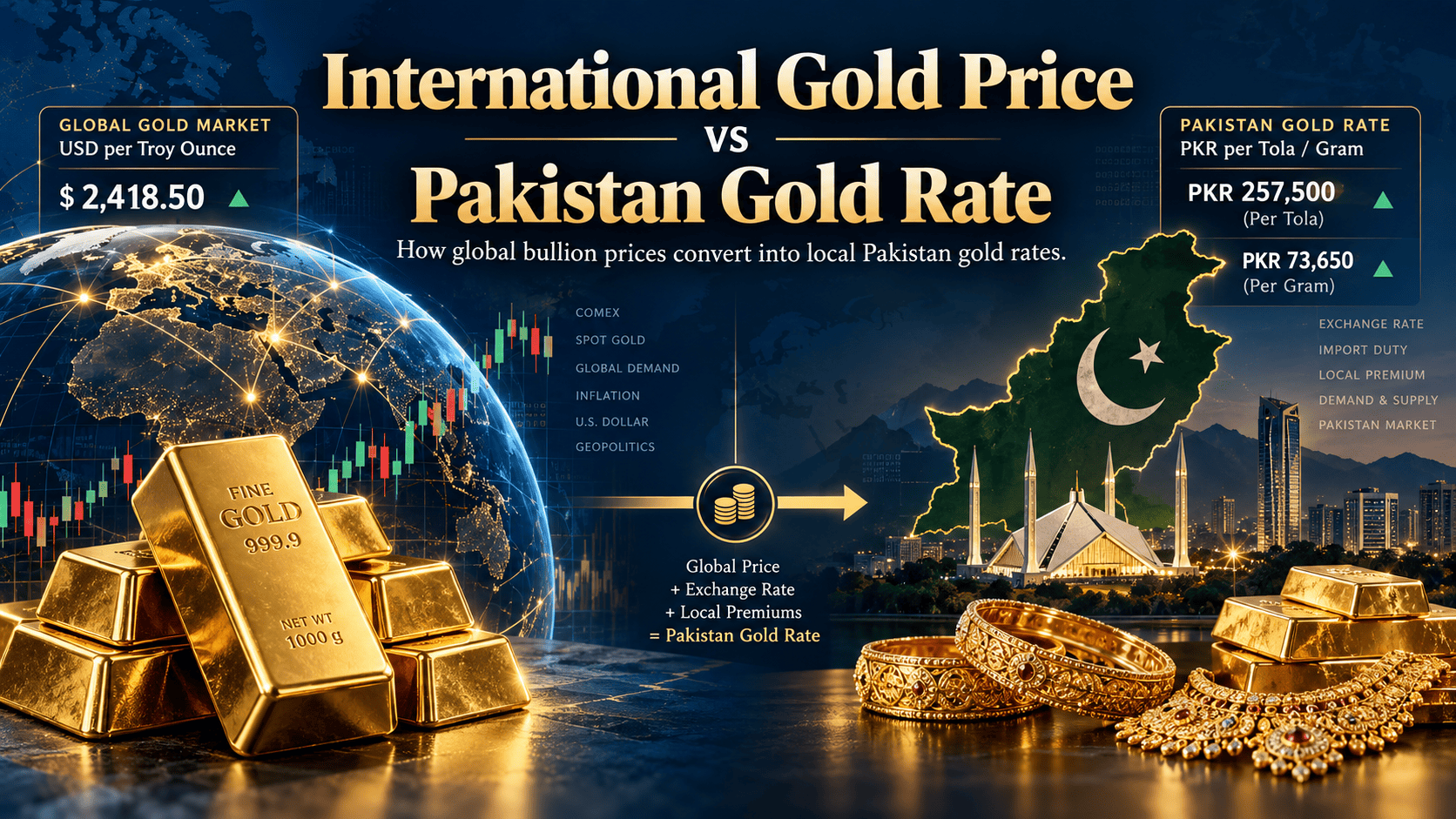
International Gold Price vs Pakistan Gold Rate: What’s the Difference?
When checking gold prices online, you may notice two very different-looking numbers.
An international website may show:
Gold: $4,000 per ounce
while a Pakistani website may show:
Gold: Rs420,000 per tola
At first glance, these prices seem unrelated.
They are actually closely connected.
Pakistan’s gold market takes its direction largely from the international gold market, but the global price must first be converted from US dollars into Pakistani rupees and from troy ounces into tolas or grams.
After that, local bullion-market conditions can cause the Pakistani rate to trade slightly above or below the simple converted value.
The basic relationship can be understood as:
International Gold Price × USD/PKR × Weight Conversion ± Local Market Adjustment = Pakistan Gold Rate
Understanding this relationship helps explain why Pakistan’s gold rate changes, why it does not always exactly match Google or an international website, and why the rupee-dollar exchange rate matters almost as much as the international gold price itself.
What Is the International Gold Price?
The international gold price represents the value of gold in the global precious-metals market.
Gold is generally quoted internationally in:
US dollars per troy ounce
The London Bullion Market Association explains that precious metals are normally quoted in US dollars per troy ounce and that one troy ounce is approximately 31.1035 grams.
You may therefore see a quote such as:
Gold: $4,000/oz
This means approximately:
$4,000 for one troy ounce of gold
It does not mean $4,000 per tola or per ordinary ounce.
The troy ounce is the weight measurement traditionally used by international precious-metals markets.
What Is the LBMA Gold Price?
When people talk about international gold benchmarks, one important reference is the LBMA Gold Price.
The LBMA Gold Price is an internationally recognised benchmark for gold delivered in London. It is set twice each London business day, at 10:30 a.m. and 3:00 p.m., and is quoted in US dollars per troy ounce.
However, this does not mean gold moves only twice a day.
Gold trading takes place throughout international market hours, and live market prices can move continuously as buyers and sellers react to economic news and market conditions.
The LBMA benchmark is therefore different from a continuously changing live spot quote, although both reflect the broader international gold market.
What Is the Pakistan Gold Rate?
The Pakistan gold rate is the local value of gold expressed in Pakistani rupees.
In Pakistan, gold is commonly quoted as:
- price per tola;
- price per 10 grams;
- price per gram.
For example:
24K Gold — Rs420,000 per tola
or:
24K Gold — Rs360,000 per 10 grams
Pakistani financial-market reports frequently publish per-tola and 10-gram rates supplied by the All-Pakistan Gems and Jewellers Sarafa Association (APGJSA). Business Recorder’s gold-market coverage, for example, reports these local rates alongside movements in the international gold market.
The Pakistan rate is therefore not a completely separate price.
It is connected to the international value of gold.
International Gold vs Pakistan Gold at a Glance
| International Gold Price | Pakistan Gold Rate |
|---|---|
| Usually quoted in USD | Quoted in PKR |
| Usually quoted per troy ounce | Commonly quoted per tola |
| Reflects global gold market | Reflects international value plus local conditions |
| 1 troy ounce ≈ 31.1035g | 1 tola ≈ 11.6638g |
| Moves with global markets | Moves with global gold, USD/PKR and local market |
| Used as global reference | Used by Pakistani buyers and jewellers |
The difference is mainly about:
currency, weight unit and local market conditions.
How Is International Gold Converted Into Pakistan Gold Rate?
The conversion is easier than it first appears.
You need three numbers:
- International gold price per troy ounce
- USD to PKR exchange rate
- Troy-ounce-to-tola conversion
The formula is:
Pakistan Gold Rate per Tola = International Gold Price × USD/PKR × (11.6638 ÷ 31.1035)
Since:
11.6638 ÷ 31.1035 ≈ 0.375
the formula can be simplified to:
Estimated Gold Rate per Tola = International Gold Price × USD/PKR × 0.375
This gives an approximate international-equivalent value for 24K gold.
Example: Converting International Gold Into PKR per Tola
Suppose:
International gold price:
$4,000 per troy ounce
USD/PKR:
Rs280
First convert the international ounce price into Pakistani rupees:
4,000 × 280
= Rs1,120,000 per troy ounce
Now convert one troy ounce into one tola.
One tola is approximately 0.375 troy ounce.
Therefore:
1,120,000 × 0.375
= Rs420,000
The estimated international-equivalent rate becomes:
Rs420,000 per tola
The complete calculation is simply:
4,000 × 280 × 0.375 = Rs420,000
These numbers are only an example and should not be treated as today’s gold rate.
Why Doesn't the Pakistan Gold Rate Always Match This Formula?
This is where many people become confused.
Suppose your calculation gives:
Rs420,000 per tola
but the local market is showing:
Rs423,000
Does that mean somebody calculated the rate incorrectly?
Not necessarily.
The formula provides a theoretical converted value.
Pakistan's actual bullion-market rate can include a local adjustment.
A useful way to represent it is:
Pakistan Market Rate = International-Equivalent Rate + Local Adjustment
For example:
International-equivalent rate:
Rs420,000
Pakistan market rate:
Rs423,000
Difference:
+Rs3,000
That Rs3,000 represents the difference between the theoretical conversion and the observed local rate.
What Causes the Local Gold Adjustment?
A local premium or discount may develop because of conditions within Pakistan's physical gold market.
These can include:
- local demand for gold;
- availability of physical bullion;
- buying and selling activity;
- dealer inventory;
- import-related costs;
- liquidity;
- market premiums;
- local trading conditions.
Pakistani gold-market reports sometimes quote international rates with an explicit premium included, illustrating that the market reference can contain more than a raw international spot-price number.
This is why blindly converting an international price may not reproduce the local quote down to the exact rupee.
Why Does USD/PKR Matter So Much?
The exchange rate is one of the most important parts of Pakistan's gold calculation.
International gold is denominated mainly in US dollars.
Pakistani buyers use rupees.
That means every international gold price has to pass through the USD/PKR exchange rate before becoming a Pakistani price.
According to the State Bank of Pakistan, Pakistan has a market-based flexible exchange-rate system, with exchange rates influenced by market demand and supply conditions.
As the exchange rate moves, the Pakistani value of gold can move even if international gold remains unchanged.
Example: International Gold Stays the Same but PKR Weakens
Suppose international gold remains:
$4,000 per ounce
Initially:
USD/PKR = Rs280
Gold value:
4,000 × 280 × 0.375
= Rs420,000 per tola
Now assume the dollar rises to:
USD/PKR = Rs290
while international gold remains exactly $4,000.
The new calculation becomes:
4,000 × 290 × 0.375
= Rs435,000
Difference:
Rs15,000 per tola
International gold did not increase at all.
Yet the theoretical Pakistani gold price increased by Rs15,000.
Why?
Because more Pakistani rupees are now required to purchase the same amount of dollar-priced gold.
Can Gold Rise in Pakistan Even When International Gold Falls?
Yes.
This can happen when the Pakistani rupee weakens more than international gold declines.
Consider this example.
Before
International gold:
$4,000
USD/PKR:
Rs280
Calculation:
4,000 × 280 × 0.375
= Rs420,000
After
International gold falls to:
$3,950
but USD/PKR rises to:
Rs290
Calculation:
3,950 × 290 × 0.375
= approximately:
Rs429,563
International gold fell by $50.
But Pakistan's theoretical gold rate increased by approximately Rs9,563.
The currency movement was stronger than the international gold decline.
This is one of the most important differences between following international gold and following the Pakistani gold rate.
Can Pakistan Gold Fall While International Gold Rises?
Yes.
The opposite situation can also happen.
Suppose:
International gold rises slightly,
but:
the Pakistani rupee strengthens significantly against the dollar.
The stronger rupee can offset the international gold increase.
For example:
Before
Gold:
$4,000
USD/PKR:
Rs290
Calculation:
4,000 × 290 × 0.375
= Rs435,000
After
Gold rises to:
$4,050
but USD/PKR falls to:
Rs280
Calculation:
4,050 × 280 × 0.375
= Rs425,250
International gold increased by $50.
Yet the theoretical Pakistani rate decreased by:
Rs9,750 per tola
because the rupee strengthened enough to offset the international rise.
International Gold and USD/PKR Work Together
The easiest way to understand the relationship is with this table:
| International Gold | USD/PKR | General Effect on Pakistan Gold |
|---|---|---|
| Rising | Rising | Strong upward pressure |
| Falling | Falling | Strong downward pressure |
| Rising | Falling | Mixed |
| Falling | Rising | Mixed |
If both international gold and USD/PKR rise at the same time, Pakistan's gold rate usually faces strong upward pressure.
If both fall, the opposite generally happens.
If one rises while the other falls, the final result depends on which movement is larger.
International Gold Price vs Local Market Rate
It is useful to separate two concepts.
International-Equivalent Gold Rate
This is the mathematically calculated value:
International Gold × USD/PKR × Weight Conversion
It answers:
“What should one tola theoretically be worth based on international gold and the exchange rate?”
Pakistan Market Gold Rate
This is the rate actually quoted in the domestic bullion market.
It can reflect:
International-equivalent value ± local market adjustment
Both numbers can be useful.
The calculated rate shows what international conditions suggest.
The market rate shows what the local market is actually quoting.
Spot Gold Price vs Pakistan Sarafa Rate
Another common mistake is comparing:
live spot gold
directly with:
Pakistan Sarafa gold rate
without converting currency or weight.
An international spot quote might say:
$4,100
That means approximately $4,100 per troy ounce.
A Pakistani rate might say:
Rs430,000
That normally means Rs430,000 per tola.
These are not comparable until you convert:
USD → PKR
and:
Troy ounce → Tola
Only then can you determine how closely the two prices match.
Troy Ounce vs Tola
International gold markets commonly use the troy ounce.
Pakistan commonly uses the tola.
The relationship is:
1 Troy Ounce ≈ 31.1035 grams
1 Tola ≈ 11.6638 grams
Therefore:
1 Troy Ounce ≈ 2.6667 Tolas
and:
1 Tola ≈ 0.375 Troy Ounce
This is why the number 0.375 appears in many Pakistan gold-rate calculations.
How to Calculate Gold Rate per Gram
Once you calculate the per-tola rate, finding the per-gram rate is straightforward.
Use:
Per-Gram Rate = Per-Tola Rate ÷ 11.6638
Suppose your calculated 24K rate is:
Rs420,000 per tola
Then:
420,000 ÷ 11.6638
= approximately:
Rs36,009 per gram
How to Calculate the 10-Gram Gold Rate
Use:
10-Gram Rate = Tola Rate × 10 ÷ 11.6638
Using Rs420,000:
420,000 × 10 ÷ 11.6638
= approximately:
Rs360,087
So the same theoretical gold price could be displayed as roughly:
Rs420,000 per tola
Rs360,087 per 10 grams
Rs36,009 per gram
They represent the same underlying gold value in different weight units.
Does Gold Purity Affect the International Comparison?
Yes.
International benchmark prices generally refer to high-purity gold.
In Pakistan, the main quoted benchmark is commonly a 24K gold rate.
Lower-karat rates can then be calculated from the 24K price.
22K
24K Rate × 22 ÷ 24
21K
24K Rate × 21 ÷ 24
18K
24K Rate × 18 ÷ 24
For example, if 24K is:
Rs420,000 per tola
then theoretical values would be approximately:
22K:
Rs385,000
21K:
Rs367,500
18K:
Rs315,000
These are metal-value calculations rather than finished jewellery prices.
Why Is Jewellery More Expensive Than the Gold Rate?
Another important distinction is:
Pakistan Gold Rate ≠ Final Jewellery Price
The market gold rate represents the value of the gold itself.
Finished jewellery can include additional costs.
A simplified jewellery-price calculation is:
Gold Value + Making Charges + Stones + Other Charges = Jewellery Price
For example:
Gold value:
Rs200,000
Making charge:
Rs15,000
Other applicable charges:
Rs5,000
Final price:
Rs220,000
This is why you should not expect a jewellery shop to sell a finished necklace at exactly the published bullion rate.
Why Do Google and Pakistani Websites Sometimes Show Different Rates?
This is one of the most common questions gold buyers have.
The differences can come from several places.
Different Weight Units
Google may show international gold per troy ounce.
A Pakistani website may show it per tola.
Different Currency
International sites use US dollars.
Pakistan sites use rupees.
Different USD/PKR Source
Not every website uses exactly the same FX reference.
Different Update Time
Gold can move quickly.
A website updated 15 minutes ago may show a different rate from a live market feed.
Local Market Adjustment
A Pakistani market rate can include a premium or discount compared with the simple international conversion.
Different Data Providers
Two market-data providers can occasionally show slightly different live quotes because of timing, feeds and market sources.
This means a small difference between two websites does not automatically indicate that one is wrong.
The important thing is to understand what price each website is actually displaying.
Why Can Pakistani Gold Prices Change Several Times a Day?
International gold markets remain active across different time zones.
During a Pakistani trading day, prices can react to activity in:
- Asia;
- London;
- Europe;
- the United States.
The international benchmark and live trading market can therefore change while Pakistani bullion traders are operating.
At the same time:
USD/PKR can move
and:
local market conditions can change
So Pakistan's gold rate may be revised more than once in a day.
A Practical Calculation for a Gold Rate Website
If you operate a gold-rate website, it is helpful to keep the individual inputs separate.
For example:
International Gold Price
gold_usd_per_ounce
USD/PKR
usd_pkr
Weight Conversion
11.6638 / 31.1035
Calculated 24K Rate
gold_usd_per_ounce × usd_pkr × (11.6638 / 31.1035)
Local Adjustment
market_rate - calculated_rate
Final Local Rate
calculated_rate + local_adjustment
This structure is much more transparent than simply storing one unexplained number.
Example for a Gold Rate Website
Suppose your data shows:
International gold:
$4,000/oz
USD/PKR:
Rs280
Calculated rate:
Rs420,000
Observed Pakistan market rate:
Rs422,500
You could display:
Pakistan Gold Rate
Rs422,500 / Tola
Calculated International-Equivalent Rate
Rs420,000 / Tola
Local Market Adjustment
+Rs2,500
This tells users not only the current rate but also why it differs from a straightforward global conversion.
Should You Automatically Add a Fixed Amount to the International Rate?
Generally, a permanent fixed adjustment such as:
International calculation + Rs3,000
should not automatically be assumed to represent the real market forever.
The difference between the theoretical and local market rate can change.
Sometimes it may be:
+Rs1,500
another time:
+Rs4,000
and under different market conditions it could potentially be below the theoretical calculation.
For a rate website, it is better to derive or update the adjustment from a reliable local-market reference rather than permanently hard-code one fixed premium.
Which Rate Should a Pakistani Buyer Follow?
It depends on the purpose.
If you want to understand the global direction of gold:
Watch the international gold price.
If you want to understand currency pressure:
Watch USD/PKR.
If you want to know the price actually being quoted in Pakistan:
Watch the local bullion/Sarafa market rate.
For the clearest picture, monitor all three.
A Pakistan-focused gold page can therefore be especially useful when it displays:
- international gold price;
- USD/PKR;
- calculated PKR value;
- Pakistan market gold rate;
- difference or local adjustment;
- last updated time.
That gives users much more context than showing only one number.
International Gold Rising Doesn't Always Mean You Should Buy or Sell
Price direction alone should not automatically be treated as an investment signal.
A rising gold price can be influenced by:
- international market demand;
- currency weakness;
- geopolitical events;
- interest-rate expectations;
- inflation expectations;
- local market conditions.
Similarly, a falling rate can happen for different reasons.
Understanding why the price moved is more useful than assuming that a recent rise or fall will necessarily continue.
Frequently Asked Questions
Is Pakistan's gold rate based on international gold?
International gold is an important foundation for Pakistan's gold rate, but the final local quote can also reflect the USD/PKR exchange rate and domestic bullion-market conditions.
Pakistani financial-market reporting commonly presents changes in local gold prices alongside changes in the international market.
What unit is international gold measured in?
International precious-metals prices are commonly quoted in US dollars per troy ounce.
One troy ounce is approximately 31.1035 grams.
What unit is gold measured in Pakistan?
Pakistan commonly quotes gold per:
- tola;
- 10 grams;
- gram.
One tola is approximately 11.6638 grams.
Why does USD/PKR affect Pakistan's gold price?
International gold is priced primarily in dollars.
Therefore, it must be converted into Pakistani rupees.
If the rupee weakens, more rupees are needed to represent the same dollar value.
The State Bank of Pakistan describes the country's exchange-rate regime as market-based and flexible.
Can Pakistan gold rise while global gold falls?
Yes.
If the Pakistani rupee weakens enough, the currency effect can outweigh a decline in international gold.
Why is Pakistan's gold rate sometimes higher than my calculated rate?
Possible reasons include:
- local premium;
- physical bullion demand;
- supply conditions;
- timing differences;
- different FX references;
- different international market feeds.
The formula provides a theoretical conversion, while the local quote reflects the domestic market.
Is international gold quoted per normal ounce?
No.
Precious metals use a troy ounce, which weighs approximately 31.1035 grams rather than the ordinary avoirdupois ounce of approximately 28.35 grams.
Who provides Pakistan's reported gold rate?
Major Pakistani financial publications commonly cite gold rates supplied by the All-Pakistan Gems and Jewellers Sarafa Association (APGJSA).
Individual jeweller buying and selling prices may still differ.
What is the easiest formula for Pakistan gold rate?
For an approximate 24K per-tola calculation:
International Gold Price × USD/PKR × 0.375
For example:
$4,000 × Rs280 × 0.375 = Rs420,000 per tola
Then compare that calculated value with the observed local market rate.
Final Thoughts
The international gold price and Pakistan gold rate are not two unrelated prices.
They are different versions of the same underlying commodity value.
The international market normally expresses gold as:
US dollars per troy ounce
Pakistan normally expresses it as:
Pakistani rupees per tola
To move from one to the other, you need to account for:
international gold price + USD/PKR + weight conversion + local market conditions
The simplest formula is:
International Gold × USD/PKR × 0.375 ≈ Theoretical 24K Gold Rate per Tola
From there, the actual Pakistan bullion-market rate may be slightly higher or lower because of local conditions.
This also explains an important point for anyone following gold in Pakistan:
Watching international gold alone is not enough.
A better picture comes from watching the international gold price and USD/PKR together, then comparing the calculated value with the local Sarafa-market rate.
Once you understand those three numbers, Pakistan's daily gold-price movements become much easier to follow.
Disclaimer: This article is intended for educational and informational purposes only. International gold prices, foreign-exchange rates and Pakistan bullion-market rates can change frequently. Example calculations are illustrative and should not be treated as live market prices, investment advice or a buying or selling recommendation.