
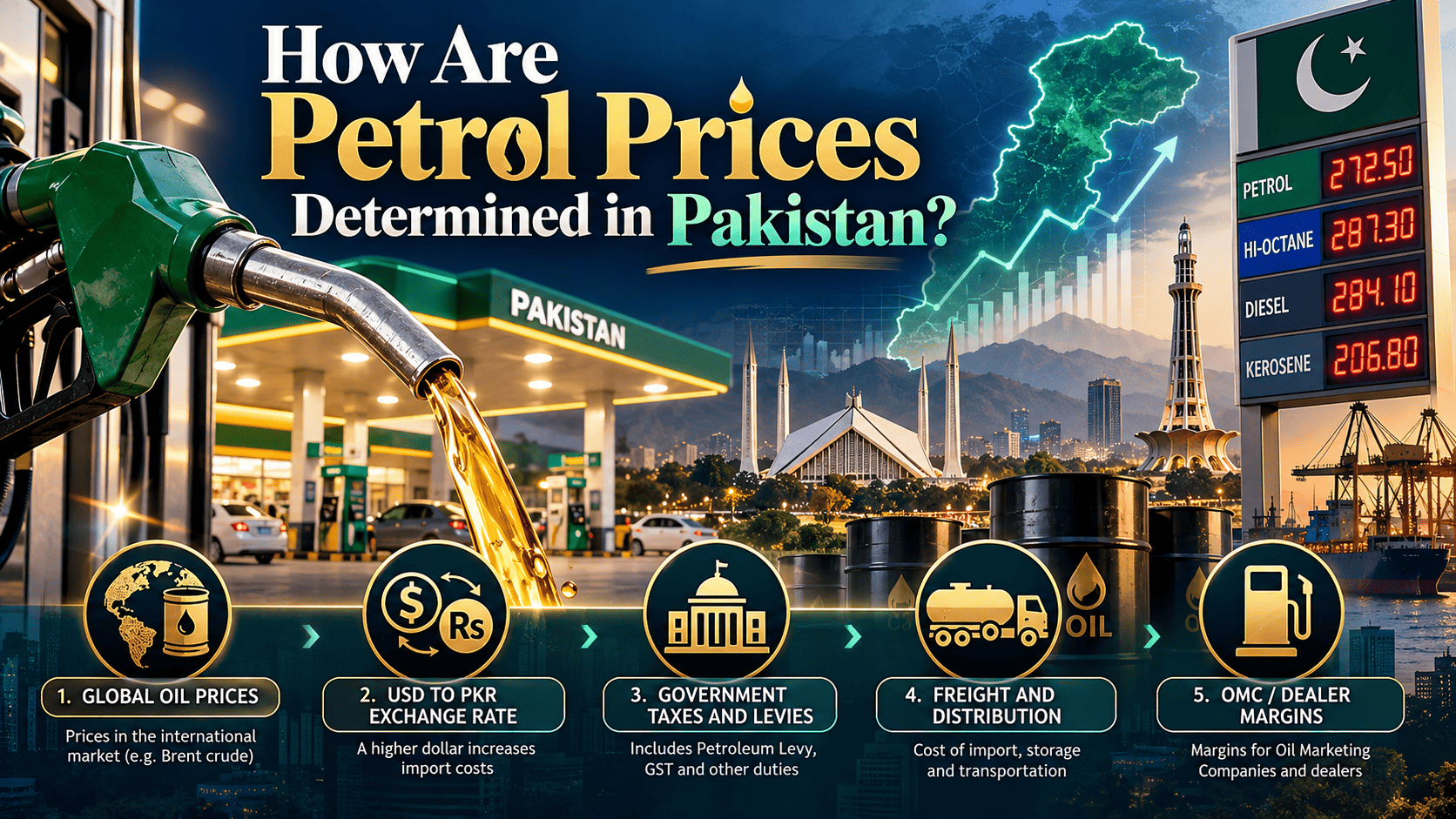
How Are Petrol Prices Determined in Pakistan?
Petrol prices are closely followed in Pakistan because fuel costs affect much more than the amount drivers pay at a petrol station.
Changes in petrol prices can influence:
- Daily commuting costs
- Public transport fares
- Delivery expenses
- Business operating costs
- Agriculture
- Manufacturing
- Logistics
- Prices of goods and services
Many people assume that petrol prices rise simply because international crude oil prices increase.
International oil prices are certainly important, but they are only one part of the calculation.
The price paid by a consumer in Pakistan can be influenced by several components, including:
- International petroleum-product prices
- Cost of imported or locally refined petrol
- USD to PKR exchange rate
- Freight and transportation costs
- Inland Freight Equalization Margin
- Oil marketing company margins
- Dealer margins
- Petroleum levy
- Applicable taxes and statutory charges
- Government policy
- Local transportation costs
- Market conditions
Pakistan's petroleum-pricing framework has also been changing. During 2026, the government began moving the sector further toward deregulation and more frequent market-based pricing. The Petroleum Division said the reform was intended to gradually reduce government intervention and allow market forces to play a greater role, while OGRA has been publishing increasingly frequent petroleum-price and company/pump-level data.
Understanding the different components makes it easier to see why petrol prices can rise or fall even when crude oil prices do not move by the same percentage.
What Petrol Is Sold in Pakistan?
Petrol used by cars and motorcycles is commonly referred to as:
Motor Spirit (MS)
or simply:
Petrol
Pakistan obtains petroleum products through a combination of:
- Domestic oil refineries
- Imported petroleum products
Even locally refined petrol is connected to international market prices because Pakistan's petroleum-pricing framework has historically used import-parity and international-market benchmarks when determining petroleum-product values. OGRA's pricing framework has included an ex-refinery/import-parity component as a major part of the price build-up.
The Simple Petrol Price Formula
A simplified way to understand petrol pricing is:
Petrol Cost + Freight + Margins + Levy + Applicable Taxes/Charges = Consumer Price
A more detailed simplified formula can be written as:
**Ex-Refinery / Import-Based Price
- Inland Freight
- Oil Marketing Company Margin
- Dealer Margin
- Petroleum Levy
- Applicable Taxes and Charges
= Retail / Ex-Depot Petrol Price**
The exact calculation and regulatory treatment can change as petroleum-pricing policies are updated.
1. International Petrol Prices
One of the biggest factors is the international price of petroleum products.
Pakistan participates in the global energy market and imports significant quantities of petroleum and petroleum products.
If international petrol prices increase, Pakistan's cost of obtaining fuel can also increase.
For example, suppose the international cost of a petroleum product increases from:
$80 per barrel
to:
$90 per barrel
That represents an increase of:
$10 per barrel
or:
12.5%
If all other factors remained unchanged, that higher international cost could put upward pressure on local petrol prices.
However, Pakistan's retail petrol price would not necessarily increase by exactly 12.5% because several other components are also included in the final price.
2. Crude Oil Price vs Petrol Price
Crude oil and petrol are related, but they are not the same product.
Crude oil is the raw material extracted from the ground.
Petrol is a refined petroleum product made after crude oil passes through a refinery.
Therefore:
Crude Oil Price ≠ Final Petrol Price
Changes in crude oil prices can eventually influence petrol prices, but petrol has its own international market price.
Refining conditions, fuel demand, refinery capacity, transportation, and product availability can cause petrol prices to behave differently from crude oil.
Example
Suppose international crude oil prices remain almost unchanged.
However, international demand for petrol suddenly increases.
Petrol itself could become more expensive even though crude oil prices have not increased significantly.
That is why looking only at Brent or another crude-oil benchmark does not always tell you exactly what will happen to petrol prices in Pakistan.
3. USD to PKR Exchange Rate
The exchange rate is another major factor.
International petroleum products are generally priced in US dollars.
Pakistan, however, sells petrol to consumers in Pakistani rupees.
This means international fuel costs must effectively be converted from:
USD → PKR
Suppose imported petrol costs:
$0.70 per litre
At USD/PKR = Rs. 280
$0.70 × 280 = Rs. 196
At USD/PKR = Rs. 290
$0.70 × 290 = Rs. 203
Difference:
Rs. 7 per litre
The international dollar price has not changed at all.
Only the exchange rate changed.
Yet the PKR cost increased.
This is one of the main reasons petrol prices can rise in Pakistan even when global oil prices are relatively stable.
What Happens When the Rupee Weakens?
Suppose:
1 USD = Rs. 280
and later:
1 USD = Rs. 300
The Pakistani rupee has weakened against the US dollar.
Pakistan now needs more rupees to purchase the same amount of dollar-denominated petroleum.
Therefore, rupee depreciation can put upward pressure on petrol prices.
What Happens When the Rupee Strengthens?
Now suppose USD/PKR falls from:
Rs. 300
to:
Rs. 280
Pakistan needs fewer rupees to pay the same dollar-denominated fuel cost.
This can reduce pressure on domestic petrol prices, assuming other factors remain unchanged.
4. Ex-Refinery or Import-Based Price
Before margins, levies, and several other components are added, petrol has a basic underlying value.
Historically, Pakistan's petroleum pricing framework has used an ex-refinery/import-parity price as a central component of the calculation. OGRA notifications describe the prescribed petroleum price as incorporating the ex-refinery/import-parity component along with other elements.
In simple terms, this is intended to represent the basic cost of petroleum before the complete distribution and retail price is built.
This component can be affected by:
- International petroleum prices
- Exchange rate
- Import costs
- Refining economics
- Government pricing formulas
What Does Import Parity Mean?
Import parity broadly refers to estimating what it would cost to obtain a product through the international market and bring it into Pakistan.
It can include factors connected with:
- International product price
- Freight
- Insurance
- Port-related costs
- Exchange rate
- Other applicable import-related expenses
The exact regulatory formula can be more complicated than this simplified explanation.
5. Inland Freight Equalization Margin
Petrol has to be transported from refineries, ports, terminals, and depots to different areas of Pakistan.
Transportation costs can vary significantly depending on distance.
For example, delivering fuel close to a major refinery or port may cost less than transporting it hundreds of kilometres inland.
Pakistan has traditionally used an:
Inland Freight Equalization Margin (IFEM)
as part of petroleum-product pricing.
OGRA describes IFEM as a component used for petroleum products including Motor Spirit and High-Speed Diesel and publishes separate IFEM notifications.
Why Is IFEM Needed?
Imagine:
Petrol transportation to City A costs:
Rs. 2 per litre
while transportation to City B costs:
Rs. 8 per litre
If every city simply paid its exact primary transport cost, there could be much larger regional differences in petrol prices.
The IFEM framework has historically been used to pool or equalize primary freight costs across designated locations.
The exact operation of IFEM is also being addressed as Pakistan moves through its petroleum-market deregulation reforms. The Petroleum Division specifically identified IFEM as one of the technical issues being handled during the transition.
6. Oil Marketing Company Margin
Petrol does not move directly from an international supplier or refinery into your car.
Oil Marketing Companies, commonly called:
OMCs
play an important role in:
- Purchasing petroleum products
- Storage
- Transportation
- Distribution
- Maintaining fuel supplies
- Operating supply infrastructure
- Supplying petrol stations
Their margin is one component of the petroleum-price structure.
OGRA's historical petroleum-price notifications have separately identified the oil marketing or distributor margin within the price build-up.
Examples of OMC-related costs can include:
- Storage
- Distribution
- Supply management
- Operations
- Financing
- Infrastructure
- Business margin
The exact margin and pricing arrangements can change under deregulation.
7. Petrol Pump Dealer Margin
Petrol-station operators also receive a margin.
This is generally known as the:
Dealer Margin
or:
Dealer Commission
The petrol station must cover expenses such as:
- Employees
- Electricity
- Maintenance
- Equipment
- Rent or land costs
- Safety requirements
- Operating expenses
- Business return
The dealer margin therefore forms another part of the amount included in the fuel's retail price.
OGRA petroleum-price notifications have historically listed dealer commission separately as part of the prescribed petroleum price.
8. Petroleum Levy
Another important component is the:
Petroleum Levy
This is a government levy applied to petroleum products.
Unlike the basic cost of petrol, petroleum levy is a fiscal component rather than the international cost of producing or purchasing the fuel.
For example, imagine a simplified price before the levy is:
Rs. 210 per litre
and an example levy were:
Rs. 60 per litre
then:
210 + 60 = Rs. 270
before considering any remaining applicable components.
The actual petroleum-levy rate is determined under government policy and can change.
OGRA notifications explicitly include the petroleum levy as one of the components used in determining petroleum-product prices.
Why Can the Government Change the Levy?
The petroleum levy is part of government fiscal policy.
Its level can be influenced by:
- Government revenue requirements
- Federal budget decisions
- Economic policy
- Petroleum-pricing policy
- Other fiscal considerations
Therefore, even if international petrol costs decrease, consumers may not always see the entire international decline reflected immediately in the pump price if another component changes at the same time.
Similarly, the government can sometimes change fiscal components in ways that affect how much of an international price movement reaches consumers.
9. General Sales Tax and Other Taxes
Taxes can also be part of petroleum pricing depending on the tax regime in force at the time.
Historically, petroleum-price build-ups have included General Sales Tax as a separate component, although the applicable tax treatment and rate can change through government policy.
Therefore, it is better not to assume that the GST percentage on petrol is permanently fixed.
The tax or levy structure should always be checked using the latest government notification.
10. Customs Duty and Refinery Protection
Imported petroleum products can also be affected by customs-duty arrangements and refinery policy.
Pakistan's Brownfield Refinery Policy, for example, provides for tariff protection and customs-duty arrangements for Motor Gasoline and Diesel under the policy's fiscal framework.
These arrangements can influence refinery economics and the broader petroleum-product price structure.
For everyday consumers, however, it is usually easier to understand the final retail price through the major categories:
Base Fuel Cost + Freight + Margins + Government Levies/Taxes
11. Secondary Transportation Costs
Petrol is transported from major depots to petrol stations.
In some areas, additional transportation is required beyond the primary freight network.
OGRA notifications have historically noted that beyond specified depot locations and in certain remote areas, additional secondary freight may be charged according to government policy.
This means the physical location of a petrol station can sometimes affect the final price.
12. Why Petrol Prices May Differ Between Locations
Under older regulated pricing arrangements, petrol prices were often discussed as a national maximum ex-depot price, with additional freight considerations in some remote locations.
Pakistan's petroleum market is now changing.
During 2026, the government began implementing a phased deregulation strategy aimed at allowing more market-based petroleum pricing. OGRA now publishes district- and pump-wise pricing data for individual oil marketing companies, and its current records show frequent company-specific price updates.
As a result, consumers should increasingly pay attention to:
- Petrol station
- Oil marketing company
- District
- Location
- Effective date
when checking a petrol price.
How Petrol Pricing Is Changing in 2026
Pakistan's fuel-pricing mechanism has been undergoing an important transition.
Earlier systems relied heavily on centrally calculated and notified prices.
In July 2026, the Petroleum Division said it was working with:
- OGRA
- Oil marketing companies
- Refineries
- Industry associations
on a new mechanism moving from weekly pricing toward a daily pricing system as part of phased deregulation.
OGRA's current website reflects this transition by publishing:
- Notified petroleum prices
- IFEM notifications
- Ex-depot computations
- District/pump-wise prices
- Individual OMC price updates
Therefore, articles that say Pakistan's petrol price is always changed only once every 15 days are no longer a reliable description of the evolving 2026 pricing system.
Why Was Petrol Previously Called a Fortnightly Price?
For years, consumers became familiar with petrol prices being reviewed approximately every:
15 days
This became commonly known as the:
Fortnightly Petrol Price Review
However, the petroleum-pricing system has continued to evolve.
By 2026, official records show much more frequent price publications, and the government has publicly announced plans for a transition toward daily market-linked pricing.
Therefore, the frequency of pricing should always be checked against the latest policy rather than assuming the historical fortnightly system still applies unchanged.
Does OGRA Decide Petrol Prices?
OGRA plays an important role, but describing the process as simply:
"OGRA decides whatever petrol should cost"
would be misleading.
OGRA's functions include petroleum-price calculations, notifications, monitoring, IFEM calculations, and regulatory oversight under the government's petroleum framework.
Government policies also determine important components such as:
- Petroleum levy
- Tax treatment
- Regulatory framework
- Deregulation policy
- Margin policies
Therefore, petrol pricing involves both regulatory calculations and government policy.
Does the Government Control Petrol Prices?
The answer depends on the pricing regime being discussed.
Historically, the government had a major role through:
- Price notifications
- Levy decisions
- Tax decisions
- Dealer margins
- OMC margins
- Policy guidelines
During 2026, Pakistan began moving toward greater petroleum-market deregulation.
The Petroleum Division described the objective as gradually reducing direct government intervention and allowing market forces to determine prices more closely, while maintaining regulatory oversight and consumer protection.
So Pakistan's system is better understood as an evolving regulated-to-market-based framework, rather than either a completely free market or a permanently fixed government price.
A Simplified Petrol Price Example
Consider this purely illustrative example.
Suppose the components of one litre of petrol are:
| Component | Example Amount |
|---|---|
| Base petroleum cost | Rs. 190 |
| Freight / IFEM | Rs. 5 |
| OMC margin | Rs. 8 |
| Dealer margin | Rs. 8 |
| Petroleum levy | Rs. 60 |
| Other applicable charges | Rs. 4 |
| Example Retail Price | Rs. 275 |
These numbers are only examples.
They are not current official petrol-price components.
The example simply shows how multiple components can combine to create the final price.
Why Petrol Can Become More Expensive Even If Oil Prices Fall
This is one of the most common questions.
Suppose international petrol prices fall by:
Rs. 10 per litre equivalent
but at the same time:
- PKR weakens against USD by an amount that adds Rs. 5
- Freight increases by Rs. 1
- A levy increases by Rs. 4
The international reduction is:
-Rs. 10
Other increases are:
+Rs. 10
The final retail price could remain roughly unchanged.
Therefore:
Falling international oil price does not automatically mean an identical reduction at Pakistani petrol pumps.
Why Petrol Can Fall Even If Crude Oil Has Not Fallen Much
The reverse is also possible.
Suppose:
- International petrol product prices decrease
- PKR strengthens
- Freight costs decline
- A government levy is reduced
The final petrol price could fall even if the headline crude-oil benchmark changed only slightly.
Again, several components have to be considered together.
International Price and Exchange Rate Work Together
The international petroleum price and USD/PKR are particularly important because they can amplify or offset each other.
Scenario 1: Oil Rises + PKR Weakens
International petrol:
Rises
USD/PKR:
Rises
Both factors push the PKR cost upward.
This can create strong pressure for a higher domestic petrol price.
Scenario 2: Oil Falls + PKR Strengthens
International petrol:
Falls
USD/PKR:
Falls
Both factors reduce the PKR cost.
This can create stronger downward pressure.
Scenario 3: Oil Falls + PKR Weakens
International petrol:
Falls
USD/PKR:
Rises
The two factors work in opposite directions.
The result depends on which movement is larger.
Example of International Price Plus Exchange Rate
Suppose petrol costs internationally:
$0.75 per litre
Case A
USD/PKR:
280
Calculation:
0.75 × 280 = Rs. 210
Case B
International price falls to:
$0.72
but USD/PKR increases to:
295
Calculation:
0.72 × 295 = Rs. 212.40
The international petrol price actually decreased.
But the PKR equivalent increased from:
Rs. 210
to:
Rs. 212.40
because the rupee weakened.
This example demonstrates why both international prices and exchange rates need to be checked together.
Why Petrol Price Changes Affect Inflation
Fuel is used throughout the economy.
When petrol and diesel become more expensive, costs may increase for:
- Transport
- Delivery services
- Distribution
- Businesses
- Agriculture
- Construction
- Logistics
Companies may pass some of those additional costs to customers.
This is one reason fuel prices can indirectly contribute to inflation.
However, the size of the impact differs across industries and products.
Petrol vs High-Speed Diesel
Petrol and High-Speed Diesel are different petroleum products.
Petrol is widely used in:
- Cars
- Motorcycles
- Small vehicles
High-Speed Diesel (HSD) is heavily used in:
- Trucks
- Buses
- Agricultural machinery
- Commercial transport
- Generators
- Heavy vehicles
Their international prices and domestic price components can differ.
Therefore, petrol and diesel do not always increase or decrease by the same amount.
Does Pakistan Produce Its Own Petrol?
Pakistan has domestic oil refineries that produce petroleum products.
However, local production does not mean petrol prices are disconnected from international markets.
Refineries may use:
- Imported crude oil
- Locally produced crude oil
and petroleum pricing remains closely linked with international benchmarks and import-parity economics.
Therefore, even locally refined petroleum products can be affected by global prices and USD/PKR movements.
Why Does Imported Crude Affect Local Petrol?
Suppose a Pakistani refinery purchases imported crude oil.
The crude is usually priced internationally in US dollars.
If either:
- International crude prices increase
or:
- USD becomes more expensive against PKR
the refinery's input cost can rise.
That cost can eventually influence refined-product prices.
Can Petrol Stations Set Any Price They Want?
Not without limits under the applicable regulatory framework.
Pakistan's petroleum sector remains regulated by OGRA in areas such as licensing, monitoring, technical standards, and petroleum-market oversight.
As deregulation progresses, oil marketing companies may have greater pricing flexibility, but the sector remains subject to:
- Regulatory requirements
- Competition rules
- Consumer-protection mechanisms
- Price reporting
- Government petroleum policy
OGRA's current publication of district- and pump-wise prices gives consumers a way to see company-specific rates.
How Can Consumers Check Petrol Prices?
For the most reliable information, consumers can check:
- OGRA petroleum-price publications
- OGRA district/pump-wise prices
- Official government petroleum announcements
- Displayed prices at authorized petrol stations
OGRA maintains dedicated sections for notified oil prices, price build-ups, IFEM, and district/pump-wise petroleum prices.
Because pricing is becoming more frequent and location/company-specific, always check the effective date of the rate.
Why the Effective Date Matters
Suppose one page shows:
Petrol = Rs. X
but its effective date is:
September 12
Another rate became effective:
September 19
The first number may already be outdated.
OGRA's current petroleum-price archive shows successive effective dates, including September 5, September 12, and September 19, 2026, while individual OMC price pages show even more frequent updates.
Therefore, petrol-price data should always include:
Price + Effective Date + Location/OMC where applicable
Common Misunderstandings About Petrol Prices
"Petrol Price Depends Only on Crude Oil"
Incorrect.
International crude and petroleum prices matter, but USD/PKR, freight, margins, levies, taxes, and policy also affect the final price.
"If Oil Falls 10%, Petrol Must Fall 10%"
Not necessarily.
Only part of the final price represents the underlying petroleum cost.
Other components may remain unchanged or move in the opposite direction.
"OGRA Can Choose Any Petrol Price"
Not exactly.
OGRA operates under legal and government-policy frameworks and performs pricing, monitoring, and regulatory functions.
"Every Petrol Pump Must Always Have Exactly the Same Price"
This is becoming less accurate as Pakistan transitions toward a more deregulated petroleum-pricing system and OGRA publishes OMC- and pump-specific price information.
"A Weak Rupee Does Not Matter if Oil Prices Fall"
It can matter significantly.
Since petroleum is priced internationally in dollars, rupee depreciation can offset some or all of an international price decline.
Frequently Asked Questions
How is the petrol price calculated in Pakistan?
A simplified calculation includes:
International/import-based petroleum cost + freight + OMC margin + dealer margin + petroleum levy + applicable taxes and other charges
The exact pricing mechanism depends on current government and regulatory policy.
What is the biggest factor affecting petrol prices?
International petroleum-product prices and the USD to PKR exchange rate are two of the biggest underlying factors, but levies, freight, margins, taxes, and policy decisions also matter.
Does crude oil price directly determine petrol price?
Not by itself.
Petrol is a refined product with its own international price, and the final Pakistani price also includes exchange-rate effects and domestic components.
Why does USD to PKR affect petrol?
International petroleum is generally priced in US dollars.
If the Pakistani rupee weakens, more rupees are required to purchase the same amount of dollar-priced fuel.
What is petroleum levy?
Petroleum levy is a government fiscal charge applied to petroleum products.
Its rate can be changed through government policy.
What is IFEM?
IFEM stands for:
Inland Freight Equalization Margin
It relates to the transportation and equalization of petroleum-product freight costs within Pakistan. OGRA publishes IFEM calculations and notifications.
What is an OMC margin?
OMC stands for:
Oil Marketing Company
The OMC margin relates to the distribution and marketing activities performed by oil marketing companies.
What is the dealer margin?
The dealer margin or dealer commission is the portion associated with petrol-station operators for retailing fuel and covering their business expenses.
Does Pakistan import petrol?
Pakistan uses both locally refined petroleum products and imported petroleum products.
Domestic refineries also rely partly on crude oil that may be imported.
Who regulates petrol companies in Pakistan?
The Oil and Gas Regulatory Authority regulates the petroleum sector in areas including licensing, monitoring, technical standards, petroleum-price functions, and other regulated activities.
Does the government still set petrol prices every 15 days?
That was the familiar historical system, but it is no longer a good description of the evolving 2026 framework.
Pakistan has been transitioning through weekly and increasingly frequent pricing toward a planned daily, more deregulated system. Official OGRA data now contains frequent company- and location-specific price publications.
Can petrol prices vary by petrol pump?
Under the evolving deregulated structure, company, district, location, and transportation factors can affect prices. OGRA currently publishes district/pump-wise prices for individual oil marketing companies.
Why can petrol rise when international oil falls?
Possible reasons include:
- PKR depreciation
- Higher petroleum levy
- Freight changes
- Margin changes
- Different petroleum-product prices
- Other applicable charges
Can petrol prices decrease when PKR strengthens?
A stronger rupee can reduce the PKR equivalent of internationally priced fuel and therefore create downward pressure on petrol prices, assuming other components do not offset the reduction.
Conclusion
Petrol prices in Pakistan are determined by much more than the international crude-oil price.
A simplified petrol-price structure looks like:
**International / Import-Based Fuel Cost
- Exchange Rate Effect
- Freight
- OMC Margin
- Dealer Margin
- Petroleum Levy
- Applicable Taxes and Charges
= Final Petrol Price**
Two factors are especially important:
International petroleum prices
and:
USD to PKR exchange rate
But they are only part of the final calculation.
Transportation costs, government levies, dealer margins, OMC margins, taxes, and regulatory policy also play a role.
Pakistan's petroleum-pricing system is also changing. In 2026, the government began implementing a phased deregulation strategy and moving toward more frequent market-based pricing. OGRA now provides company-, district-, and pump-level petroleum-price information alongside its other pricing data.
Therefore, when trying to understand why petrol became more expensive or cheaper, do not look at only one number.
Check:
International petrol prices + USD/PKR + government levies + freight + margins + current petroleum-pricing policy
together.
That gives a much clearer picture of how petrol prices are determined in Pakistan.
Disclaimer: Petrol prices, international petroleum prices, foreign exchange rates, government levies, taxes, margins, freight charges, and petroleum-pricing policies can change frequently. Calculations, rates, and figures used in this article are for educational purposes and examples only. They do not represent current official petrol prices unless specifically stated. Always check the latest petrol price, effective date, applicable taxes and levies, and official notifications from OGRA or the Government of Pakistan before making financial or business decisions.