
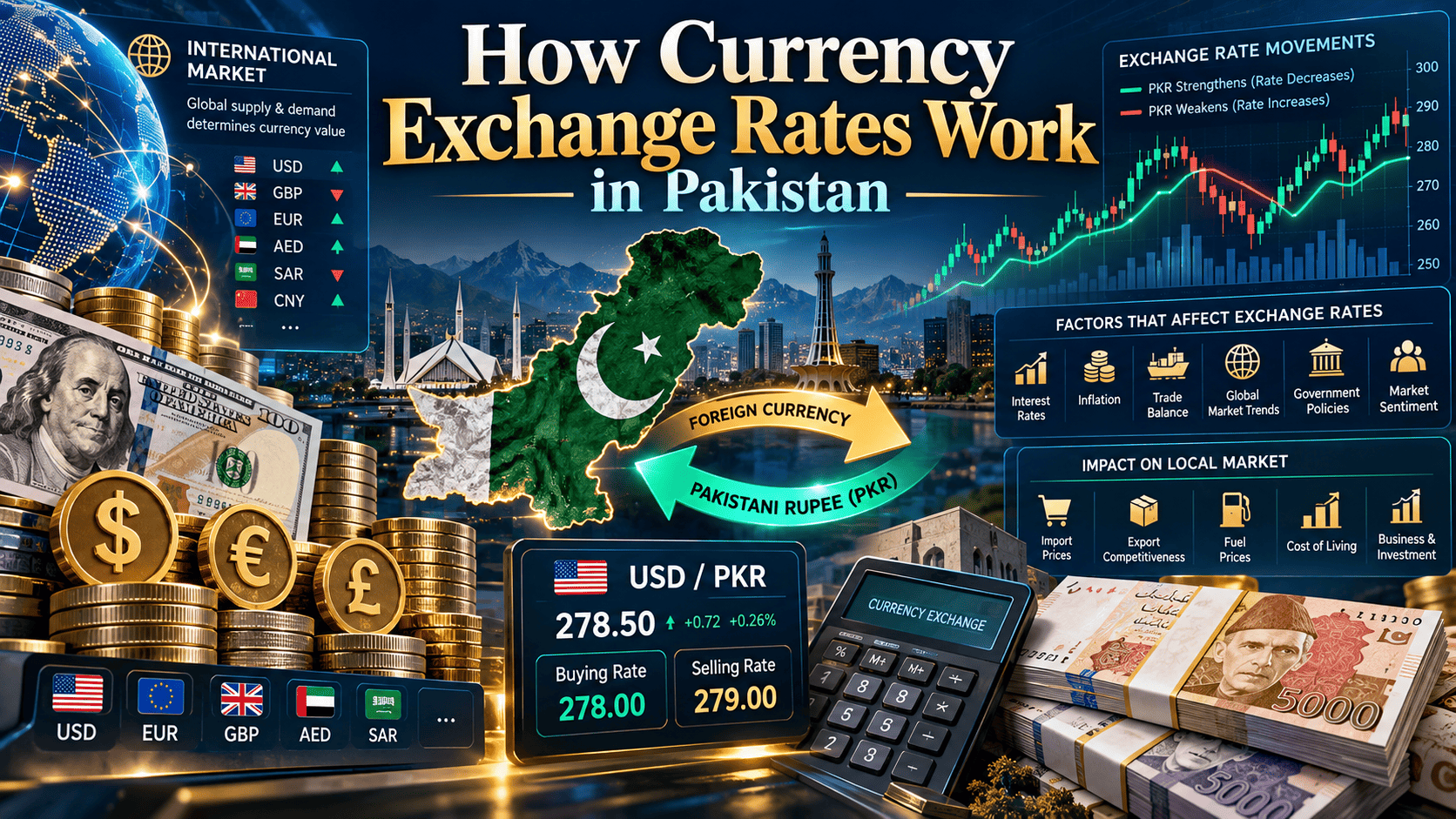
How Currency Exchange Rates Work in Pakistan
Currency exchange rates affect many everyday financial activities in Pakistan.
Whether you are:
- Buying US dollars for travel
- Receiving money from abroad
- Paying an international supplier
- Sending tuition fees overseas
- Purchasing an online service
- Using a debit or credit card internationally
- Converting UAE dirhams, Saudi riyals, euros, or pounds into Pakistani rupees
the exchange rate determines how much one currency is worth compared with another.
For example, if:
1 USD = Rs. 280
it means one US dollar is worth approximately 280 Pakistani rupees at that particular quoted rate.
However, currency exchange in Pakistan is not based on one single rate that applies everywhere.
You may see:
- Interbank rate
- Open-market rate
- Buying rate
- Selling rate
- Bank customer rate
- Cash rate
- Telegraphic Transfer (TT) rate
- Remittance conversion rate
- Card exchange rate
Understanding how these rates work makes it much easier to calculate the actual amount you may receive or pay.
What Is a Currency Exchange Rate?
A currency exchange rate tells you the value of one currency in terms of another.
For example:
1 USD = Rs. 280
means:
USD 1 is worth Rs. 280
Similarly:
1 AED = Rs. 76
means:
1 UAE Dirham is worth Rs. 76
Exchange rates are normally represented as currency pairs.
Common currency pairs in Pakistan include:
- USD/PKR
- AED/PKR
- SAR/PKR
- GBP/PKR
- EUR/PKR
- CAD/PKR
- AUD/PKR
The first currency is called the base currency, while the second is the quote currency.
For:
USD/PKR = 280
USD is the base currency and PKR is the quote currency.
Who Controls Exchange Rates in Pakistan?
Pakistan currently operates a market-based flexible exchange-rate system.
According to the State Bank of Pakistan, exchange rates are determined mainly by market demand and supply conditions. SBP also states that exchange-rate trends generally reflect Pakistan's external balance-of-payments position and other macroeconomic indicators.
This means Pakistan does not simply maintain one permanently fixed dollar rate.
Instead, the value of the rupee can change as demand and supply for foreign currencies change.
What Is the Role of the State Bank of Pakistan?
The State Bank of Pakistan regulates Pakistan's foreign-exchange system and manages the country's foreign-exchange reserves.
SBP also publishes several types of foreign-exchange market data, including:
- Weighted Average Customer Exchange Rates
- Mark-to-Market Revaluation Rates
- Conversion Rates
- Open Market Closing Exchange Rates
- Information about FX intervention in the interbank market
According to SBP, its intervention in the foreign-exchange market is intended mainly to address disorderly market conditions and build foreign-exchange buffers rather than suppress the underlying exchange-rate trend.
Why Are There Different Exchange Rates?
One of the biggest sources of confusion is seeing different rates for the same currency.
For example, on the same day you might see:
Interbank USD/PKR: Rs. 280
Open Market Buying: Rs. 281
Open Market Selling: Rs. 283
These rates can differ because they represent different types of transactions.
The rate used between banks is not necessarily the same as the rate offered by an exchange company to someone buying physical dollars.
Similarly, the rate used for a remittance or card transaction may also be different.
What Is the Interbank Exchange Rate?
The interbank market is the foreign-exchange market in which banks and authorized dealers trade currencies.
In Pakistan, authorized dealers in the interbank market are allowed to quote their own buying and selling rates.
The interbank market is particularly important for:
- Imports
- Exports
- Corporate transactions
- Commercial payments
- International settlements
- Banking transactions
- Foreign investments
For example, a Pakistani importer who needs USD to pay an overseas supplier generally completes the foreign-exchange transaction through a bank.
The relevant rate will be linked to banking and interbank market conditions.
Does a Customer Receive the Exact Interbank Rate?
Not necessarily.
This is an important point.
Suppose the reported interbank rate is:
1 USD = Rs. 280
A bank might quote a customer:
USD Buying = Rs. 279
and:
USD Selling = Rs. 281
The difference can result from:
- Bank spread
- Transaction type
- Customer pricing
- Currency amount
- Market conditions
- Fees or charges
Therefore, a headline interbank rate should generally be considered a market reference rather than a guaranteed customer rate.
What Is the Open Market Exchange Rate?
The open-market exchange rate generally refers to rates offered through authorized exchange companies for buying and selling foreign currency.
This is especially relevant when dealing with physical foreign currency notes.
For example, someone may visit an exchange company to:
- Buy dollars before travelling
- Sell dollars after returning to Pakistan
- Purchase UAE dirhams
- Buy Saudi riyals
- Convert British pounds into PKR
SBP publishes open-market closing exchange-rate information as part of its financial market data.
How Exchange Companies Work
Exchange companies buy and sell foreign currency.
They normally display two rates:
Buying Rate
and:
Selling Rate
For example:
USD Buying: Rs. 280
USD Selling: Rs. 282
If you have dollars and want Pakistani rupees, the company is buying the dollars from you.
Therefore:
Buying Rate applies
If you want to purchase dollars using Pakistani rupees, the exchange company is selling dollars to you.
Therefore:
Selling Rate applies
What Is the Buying Rate?
The buying rate is the rate at which a bank or exchange company buys foreign currency from you.
Suppose you have:
USD 1,000
and the buying rate is:
Rs. 280
Calculation:
1,000 × 280 = Rs. 280,000
You would receive approximately:
Rs. 280,000
before any applicable charges.
What Is the Selling Rate?
The selling rate is the rate at which a bank or exchange company sells foreign currency to you.
Suppose you want:
USD 1,000
and the selling rate is:
Rs. 282
Calculation:
1,000 × 282 = Rs. 282,000
You would need approximately:
Rs. 282,000
before any additional charges.
Why Is the Selling Rate Higher Than the Buying Rate?
The difference between buying and selling rates is known as the spread.
For example:
Buying = Rs. 280
Selling = Rs. 282
Spread:
282 - 280 = Rs. 2
The spread helps cover factors such as:
- Operating expenses
- Currency handling
- Market risk
- Liquidity risk
- Dealer margin
Exchange companies are required to display prevailing exchange rates for major currencies at their outlets. SBP has also issued rules governing buying and selling spreads and rate displays.
Simple Example of Currency Exchange
Suppose the USD rates are:
Buying Rate: Rs. 280
Selling Rate: Rs. 282
If You Sell USD 500
The exchange company buys your dollars.
Calculation:
500 × 280 = Rs. 140,000
You receive approximately:
Rs. 140,000
If You Buy USD 500
The exchange company sells dollars to you.
Calculation:
500 × 282 = Rs. 141,000
You pay approximately:
Rs. 141,000
This example shows why it is important to know whether you are looking at the buying or selling rate.
How Are Exchange Rates Determined?
Exchange rates are mainly influenced by demand and supply.
If demand for US dollars increases while dollar supply remains limited, USD can become more expensive in Pakistani rupees.
In simplified terms:
Higher USD Demand → Pressure for USD/PKR to Rise
If foreign-currency inflows increase relative to demand:
Higher USD Supply → Pressure for USD/PKR to Fall
Many economic activities affect this demand and supply.
Imports Increase Foreign-Currency Demand
Pakistani businesses import products such as:
- Petroleum
- Machinery
- Electronics
- Chemicals
- Raw materials
- Medical equipment
- Vehicles
- Food products
Foreign suppliers often require payment in dollars or another international currency.
Therefore, importers need foreign currency.
Higher import payments can increase demand for USD and other currencies.
Exports Bring Foreign Currency Into Pakistan
Exports work in the opposite direction.
Pakistan earns foreign currency by exporting products and services such as:
- Textiles
- Garments
- Rice
- Sports goods
- Surgical instruments
- Leather products
- IT services
When exporters receive foreign-currency payments, those funds contribute to Pakistan's foreign-exchange supply.
Stronger exports can therefore help improve the availability of foreign currency.
Remittances Affect Currency Supply
Overseas Pakistanis send significant amounts of money back to Pakistan.
For example, someone working in:
- Saudi Arabia
- UAE
- United Kingdom
- United States
- Qatar
may send money to family members in Pakistan.
These remittance inflows increase foreign-currency availability.
However, the amount the recipient receives in PKR depends on the rate used by the bank or remittance provider.
Foreign Investment Also Matters
Foreign companies and investors can bring foreign currency into Pakistan.
Examples include:
- Foreign Direct Investment
- Investment in Pakistani companies
- Investment in financial assets
- Development projects
These inflows can increase the availability of foreign currency.
Foreign capital leaving Pakistan can have the opposite effect.
Foreign Exchange Reserves
Pakistan's foreign-exchange reserves are managed by the State Bank of Pakistan.
Reserves can be used to meet foreign-currency obligations such as:
- External debt payments
- International obligations
- Other official foreign-currency requirements
Reserve levels are closely watched because they provide information about the country's external financial position.
External Debt Payments
Pakistan also needs foreign currency to make payments on external debt.
Suppose:
USD 1 billion
in external payments becomes due.
That creates a need for foreign currency.
If large foreign-currency payments occur while inflows are weak, pressure on the FX market may increase.
International Oil Prices
Pakistan imports energy products.
If international oil prices rise, Pakistan may need more dollars to purchase the same quantity of fuel.
For example:
If the cost of oil imports increases from:
USD 2 billion
to:
USD 3 billion
an additional USD 1 billion of foreign currency is required.
That can increase demand for dollars.
Global US Dollar Movements
The US dollar itself also changes in value internationally.
Changes in:
- US interest rates
- Federal Reserve policy
- US inflation
- Global investment flows
- International financial conditions
can strengthen or weaken the dollar globally.
If the US dollar becomes stronger internationally, other currencies, including PKR, can face pressure against it.
Why Does the Exchange Rate Change During the Day?
Foreign-exchange transactions happen continuously.
During a trading day:
- Importers may buy dollars
- Exporters may convert proceeds
- Banks may complete corporate transactions
- Remittance flows may arrive
- Businesses may make international payments
Because demand and supply continuously change, currency quotations can also change.
This is why a rate seen in the morning may not necessarily remain the same in the afternoon.
What Is a Bank Customer Exchange Rate?
Banks can quote specific rates to customers.
For example:
Market reference rate: Rs. 280
Bank may quote:
Customer Buying: Rs. 279
Customer Selling: Rs. 281
SBP publishes Weighted Average Customer Exchange Rates, which reflect customer-related foreign-exchange market information.
The actual rate available from a specific bank can still differ.
What Is a Cash Exchange Rate?
A cash rate usually relates to physical foreign-currency notes.
For example:
You bring:
USD 1,000 in cash
to an exchange company.
The dealer's cash buying rate determines approximately how much PKR you receive.
Handling physical currency involves considerations that are different from electronic transfers.
Therefore, a cash rate may differ from a transfer rate.
What Is a TT Rate?
TT generally means:
Telegraphic Transfer
Despite the historical name, TT rates are commonly associated with electronic foreign-currency transfers.
Banks may quote:
- TT Buying
- TT Selling
TT buying can be relevant when converting incoming foreign-currency funds into PKR.
TT selling can be relevant when purchasing foreign currency for certain international payments.
The exact application depends on the bank and transaction type.
Cash Rate vs TT Rate
Cash and TT rates can be different.
For example:
USD Cash Buying: Rs. 279
USD TT Buying: Rs. 280
This can happen because electronic transfers and physical currency involve different costs and settlement processes.
Therefore, when checking rates, make sure the rate matches the type of transaction you are making.
How Remittance Exchange Rates Work
Suppose someone sends:
USD 1,000
from the United States to Pakistan.
If the remittance provider applies:
Rs. 280 per USD
the approximate PKR amount is:
1,000 × 280 = Rs. 280,000
However, the rate can vary depending on:
- Sending bank
- Remittance provider
- Receiving institution
- Currency
- Time of conversion
- Service terms
Therefore, the open-market cash rate should not automatically be used to calculate the value of a remittance.
How Credit Card Exchange Rates Work
Suppose you use a Pakistani credit card to purchase something internationally for:
USD 100
The final PKR amount may depend on:
- Card network exchange rate
- Bank conversion rate
- Settlement date
- Foreign transaction charges
- Applicable taxes or fees
Therefore:
USD 100 × Google exchange rate
may not equal the final amount shown on your card statement.
Why Card Transactions Can Cost More Than the Online Rate
Suppose an online website shows:
USD/PKR = Rs. 280
You spend:
USD 100
Simple conversion:
100 × 280 = Rs. 28,000
But your final bank charge may be higher because the bank or card provider may use:
- A different conversion rate
- A foreign transaction fee
- Additional applicable charges
This is why online reference rates should not be treated as guaranteed card rates.
How Import Payments Work
Suppose a Pakistani company imports equipment worth:
USD 50,000
The company normally arranges payment through an authorized bank.
If its bank quotes:
Rs. 281 per USD
the currency value is:
50,000 × 281
= Rs. 14,050,000
Additional banking charges may apply.
The importer should therefore obtain an actual FX quotation from the bank rather than simply using an online open-market rate.
How Export Payments Work
Suppose a Pakistani exporter receives:
USD 20,000
from an overseas customer.
If the applicable bank conversion rate is:
Rs. 280
the approximate PKR equivalent is:
20,000 × 280
= Rs. 5,600,000
The final amount depends on the applicable customer rate and any charges.
How Travel Currency Exchange Works
Suppose you are travelling to Dubai and want:
AED 5,000
The exchange company displays:
AED Buying: Rs. 76
AED Selling: Rs. 77
Because you are buying AED, the selling rate applies.
Calculation:
5,000 × 77
= Rs. 385,000
You would therefore need approximately Rs. 385,000 before any applicable charges.
Selling Foreign Currency After Travel
Suppose you return from Dubai with:
AED 1,000
The exchange company offers:
AED Buying: Rs. 76
The calculation is:
1,000 × 76 = Rs. 76,000
Because you are selling AED, the exchange company's buying rate applies.
Why Do Currency Exchange Websites Show Different Rates?
This is very common.
One website may display:
Interbank Rate
Another may display:
Open Market Buying Rate
Another:
Open Market Selling Rate
Another:
International Mid-Market Rate
And another may show:
Previous Closing Rate
Therefore, websites can show different values without necessarily being wrong.
The most important question is:
What type of rate is being displayed?
What Is a Mid-Market Rate?
Suppose:
Buying = Rs. 279
Selling = Rs. 281
A simple midpoint is:
(279 + 281) ÷ 2
= Rs. 280
This is sometimes called a mid-market or midpoint reference rate.
However, customers generally do not buy and sell currency at exactly the midpoint.
Actual transactions typically take place at a buying or selling rate.
Why Is Google's Rate Different From an Exchange Company?
Google and other online financial services may display a reference or market-derived exchange rate.
An exchange company, however, needs to quote:
- A buying price
- A selling price
For example:
Online reference: Rs. 280
Exchange company:
Buying: Rs. 279
Selling: Rs. 282
This does not necessarily mean either source is incorrect.
They may represent different types of rates.
What Is the Open-Market Closing Rate?
SBP publishes open-market closing exchange-rate data as part of its foreign-exchange market information.
A closing rate represents market information from a particular point or period.
It should not automatically be considered a guaranteed live rate available from every exchange company the next day.
Live retail rates can change as market conditions change.
What Is a Mark-to-Market Rate?
SBP also publishes a Mark-to-Market Revaluation Exchange Rate.
This is primarily a financial-market and accounting reference used for revaluation purposes.
It should not be confused with the amount an exchange company will pay you for physical dollars.
Currency Exchange Example: USD to PKR
Suppose:
USD Buying = Rs. 280
USD Selling = Rs. 282
Selling USD 2,000
2,000 × 280
= Rs. 560,000
Buying USD 2,000
2,000 × 282
= Rs. 564,000
Difference:
Rs. 4,000
This difference comes from the Rs. 2 per-dollar spread multiplied by USD 2,000.
Currency Exchange Example: AED to PKR
Suppose:
AED Buying = Rs. 76.00
AED Selling = Rs. 76.80
If you sell:
AED 2,000 × 76
= Rs. 152,000
If you buy:
AED 2,000 × 76.80
= Rs. 153,600
Currency Exchange Example: SAR to PKR
Suppose:
SAR Buying = Rs. 74.50
SAR Selling = Rs. 75.20
Sell SAR 1,000:
1,000 × 74.50 = Rs. 74,500
Buy SAR 1,000:
1,000 × 75.20 = Rs. 75,200
Currency Exchange Example: GBP to PKR
Suppose:
GBP Buying = Rs. 370
GBP Selling = Rs. 374
Sell GBP 500:
500 × 370 = Rs. 185,000
Buy GBP 500:
500 × 374 = Rs. 187,000
What Documents May Be Required at an Exchange Company?
Currency exchange in Pakistan is regulated.
SBP's current regulatory framework contains identification, transaction-recording, source-of-funds, payment-method, and purpose-related requirements depending on the type and size of the transaction. For example, the regulatory framework sets additional documentation and banking-channel requirements for certain higher-value transactions.
The exact documents required can depend on:
- Transaction amount
- Currency
- Purpose
- Whether you are buying or selling
- Applicable regulations
Customers should check the latest requirements with an authorized exchange company before completing a transaction.
Why Should You Use an Authorized Exchange Company?
Foreign-exchange activity is regulated in Pakistan.
Using authorized banks and exchange companies provides:
- Better transaction records
- Regulatory oversight
- Documented exchange rates
- Transaction receipts
- Greater transparency
Avoid relying on informal or unauthorized currency dealers.
How to Calculate Currency Conversion
The basic formula is:
Foreign Currency Amount × PKR Exchange Rate
For example:
USD 500 × Rs. 280
= Rs. 140,000
However, make sure you are using the correct rate.
If you are selling USD:
Use the buying rate
If you are buying USD:
Use the selling rate
How to Convert PKR Into Foreign Currency
Suppose you have:
Rs. 282,000
and want to buy dollars.
Selling rate:
Rs. 282 per USD
Calculation:
282,000 ÷ 282
= USD 1,000
Therefore, Rs. 282,000 would purchase approximately USD 1,000 at that example rate before any applicable fees.
How to Calculate the Spread
Formula:
Spread = Selling Rate - Buying Rate
Suppose:
Buying = Rs. 280
Selling = Rs. 282
Then:
282 - 280 = Rs. 2
Spread:
Rs. 2 per USD
How to Calculate Spread Percentage
One simple calculation is:
Spread % = (Selling Rate - Buying Rate) ÷ Buying Rate × 100
Example:
Buying = Rs. 280
Selling = Rs. 282
Difference:
Rs. 2
Calculation:
2 ÷ 280 × 100
≈ 0.71%
So the approximate spread is:
0.71%
What Makes Exchange Rates Move?
Currency rates can move because of:
- Import demand
- Export receipts
- Remittances
- Foreign investment
- External debt payments
- Foreign exchange reserves
- International oil prices
- Inflation
- Interest rates
- Global dollar movements
- Market expectations
- Official financing
There is rarely one single reason for an exchange-rate movement.
Which Rate Should You Use?
The correct exchange rate depends on your transaction.
If You Are Selling Physical USD
Use:
Open Market Buying Rate
If You Are Buying Physical USD
Use:
Open Market Selling Rate
If You Are Receiving a Remittance
Use:
The rate offered by the remittance provider or receiving bank
If You Are Making an Import Payment
Use:
The actual FX quotation from your bank
If You Are Using a Card Internationally
Use:
The conversion rate and charges applied by your bank/card provider
If You Are Comparing Currency Markets
You may check:
Interbank and open-market rates
depending on what you are analysing.
Common Mistakes When Checking Exchange Rates
Mistake 1: Looking at Only One Rate
Always check whether the rate is:
- Buying
- Selling
- Interbank
- Open market
- Customer rate
Mistake 2: Assuming Google Is the Cash Rate
An online reference rate may not equal the rate offered by an exchange company.
Mistake 3: Using the Selling Rate When Selling Currency
If you sell foreign currency, the dealer's buying rate applies.
Mistake 4: Ignoring Fees
International cards, transfers, and banking transactions may include additional charges.
Mistake 5: Using an Old Rate
Exchange rates can change during the day.
Always check the latest applicable rate when completing a transaction.
Frequently Asked Questions
How are exchange rates determined in Pakistan?
Pakistan operates a market-based flexible exchange-rate system. Rates are primarily influenced by foreign-currency demand and supply.
Does SBP fix the dollar rate every day?
Pakistan does not currently operate a simple fixed daily USD/PKR system. According to SBP, the exchange rate is determined by market demand and supply conditions.
What is the interbank rate?
The interbank rate refers to foreign-exchange pricing in the banking market between banks and authorized dealers.
What is the open-market rate?
The open-market rate generally refers to foreign-currency buying and selling rates offered through authorized exchange companies.
Which rate should I use if I have dollars?
If you have physical dollars and want Pakistani rupees from an exchange company, check its USD buying rate.
Which rate should I use if I want dollars?
If you want to purchase physical dollars, check the exchange company's USD selling rate.
Why is the selling rate higher?
The difference between buying and selling rates is the spread, which helps cover operating costs, risk, and dealer margin.
Why do banks have different currency rates?
Banks may use different customer rates, spreads, transaction methods, and service charges.
Why does the dollar rate change during the day?
Demand and supply for foreign currency continuously change as importers, exporters, banks, investors, and other market participants complete transactions.
Is an online USD/PKR rate guaranteed?
No.
Online rates may represent reference, mid-market, interbank, open-market, or previous-closing data.
The actual rate depends on the provider and transaction.
Are exchange companies regulated in Pakistan?
Yes.
Exchange companies operate under SBP's regulatory framework and foreign-exchange rules.
Can an exchange company have a different rate from another company?
Yes.
Different exchange companies can quote slightly different buying and selling rates depending on market conditions and their own currency availability.
Conclusion
Currency exchange rates in Pakistan work through a combination of market demand and supply, banks, authorized dealers, exchange companies, and different transaction-specific rates.
The most important thing to understand is that there is not always one single exchange rate for every transaction.
You may see:
Interbank Rate
for banking-market transactions,
Open Market Rate
for retail foreign-currency exchange,
and:
Customer Buying and Selling Rates
for actual transactions.
The easiest rule to remember is:
If you sell foreign currency, check the buying rate.
If you buy foreign currency, check the selling rate.
For remittances, cards, imports, exports, and international transfers, always check the actual rate and charges offered by the bank or service provider involved.
Understanding these differences can help you calculate currency values more accurately and avoid confusion when comparing exchange rates across different websites, banks, and exchange companies.
Disclaimer: Foreign exchange rates can change frequently and may vary between banks, exchange companies, remittance providers, card issuers, and other financial institutions. Calculations and figures used in this article are for educational purposes and examples only. Actual buying and selling rates, fees, spreads, taxes, and other charges may differ depending on market conditions and the service provider. Always check the latest applicable exchange rate and transaction requirements before buying, selling, transferring, or making a financial decision.