
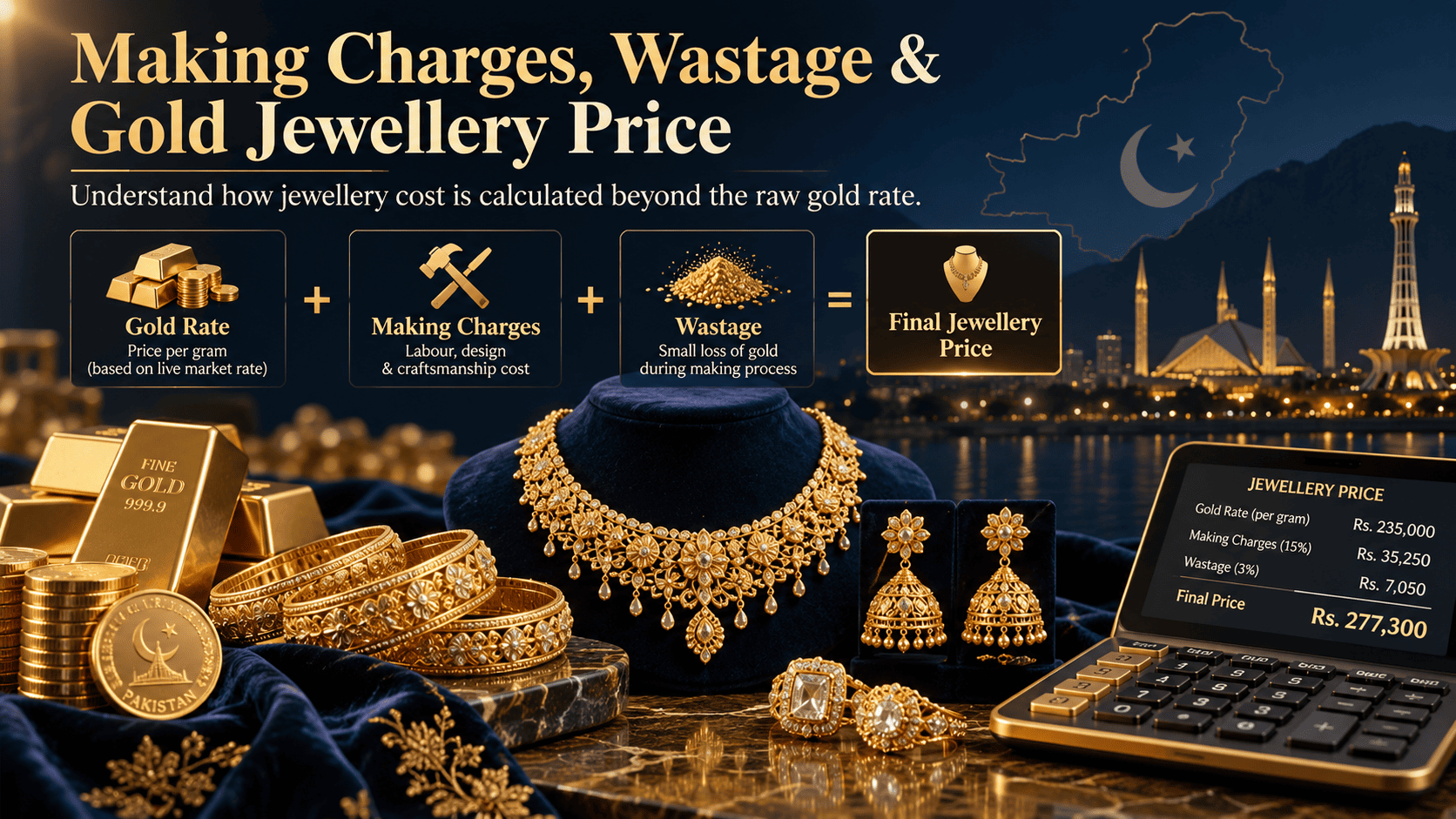
Making Charges, Wastage & Gold Jewellery Price: How the Final Price Is Calculated
When buying gold jewellery in Pakistan, many people check the daily gold rate and assume the shop price should simply be:
Gold Rate × Weight
But the final jewellery price is usually higher.
That is because a jewellery item is not priced only on the value of the gold inside it. The jeweller may also charge for:
- making or labour;
- design complexity;
- wastage;
- stones or other materials;
- polishing and finishing;
- dealer margin;
- other applicable charges.
This is why a 10-gram necklace can cost noticeably more than the value of 10 grams of gold.
Understanding these charges can help you compare jewellers more fairly and know exactly what you are paying for.
What Is the Basic Gold Jewellery Price Formula?
A simple jewellery-price formula is:
Final Jewellery Price = Gold Value + Making Charges + Wastage + Stones + Other Charges
The gold-value portion itself can be calculated as:
Gold Value = Net Gold Weight × Gold Rate Per Gram
If the jewellery is not 24K, purity must also be considered.
For example:
22K Gold Value = Weight × 24K Rate Per Gram × 22 ÷ 24
This gives the approximate underlying metal value.
The remaining amount represents jewellery-related charges.
Why Is Jewellery More Expensive Than the Daily Gold Rate?
The gold rate you see on a website usually represents the value of the raw precious metal.
A finished necklace, ring or bangle requires additional work.
Someone has to:
- design it;
- melt and shape the gold;
- create the pattern;
- join different parts;
- polish it;
- set stones;
- inspect the final piece.
This labour has a cost.
A simple gold bar requires much less craftsmanship than an intricate bridal necklace.
That is why two items containing the same amount of gold can have very different retail prices.
What Are Making Charges?
Making charges are the amount a jeweller charges for turning raw gold into finished jewellery.
They are essentially the cost of craftsmanship and manufacturing.
Making charges may cover:
- labour;
- design work;
- casting;
- cutting;
- soldering;
- polishing;
- stone setting;
- finishing;
- workshop expenses.
A plain gold bangle may require relatively little work.
A highly detailed bridal necklace may require significantly more time and skill.
Therefore, making charges can vary considerably between jewellery designs.
How Are Making Charges Calculated?
Jewellers can calculate making charges in different ways.
The most common methods are:
- fixed amount per gram;
- percentage of the gold value;
- fixed amount per jewellery item.
The method should ideally be clearly explained on the invoice.
Method 1: Making Charges Per Gram
A jeweller may charge a fixed amount for every gram of jewellery.
For example:
Gold weight:
10 grams
Making charge:
Rs3,000 per gram
Calculation:
10 × 3,000 = Rs30,000
So the making charge would be:
Rs30,000
If the gold itself is worth Rs350,000, the price before any other charges would become:
Rs350,000 + Rs30,000
= Rs380,000
Method 2: Percentage-Based Making Charges
Another jeweller may charge a percentage of the gold value.
Suppose:
Gold value:
Rs400,000
Making charge:
10%
Calculation:
400,000 × 10% = Rs40,000
So:
Gold Value = Rs400,000
Making Charges = Rs40,000
Subtotal:
Rs440,000
More detailed or luxury designs may carry higher percentage charges.
Method 3: Fixed Making Charge
A jeweller may simply quote:
Making charges: Rs25,000
for a particular ring, necklace or other item.
In that case, the calculation is easy:
Gold Value + Rs25,000
This method may be used for pieces where the work required is not directly related to the item's weight.
What Is Gold Wastage?
Gold wastage is a term used to describe gold that may be lost or consumed during jewellery manufacturing.
The jewellery-making process can involve:
- cutting;
- filing;
- polishing;
- soldering;
- shaping;
- casting.
Tiny quantities of material can be lost during these processes.
Historically, jewellers sometimes charged customers an additional percentage to account for this manufacturing loss.
For example:
If a jeweller applies:
5% wastage
to 10 grams of gold:
10 × 5% = 0.5 gram
The pricing may effectively include the value of:
10.5 grams
even though the finished jewellery weighs around 10 grams.
Practices vary significantly between jewellers, so customers should ask exactly how wastage is being calculated.
Is Wastage the Same as Making Charges?
No.
They are two different concepts.
Making Charge
Payment for the jeweller's labour and craftsmanship.
Wastage Charge
An amount added to account for material loss during manufacturing.
For example, an invoice may show:
Gold value:
Rs350,000
Wastage:
Rs15,000
Making charge:
Rs25,000
Total before other charges:
Rs390,000
Always ask whether the quoted making price already includes wastage.
Otherwise, you may accidentally compare one jeweller's combined price with another jeweller's separate charges.
Why Do Wastage Charges Differ Between Designs?
Some jewellery designs require more manufacturing work than others.
A plain bangle may involve relatively simple shaping and polishing.
A detailed jewellery piece may require:
- multiple small components;
- intricate cutting;
- complex soldering;
- detailed engraving;
- stone settings;
- repeated polishing.
More complicated production can lead to higher labour and potentially more material loss.
That is why wastage percentages, where charged, may differ by design.
What Is the Difference Between Gross Weight and Net Gold Weight?
This is one of the most important things to understand when buying jewellery.
Gross Weight
The total weight of the entire item.
It can include:
- gold;
- stones;
- diamonds;
- beads;
- decorative materials.
Net Gold Weight
The weight of the actual gold only.
For calculating the underlying gold value, net gold weight is the more important number.
Example: Gross Weight vs Net Gold Weight
Suppose a ring weighs:
10 grams
The stones weigh:
2 grams
So the net gold weight is:
8 grams
If the gold price is:
Rs35,000 per gram
the underlying gold value is:
8 × 35,000
= Rs280,000
It would be incorrect to calculate:
10 × 35,000
if two grams of the item are stones rather than gold.
This is why jewellery containing stones should ideally have the stone weight separated from the gold weight.
How Does Gold Purity Affect Jewellery Price?
Gold jewellery is available in different purities such as:
- 24K;
- 22K;
- 21K;
- 18K.
24K contains the highest amount of pure gold.
22K contains approximately:
91.67% gold
21K contains:
87.5% gold
18K contains:
75% gold
So a 10-gram 18K item does not contain as much pure gold as a 10-gram 22K item.
How to Calculate Gold Value Based on Purity
Suppose the 24K gold rate is:
Rs40,000 per gram
For 22K:
40,000 × 22 ÷ 24
= approximately:
Rs36,667 per gram
For 21K:
40,000 × 21 ÷ 24
= Rs35,000 per gram
For 18K:
40,000 × 18 ÷ 24
= Rs30,000 per gram
These are the approximate pure-metal values before jewellery charges.
Full Jewellery Price Example
Let's calculate a complete example.
Suppose you are buying a 22K bracelet.
Net gold weight:
10 grams
24K gold rate:
Rs40,000 per gram
Making charge:
Rs2,500 per gram
Wastage:
3%
No stones.
Step 1: Calculate 22K Gold Rate
40,000 × 22 ÷ 24
= approximately:
Rs36,667 per gram
Step 2: Calculate Gold Value
36,667 × 10
= approximately:
Rs366,670
Step 3: Calculate Wastage
If wastage is charged as 3% of gold value:
366,670 × 3%
= approximately:
Rs11,000
Step 4: Calculate Making Charge
Making charge:
Rs2,500 per gram
For 10 grams:
10 × 2,500
= Rs25,000
Step 5: Calculate Total
Gold value:
Rs366,670
Wastage:
Rs11,000
Making:
Rs25,000
Subtotal:
Rs402,670
Any stones, taxes or other clearly disclosed charges would then be added separately where applicable.
This example is only for understanding the calculation and does not represent a current market price.
Another Example: Percentage-Based Making Charges
Suppose:
Gold value:
Rs500,000
Making charge:
8%
Wastage:
2%
Calculate making charge:
500,000 × 8% = Rs40,000
Calculate wastage:
500,000 × 2% = Rs10,000
Subtotal:
500,000 + 40,000 + 10,000
= Rs550,000
This is why understanding percentages is important when comparing jewellery prices.
Making Charges Can Significantly Change the Final Price
Imagine two jewellers sell identical-weight 22K gold bracelets.
Both contain gold worth:
Rs400,000
Jeweller A
Making charge:
Rs20,000
Final before other charges:
Rs420,000
Jeweller B
Making charge:
Rs50,000
Final before other charges:
Rs450,000
The gold is worth the same amount.
The difference is:
Rs30,000
because of craftsmanship and pricing policy.
Simply comparing the gold rate would not reveal this difference.
Why Do Bridal Jewellery Making Charges Tend to Be Higher?
Bridal jewellery can involve much more work than a simple chain or bangle.
A bridal set may include:
- detailed patterns;
- handmade components;
- stone settings;
- engraving;
- multiple joining points;
- custom design work.
As a result, the labour cost can represent a meaningful portion of the final price.
When buying expensive bridal jewellery, ask for the charges separately instead of accepting only one total figure.
Jewellery Price vs Gold Value
These two terms should not be confused.
Gold Value
The market value of the actual gold contained in the jewellery.
Jewellery Price
The total amount you pay for the finished product.
For example:
Gold value:
Rs300,000
Making:
Rs30,000
Stones:
Rs20,000
Other charges:
Rs5,000
Final jewellery price:
Rs355,000
The jewellery therefore costs Rs55,000 more than its underlying gold value.
Do You Get Making Charges Back When Selling Jewellery?
Usually, you should not assume that you will recover the full making charge when selling used jewellery.
Imagine you purchased a piece for:
Rs450,000
consisting of:
Gold value:
Rs400,000
Making and other charges:
Rs50,000
When selling later, a buyer may primarily evaluate:
- current gold rate;
- purity;
- net gold weight;
- recoverable gold content.
The Rs50,000 originally paid for craftsmanship may not be fully reflected in the resale value.
This is an important difference between buying jewellery and buying gold mainly for investment purposes.
Why Can Buying and Selling Prices Be Different?
Jewellers may maintain separate:
selling rates
and:
buying rates
Suppose a shop sells 22K gold at:
Rs37,000 per gram
but buys it back at:
Rs35,500 per gram
That difference is the dealer's spread.
The shop may also inspect purity and apply deductions depending on the jewellery condition or testing result.
Therefore, resale calculations should be based on the actual buying rate offered by the dealer.
How Does Stone Jewellery Affect Pricing?
Jewellery containing:
- diamonds;
- gemstones;
- pearls;
- zircon;
- other stones
requires extra attention.
The invoice should ideally distinguish:
Gold weight
from:
Stone weight
and:
Stone price
For example:
Gross weight:
15 grams
Stone weight:
3 grams
Net gold weight:
12 grams
If the jeweller calculates the gold rate on the full 15 grams, ask for clarification.
Gold value should normally be based on the gold portion rather than the weight of non-gold material.
What Should a Gold Jewellery Invoice Show?
A clear jewellery invoice makes it easier to understand what you paid for.
Useful details can include:
- jewellery description;
- purity, such as 22K or 18K;
- gross weight;
- stone weight where relevant;
- net gold weight;
- gold rate used;
- gold value;
- making charges;
- wastage if charged separately;
- stone price;
- other applicable charges;
- final total.
Keeping the invoice can also be useful when you later want to verify or resell the jewellery.
How to Compare Two Jewellers Properly
Do not compare only the final price.
Ask both shops for the same information.
For example:
Jeweller A
Net gold weight: 10g
Purity: 22K
Gold value: Rs370,000
Making: Rs20,000
Wastage: Rs10,000
Total: Rs400,000
Jeweller B
Net gold weight: 10g
Purity: 22K
Gold value: Rs370,000
Making: Rs15,000
Wastage: Rs5,000
Total: Rs390,000
Now the comparison is much clearer.
Without the breakdown, you might not know why the shops gave different quotes.
Can Making Charges Be Negotiated?
Jewellery pricing varies by seller, design and market conditions.
Some jewellers may have fixed making charges, while others may offer discounts or negotiate certain charges.
Instead of asking only:
“Can you reduce the price?”
you can ask:
“What is the gold value, and how much are you charging for making?”
That gives you a clearer basis for comparison.
Why Is Handmade Jewellery Often More Expensive?
Handmade jewellery may require a skilled craftsman to spend many hours creating a single piece.
Machine-made jewellery can sometimes be produced more efficiently.
Therefore, handmade designs can carry higher making charges even when the gold weight is the same.
You are paying not only for the metal, but also for the craftsmanship.
Does a Higher Making Charge Mean Better Jewellery?
Not automatically.
A high making charge can reflect:
- complex craftsmanship;
- a custom design;
- brand positioning;
- higher workshop costs.
But price alone does not guarantee superior quality.
When evaluating jewellery, also consider:
- finishing;
- purity;
- weight accuracy;
- design quality;
- seller reputation;
- invoice transparency.
What Is a Fair Making Charge?
There is no single percentage or rupee amount that applies to every jewellery item.
Making costs depend on:
- type of jewellery;
- design complexity;
- manufacturing method;
- labour;
- brand;
- location;
- seller.
This is why comparing multiple sellers is more useful than looking for one universal making-charge percentage.
How to Calculate Making Charges as a Percentage
If you know the gold value and making charge, you can calculate the percentage yourself.
Use:
Making Charge Percentage = Making Charge ÷ Gold Value × 100
Example:
Gold value:
Rs400,000
Making charge:
Rs32,000
Calculation:
32,000 ÷ 400,000 × 100
= 8%
So the effective making charge is:
8% of the gold value
This is useful when one shop charges per gram and another quotes a percentage.
How to Convert Per-Gram Making Charges Into a Percentage
Suppose:
Gold value per gram:
Rs36,000
Making charge per gram:
Rs3,000
Use:
3,000 ÷ 36,000 × 100
= approximately:
8.33%
That allows you to compare the charge with a jeweller quoting an 8% or 10% making fee.
What Is Wastage Percentage?
Wastage percentage tells you how much additional gold value is being added relative to the underlying jewellery calculation.
For example:
Gold value:
Rs400,000
Wastage charge:
Rs20,000
Calculation:
20,000 ÷ 400,000 × 100
= 5%
So the effective wastage charge is 5%.
Should Wastage Always Be Charged?
Practices differ between sellers and manufacturing methods.
Some jewellers may charge wastage separately.
Others may include manufacturing loss within their making charge.
Some modern pricing models may not present a separate wastage line at all.
The important thing is transparency.
Ask:
“Is wastage included in the making charge, or is it charged separately?”
This avoids paying a charge you did not realise was being added.
Why Can Two Identical-Weight Items Have Different Prices?
Consider two necklaces.
Both weigh:
20 grams
Both are:
22K
Yet one costs significantly more.
Possible reasons include:
- different making charges;
- different wastage charges;
- stones;
- design complexity;
- brand premium;
- handmade vs machine-made work.
Weight alone is therefore not enough to determine jewellery price.
Simple Formula for Your Own Calculation
If there are no stones:
Final Price = Net Gold Weight × Gold Rate + Making + Wastage + Other Charges
For purity-adjusted calculations:
Gold Value = Net Weight × 24K Price Per Gram × Karat ÷ 24
Then:
Final Price = Gold Value + Making Charges + Wastage + Other Charges
For stone jewellery:
Final Price = Gold Value + Making + Wastage + Stone Price + Other Charges
Practical Example With 18K Jewellery
Suppose:
Jewellery weight:
12 grams
Purity:
18K
24K rate:
Rs40,000 per gram
Making:
Rs3,000 per gram
No wastage.
First calculate 18K rate:
40,000 × 18 ÷ 24
= Rs30,000 per gram
Gold value:
12 × 30,000
= Rs360,000
Making:
12 × 3,000
= Rs36,000
Total:
Rs396,000
This example shows how purity and making charges both influence the final price.
Why Gold Rate Websites Should Separate Jewellery Calculations
A gold rate and a jewellery price are not the same thing.
For a gold website, it is useful to show them separately.
For example:
Market Gold Rate
24K per gram:
Rs40,000
Jewellery Calculator
User enters:
Weight: 10g
Purity: 22K
Making charge: Rs2,500/g
Wastage: 3%
The calculator can then show:
- gold value;
- purity adjustment;
- making charge;
- wastage;
- final estimated jewellery price.
This is more useful than displaying only the daily bullion rate.
Common Mistakes When Buying Gold Jewellery
Mistake 1: Looking Only at the Gold Rate
Two jewellers may use the same gold rate but charge very different making fees.
Mistake 2: Ignoring Net Gold Weight
For jewellery containing stones, gross weight may not equal gold weight.
Mistake 3: Not Asking About Wastage
A quotation may look attractive until an additional wastage charge is added.
Mistake 4: Ignoring Purity
10 grams of 18K jewellery contains less pure gold than 10 grams of 22K jewellery.
Mistake 5: Assuming Making Charges Are Recoverable
When selling used jewellery, the original craftsmanship cost may not be recovered.
Mistake 6: Comparing Total Price Without a Breakdown
Always compare:
weight + purity + gold rate + making + wastage
rather than only the final number.
Questions to Ask Before Buying Gold Jewellery
Before paying, consider asking:
What is the gold purity?
What is the net gold weight?
What gold rate are you using?
How much is the making charge?
Is the making charge per gram or percentage based?
Is wastage being charged separately?
What is the stone weight?
What is the price of the stones?
What rate will you use if I sell this jewellery back?
These questions make the transaction easier to understand.
Frequently Asked Questions
What are making charges in gold jewellery?
Making charges are the cost of turning raw gold into finished jewellery.
They cover labour, manufacturing and craftsmanship.
What is wastage in gold jewellery?
Wastage refers to material that may be lost during manufacturing processes such as cutting, polishing and shaping.
Some jewellers add a separate wastage charge, while others may include it within making charges.
Is wastage the same as making charges?
No.
Making charges relate primarily to labour and craftsmanship.
Wastage relates to material loss or an amount charged to account for manufacturing loss.
How are gold making charges calculated?
They may be charged:
- per gram;
- as a percentage;
- as a fixed amount per item.
The method varies between jewellers.
How do I calculate the final jewellery price?
A simplified formula is:
Gold Value + Making Charges + Wastage + Stones + Other Charges
What is net gold weight?
Net gold weight refers to the weight of the actual gold after excluding stones and other non-gold materials.
Do I get making charges back when I sell jewellery?
You should generally not assume that the full making charges will be recovered.
Buyback values often focus more heavily on the current value of the recoverable gold.
Why is 22K jewellery cheaper than the same weight of 24K gold?
22K contains approximately 91.67% gold, while 24K is nearly pure gold.
Therefore, the same physical weight of 22K contains less pure gold.
Why do two jewellers quote different prices for the same weight?
They may have different:
- making charges;
- wastage policies;
- gold rates;
- margins;
- design costs;
- stone prices.
Always request a detailed breakdown.
Final Thoughts
The daily gold rate is only the starting point when calculating jewellery prices.
The final amount you pay can include several components:
Gold Value + Making Charges + Wastage + Stones + Other Charges
For buyers, the most important details to understand are:
Gold purity
Net gold weight
Gold rate used
Making charges
Wastage
If a jewellery item contains stones, also check their weight and price separately.
A transparent bill makes it much easier to know how much of your payment is going toward the actual gold and how much is going toward craftsmanship and other charges.
Before buying, compare more than just the headline gold rate.
A shop offering the same gold rate may still be significantly more expensive if its making or wastage charges are higher.
Understanding the complete calculation helps you make a more informed comparison and reduces surprises when you eventually decide to sell or exchange the jewellery.
Disclaimer: This article is for educational and informational purposes only. Jewellery pricing methods, making charges, wastage policies, dealer spreads and other costs can vary between sellers. Always ask the jeweller for a complete price breakdown before making a purchase.