
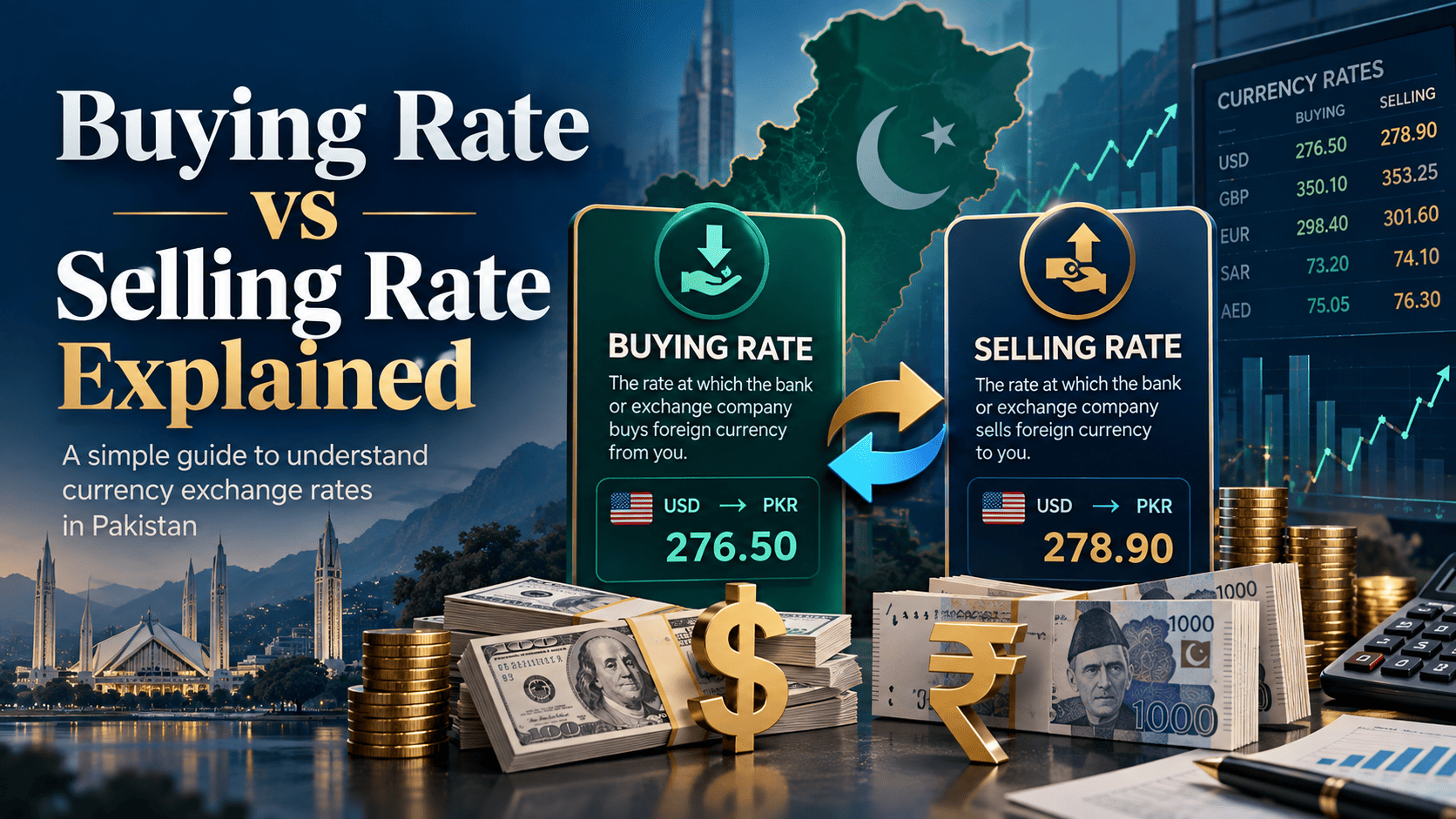
Buying Rate vs Selling Rate Explained
When checking currency exchange rates, you will often see two different prices for the same currency:
- Buying Rate
- Selling Rate
For example, a currency exchange company may display:
USD Buying Rate: Rs. 280
USD Selling Rate: Rs. 282
At first, this can be confusing. Why does the same US dollar have two different rates?
The answer is simple: the buying rate is the price at which a bank or exchange company buys foreign currency from you, while the selling rate is the price at which it sells foreign currency to you.
Understanding this difference is important when exchanging US dollars, UAE dirhams, Saudi riyals, British pounds, euros, or any other foreign currency in Pakistan.
What Is a Buying Rate?
The buying rate is the rate at which a bank, exchange company, or currency dealer buys foreign currency from a customer.
In simple words:
If you give foreign currency to the exchange company, the buying rate applies.
For example, suppose you have:
USD 1,000
and the exchange company's buying rate is:
Rs. 280 per USD
The calculation would be:
1,000 × 280 = Rs. 280,000
You would receive approximately:
Rs. 280,000
before considering any applicable charges.
What Is a Selling Rate?
The selling rate is the rate at which a bank or exchange company sells foreign currency to you.
In simple words:
If you want to buy foreign currency, the selling rate applies.
Suppose you want to purchase:
USD 1,000
and the selling rate is:
Rs. 282 per USD
The calculation would be:
1,000 × 282 = Rs. 282,000
You would need approximately:
Rs. 282,000
before any applicable charges.
The Easiest Way to Remember
A simple way to remember the difference is to think from the bank's or exchange company's point of view.
Buying Rate = They buy currency from you
Selling Rate = They sell currency to you
This is one of the most important things to understand when checking exchange rates.
Buying Rate vs Selling Rate Example
Suppose the USD to PKR rate is displayed as:
| Rate Type | USD/PKR |
|---|---|
| Buying Rate | Rs. 280 |
| Selling Rate | Rs. 282 |
If you have USD and want Pakistani rupees, the dealer may buy your dollars at:
Rs. 280 per USD
If you have Pakistani rupees and want USD, the dealer may sell dollars to you at:
Rs. 282 per USD
The difference between these two rates is known as the spread.
What Is the Spread?
The spread is the difference between the selling rate and the buying rate.
The formula is:
Spread = Selling Rate - Buying Rate
Using the example above:
Rs. 282 - Rs. 280 = Rs. 2
So the spread is:
Rs. 2 per USD
This spread is one of the ways banks and exchange companies cover operating costs and earn revenue from currency exchange transactions.
Why Is the Selling Rate Higher Than the Buying Rate?
The selling rate is normally higher than the buying rate because currency dealers need to cover:
- Business expenses
- Currency handling costs
- Market risk
- Price fluctuations
- Staff and operational costs
- Dealer margin
- Liquidity risk
A dealer generally tries to buy currency at a lower price and sell it at a higher price.
This is similar to many other businesses.
For example, a shop may buy a product for Rs. 1,000 and sell it for Rs. 1,100.
Currency exchange works on a similar basic principle, although foreign exchange prices can change continuously.
Example: Selling USD to an Exchange Company
Suppose you return to Pakistan after travelling abroad and still have:
USD 500
You visit an exchange company.
The displayed rates are:
USD Buying: Rs. 279
USD Selling: Rs. 281
Because you are giving dollars to the exchange company, the buying rate applies.
Calculation:
500 × 279 = Rs. 139,500
You would receive approximately:
Rs. 139,500
Example: Buying USD From an Exchange Company
Now suppose you are travelling to another country and want to buy:
USD 500
The same exchange company has:
USD Buying: Rs. 279
USD Selling: Rs. 281
Because the company is selling dollars to you, the selling rate applies.
Calculation:
500 × 281 = Rs. 140,500
You would need approximately:
Rs. 140,500
The difference between what the dealer pays and what the dealer charges is part of the spread.
Buying and Selling Rate for USD to PKR
The US dollar is one of the most commonly followed foreign currencies in Pakistan.
A typical rate display may look like:
USD Buying: Rs. 280
USD Selling: Rs. 282
If you are selling US dollars:
Use Rs. 280
If you are buying US dollars:
Use Rs. 282
This same concept applies to other currencies.
Buying and Selling Rate for AED to PKR
Suppose an exchange company displays:
AED Buying: Rs. 76.00
AED Selling: Rs. 76.70
If you have UAE dirhams and want Pakistani rupees, the dealer's buying rate applies.
For:
AED 1,000
Calculation:
1,000 × 76 = Rs. 76,000
If you want to buy AED 1,000:
1,000 × 76.70 = Rs. 76,700
Buying and Selling Rate for SAR to PKR
The same method applies to Saudi riyals.
Suppose:
SAR Buying: Rs. 74.50
SAR Selling: Rs. 75.20
If you sell:
SAR 2,000 × Rs. 74.50 = Rs. 149,000
If you buy:
SAR 2,000 × Rs. 75.20 = Rs. 150,400
The exact rates can vary between exchange companies and throughout the day.
Buying and Selling Rate for GBP to PKR
Suppose:
GBP Buying: Rs. 370
GBP Selling: Rs. 374
If you sell:
GBP 500 × Rs. 370 = Rs. 185,000
If you buy:
GBP 500 × Rs. 374 = Rs. 187,000
The difference becomes more noticeable when exchanging larger amounts.
Buying and Selling Rate for EUR to PKR
Suppose:
EUR Buying: Rs. 325
EUR Selling: Rs. 328
If you sell:
EUR 1,000 × Rs. 325 = Rs. 325,000
If you buy:
EUR 1,000 × Rs. 328 = Rs. 328,000
Again, the dealer pays the lower buying rate and charges the higher selling rate.
Why Does the Spread Change?
The spread is not always fixed.
It can change depending on several factors.
1. Market Volatility
If currency prices are moving quickly, dealers may increase the spread to protect themselves from sudden price changes.
2. Currency Demand
If many customers want to buy a particular foreign currency, the selling rate may increase.
For example, demand for Saudi riyals can increase during periods when more people are travelling for Umrah or Hajj.
3. Currency Supply
If a particular currency is difficult to obtain, the spread may widen.
If supply is strong, the spread may become smaller.
4. Currency Popularity
Major currencies such as USD, GBP, EUR, AED, and SAR generally have more active markets.
Less commonly traded currencies may have wider spreads.
5. Transaction Size
In some cases, large transactions may receive a slightly different rate from smaller transactions.
However, this depends on the bank or exchange company.
6. Market Liquidity
Liquidity refers to how easily a currency can be bought or sold.
Currencies with higher liquidity generally have tighter spreads.
Currencies with lower liquidity may have larger buying and selling differences.
What Does a Small Spread Mean?
A smaller spread means the buying and selling rates are close together.
For example:
Buying: Rs. 280.00
Selling: Rs. 280.50
Spread:
Rs. 0.50
A smaller spread generally indicates a more liquid or competitive market.
What Does a Large Spread Mean?
A larger spread means there is a bigger difference between buying and selling prices.
For example:
Buying: Rs. 278
Selling: Rs. 283
Spread:
Rs. 5
A wider spread can occur because of:
- Low liquidity
- High volatility
- Currency shortages
- Strong demand
- Dealer risk
- Market uncertainty
How to Calculate Spread Percentage
You can also calculate the spread as a percentage.
One simple formula is:
Spread % = (Selling Rate - Buying Rate) ÷ Buying Rate × 100
Suppose:
Buying Rate = Rs. 280
Selling Rate = Rs. 282
Difference:
282 - 280 = 2
Now:
2 ÷ 280 × 100 ≈ 0.71%
So the approximate spread is:
0.71%
Why Do Different Exchange Companies Have Different Rates?
Not every exchange company has exactly the same buying and selling rate.
Rates can vary because of:
- Different currency inventories
- Different customer demand
- Dealer margins
- Business costs
- Market access
- Transaction volumes
- Competition
- Location
- Risk management
For this reason, you may see small differences between exchange companies even at the same time.
Can the Rate Change During the Day?
Yes.
Foreign exchange rates can move multiple times during the day.
For example, a USD buying rate might be:
Rs. 280 in the morning
and later become:
Rs. 281
Changes may occur because of:
- International currency movements
- Local demand
- Local supply
- Interbank market movements
- Economic news
- Market expectations
This is why currency-rate websites often update rates frequently.
Buying Rate vs Selling Rate in the Open Market
In the open market, exchange companies usually quote both rates.
For example:
USD Buying: Rs. 280
USD Selling: Rs. 282
For customers:
Selling dollars → Buying rate applies
Buying dollars → Selling rate applies
The open market is commonly used for physical foreign currency exchange.
Buying Rate vs Selling Rate at Banks
Banks may also have separate customer buying and selling rates.
However, bank rates can differ from open-market rates.
Banks may publish different rates for:
- Cash transactions
- Telegraphic transfers
- Foreign remittances
- Bank drafts
- International payments
Therefore, it is important to check the correct rate for your specific transaction.
Cash Rate vs Transfer Rate
Sometimes a bank may show separate rates for:
- Currency notes
- Telegraphic transfers
- Remittances
For example:
USD Cash Buying Rate
and:
USD TT Buying Rate
may not be exactly the same.
This happens because handling physical cash involves different costs and processes compared with electronic transfers.
What Is a TT Rate?
TT usually refers to a Telegraphic Transfer rate.
Banks may use TT buying and selling rates for electronic foreign-currency transactions.
For example:
TT Buying Rate
may apply when a bank converts incoming foreign currency into Pakistani rupees.
TT Selling Rate
may apply when a bank provides foreign currency for an outgoing international payment.
Exact application depends on the transaction and the bank.
Buying Rate for Remittances
Suppose you receive USD from abroad.
The bank or remittance provider may convert the USD into PKR using its applicable customer conversion rate.
This rate may not be identical to the physical cash buying rate.
Therefore, if you are receiving a remittance, check the rate used by the specific service provider.
Selling Rate for International Payments
If you need foreign currency to make an international payment, your bank may use a selling rate.
For example, if you need:
USD 5,000
and the applicable selling rate is:
Rs. 282
the base currency value would be:
5,000 × 282 = Rs. 1,410,000
Additional banking charges may still apply.
Which Rate Should You Use?
The correct rate depends on your transaction.
If you have foreign currency and want PKR:
Check the buying rate.
If you have PKR and want foreign currency:
Check the selling rate.
This is the easiest rule to remember.
A Simple Real-Life Example
Imagine you have:
USD 1,000
An exchange company shows:
Buying: Rs. 280
Selling: Rs. 282
If You Sell USD 1,000
The exchange company buys your dollars.
So:
1,000 × 280 = Rs. 280,000
You receive approximately:
Rs. 280,000
If You Buy USD 1,000
The exchange company sells dollars to you.
So:
1,000 × 282 = Rs. 282,000
You pay approximately:
Rs. 282,000
Why You Should Check Both Rates
Looking at only one number can create confusion.
For example, a website may show:
USD/PKR = Rs. 281
but that may be:
- A mid-market rate
- An interbank rate
- A buying rate
- A selling rate
- A previous closing rate
Before calculating your exchange amount, check exactly which type of rate is being displayed.
Buying Rate vs Mid-Market Rate
The buying rate is the amount offered by the dealer when purchasing currency from you.
A mid-market rate is usually a reference rate between buying and selling quotations.
For example:
Buying: Rs. 280
Selling: Rs. 282
Approximate midpoint:
(280 + 282) ÷ 2 = Rs. 281
The mid-market rate may be useful for comparison, but customers normally transact at a buying or selling rate rather than exactly at the midpoint.
Selling Rate vs Mid-Market Rate
The selling rate is usually higher than the midpoint because it includes the dealer's spread.
Using the same example:
Midpoint: Rs. 281
Selling Rate: Rs. 282
The customer buying USD pays the higher rate.
How to Calculate Currency Value Using the Buying Rate
Use:
Foreign Currency Amount × Buying Rate
For example:
USD 2,000 × Rs. 280
= Rs. 560,000
So if you sell USD 2,000, you may receive approximately Rs. 560,000 at that example buying rate.
How to Calculate Currency Cost Using the Selling Rate
Use:
Foreign Currency Amount × Selling Rate
For example:
USD 2,000 × Rs. 282
= Rs. 564,000
So purchasing USD 2,000 would cost approximately Rs. 564,000 at that example selling rate.
Common Mistake: Using the Wrong Rate
One of the most common mistakes is using the selling rate when calculating how much money you will receive for foreign currency.
For example, suppose:
Buying = Rs. 280
Selling = Rs. 282
You have USD 1,000.
If you incorrectly use Rs. 282:
1,000 × 282 = Rs. 282,000
But the dealer is buying your dollars, so the relevant rate is Rs. 280:
1,000 × 280 = Rs. 280,000
That creates a difference of:
Rs. 2,000
For larger amounts, the difference can become much more significant.
Another Common Mistake: Assuming Online Rates Are Guaranteed
The rate displayed on a website is usually an indication or market reference.
The final transaction rate may depend on:
- Exchange company
- Bank
- Transaction amount
- Location
- Currency availability
- Time of transaction
- Applicable fees
Always confirm the actual rate before completing a transaction.
Quick Buying vs Selling Rate Table
| Situation | Rate to Check |
|---|---|
| You sell USD for PKR | Buying Rate |
| You buy USD with PKR | Selling Rate |
| You sell AED for PKR | Buying Rate |
| You buy AED with PKR | Selling Rate |
| You sell SAR for PKR | Buying Rate |
| You buy SAR with PKR | Selling Rate |
| Dealer buys currency from you | Buying Rate |
| Dealer sells currency to you | Selling Rate |
Frequently Asked Questions
What is a buying rate?
The buying rate is the rate at which a bank or exchange company buys foreign currency from you.
What is a selling rate?
The selling rate is the rate at which a bank or exchange company sells foreign currency to you.
Which rate is higher?
The selling rate is generally higher than the buying rate.
Why is the selling rate higher?
The difference helps the currency dealer cover operating costs, market risk, and business margins.
What is the difference between buying and selling rates called?
The difference is known as the spread.
Which rate should I use if I have US dollars?
If you are selling US dollars and receiving Pakistani rupees, check the USD buying rate.
Which rate should I use if I want to buy US dollars?
Check the USD selling rate.
Does every exchange company have the same rate?
No.
Rates can vary slightly between exchange companies because of different margins, demand, supply, and currency availability.
Can buying and selling rates change during the day?
Yes.
Foreign exchange rates can change throughout the day depending on market conditions.
Are open-market buying and selling rates the same as bank rates?
Not necessarily.
Banks and exchange companies may use different rates, and banks may also have different rates for cash, remittances, and electronic transfers.
What happens if the buying and selling rates are very close?
A smaller difference means a tighter spread.
This is often associated with a more active and liquid currency market.
What happens if the spread is large?
A larger spread may reflect higher volatility, lower liquidity, stronger demand, limited supply, or greater dealer risk.
Conclusion
Understanding the difference between the buying rate and selling rate makes currency exchange much easier.
The most important rule is:
If you sell foreign currency, use the buying rate.
If you buy foreign currency, use the selling rate.
For example:
USD Buying = Rs. 280
USD Selling = Rs. 282
If you sell USD 1,000:
1,000 × 280 = Rs. 280,000
If you buy USD 1,000:
1,000 × 282 = Rs. 282,000
The difference between the buying and selling rates is called the spread.
Whenever you check currency rates, make sure you understand whether the displayed figure is a buying rate, selling rate, interbank rate, open-market rate, or another type of exchange rate.
This will help you make more accurate calculations and avoid confusion when exchanging foreign currency.
Disclaimer: Foreign exchange rates can change frequently and may vary between banks, exchange companies, remittance providers, and other financial institutions. Calculations and figures used in this article are for educational purposes and examples only. Actual buying and selling rates, spreads, fees, and charges may differ depending on market conditions and the service provider. Always check the latest applicable exchange rate before buying, selling, transferring, or making a financial decision.